
Creeping Fig Terrarium: Climber or Jar Takeover?

A creeping fig terrarium is a good idea if the container is big enough and you are willing to trim. Creeping fig (Ficus pumila) loves the warm, humid air inside a closed jar, and its small juvenile leaves will press flat against the glass and climb. The takeover risk is real, though. The vine grows steadily, and if it is left alone long enough it switches to a bushy adult form with much larger leaves that no small jar can hold. Pick a small-leaved variety, plant it at the back, and cut it back before it reaches the lid.
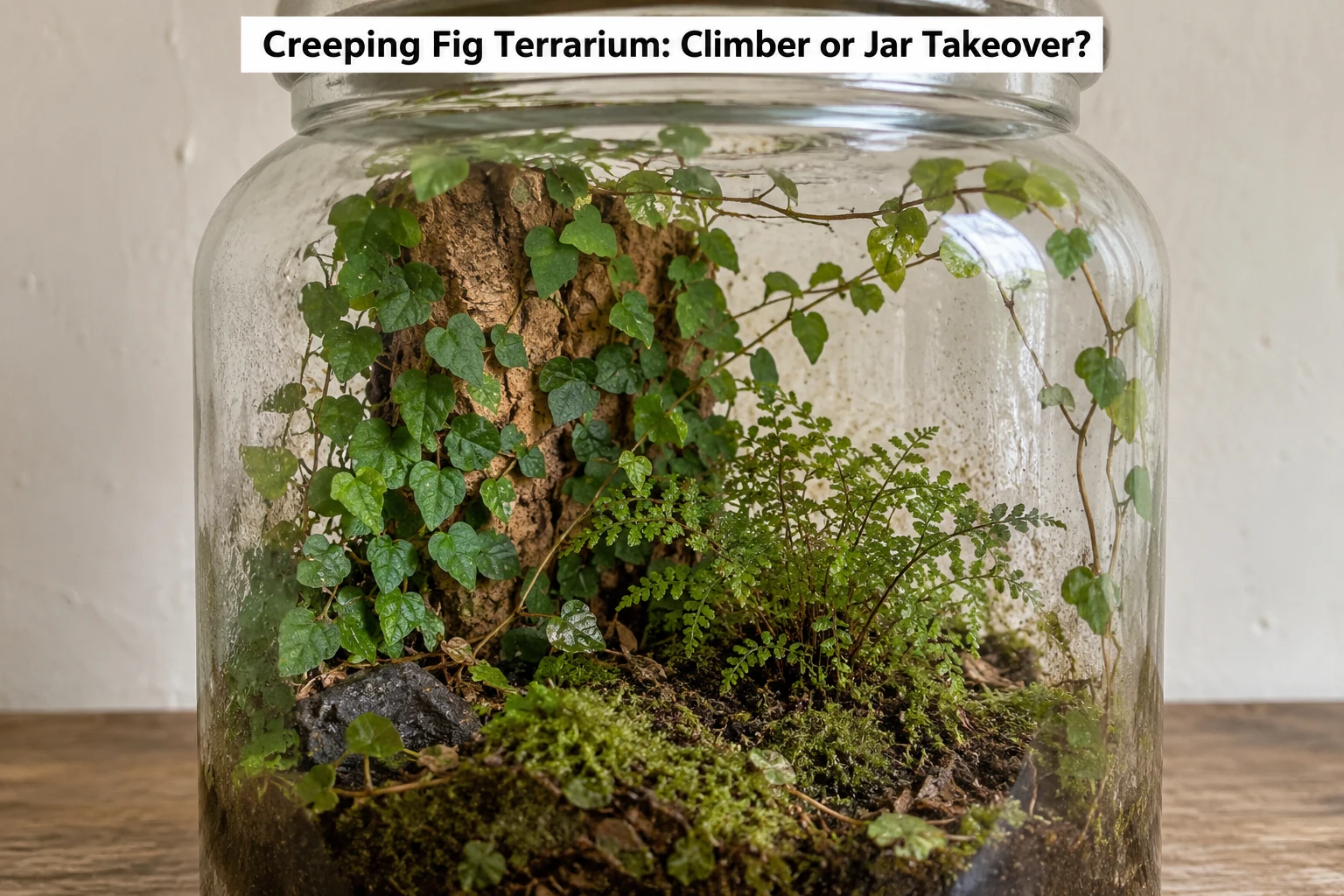
“I treat creeping fig as a climber that needs boundaries, not a plant to seal away and forget. Keeping its growth at the back leaves the viewing glass clear and protects smaller plants from shade. I watch the space below the lid as closely as the foliage, because a wandering stem can interfere with the seal before the jar looks overgrown.”
Is a creeping fig terrarium a good idea or a takeover?
Both, depending on the jar and on you. Creeping fig is one of the easiest climbers to keep alive in a closed build, which is exactly why it causes trouble. Plants that struggle stay small. Plants that thrive keep growing, and a sealed jar has no spare room.
Here is the honest split:
| Situation | Verdict |
|---|---|
| Large jar, carboy or tank, and you trim every few weeks | Good fit. It covers the back glass and softens the build. |
| Medium jar, small-leaved variety, regular trimming | Workable. Expect it to be the plant you prune most. |
| Small jar or bottle you want to leave alone for months | Poor fit. It will fill the space and crowd everything else. |
| Build with slow, delicate plants (small ferns, moss) | Risky. The fig will shade and smother them. |
If you want a jar you can seal and forget, creeping fig is the wrong plant. If you enjoy a quick trim with long scissors now and then, it is one of the more rewarding climbers you can grow.
How creeping fig climbs, and why glass is a weak grip
Creeping fig does not twine or use tendrils. It sticks. The Clemson Home & Garden Information Center fact sheet on climbing fig (read on 2026-09-23) describes aerial rootlets along the length of the stem that let the plant hug vertical surfaces, plus adhesive pads made of clustered roots that secrete a sticky latex compound. That is the same trick English ivy uses.
On a garden wall this grip is famously strong. The NC State Extension Gardener Plant Toolbox entry for Ficus pumila (read on 2026-09-23) notes that creeping fig “can cement itself to porous surfaces.” Glass is not porous, which changes the picture in a terrarium:
- It can still attach. Juvenile stems press their leaves flat against the glass and the rootlets take hold, especially where the glass stays wet with condensation.
- The grip is weaker than on cork or wood. Vivarium keepers on hobby forums generally report that it peels off glass without damaging it, and that many climbers do better with a textured background to root into.
- It leaves marks. Clemson notes that when vines are pulled off a wall, the attachments often remain. On glass, those leftover holdfasts can show up as small specks that need careful scraping.
So yes, it will climb the glass. It just climbs more happily on a strip of cork bark or a moss-covered background, and it holds on better there too.
The real takeover risk is the adult form
Most creeping fig guides say “trim it regularly” and stop there. The more useful thing to know is why. Ficus pumila has two distinct life stages, and they behave like different plants.
Clemson describes juvenile leaves as small, under an inch long, and adult leaves as 2 to 4 inches long, darker, shiny and leathery. NC State describes the adult shoots as non-climbing, extending horizontally away from the wall. Clemson adds that mature stems lack aerial roots and become thick and shrubby.
| Feature | Juvenile form (what you buy) | Adult form (what you get if ignored) |
|---|---|---|
| Leaf size | Under 1 inch (Clemson) | 2 to 4 inches (Clemson) |
| Leaf texture | Thin, fine | Leathery, glossy |
| Climbing roots | Yes, along the stem | Absent on mature stems |
| Growth direction | Flat against surfaces | Sticks out horizontally, shrubby |
| Fits in a jar? | Yes, with trimming | No |
Those leaf sizes describe plants grown outdoors on walls, not in jars, and a terrarium plant may never reach the adult stage at all if you keep trimming. The point stands anyway: the plant that starts as a flat green lace on the glass is capable of becoming a woody shrub. In a sealed jar, horizontal shoots push toward the middle of the build, shade everything below them and crowd the lid.
Clemson’s advice for keeping the juvenile look on walls is to remove mature shoots at their points of attachment. The same rule works inside glass. If you ever see a thicker stem with noticeably larger, leathery leaves heading out into open space, cut it off where it starts.
Which creeping fig suits which terrarium
The plain species is the most vigorous. For glass, smaller cultivars are easier to live with. Clemson lists several, and these are the ones most often sold for terrariums:
| Variety | What Clemson says | Where it fits |
|---|---|---|
| ‘Minima’ | Tiny leaves that make it suitable for growing indoors | Medium to large closed jars; the usual glass climber |
| ‘Quercifolia’ (oakleaf) | Small, lobed foliage that looks like miniature oak leaves | Medium jars; tends to look busier and tighter than the plain form |
| ‘Snowflake’ | Variegated, with wide white leaf margins | Larger builds with good light |
| ‘Sunny Fig’ | Variegated, white areas extending past the normal leaf edge | Same as above |
| Plain Ficus pumila | The vigorous standard form | Big tanks and carboys only |
Variegated forms are worth a little extra thought. White leaf areas carry less chlorophyll than green ones, so these types tend to look their best with brighter light, and in a dim corner the contrast can fade.
For a container you can barely fit a hand into, such as a demijohn or carboy, think carefully first. Creeping fig makes a lovely green background in big glass, but every trim has to be done with long tools through a narrow neck, and a vigorous climber in a container like that means a lot of trims.
Planting it so it climbs where you want
Placement decides whether creeping fig decorates the glass or blocks it.
- Plant it at the back or one side. Vivarium growers commonly put it near the back or side walls so it has room to climb, and keep it away from the front glass you look through.
- Give it something better than glass. A piece of cork bark, a wood branch or a moss-covered back panel gives the rootlets a surface they can really hold. The vine will still wander onto the glass, but it will not depend on it.
- Pin it at the start. New cuttings do not grip right away. A bent piece of plant-safe wire or a small toothpick holds the stem against the surface until the rootlets take over.
- Keep it away from the lid and seal. Stems that reach the rim can wedge between the glass and a cork or gasket and break the seal. If your build relies on a tight closure, the notes on how the lid seal changes a terrarium explain why even a small gap matters.
- Plant it last, and small. A single rooted cutting is plenty. Two or three plants in one jar will cover the glass fast.
Handle the stems with a little care. Creeping fig stems carry a milky sap, and Clemson recommends gloves because the latex may cause dermatitis. If you have sensitive skin, wear thin gloves when you trim and wash your hands afterwards.
Trimming a creeping fig terrarium before it becomes a rescue
This is the habit that makes or breaks the plant in glass. Trim little and often rather than hacking it back once it has taken over.
- Cut stems that leave the glass. Anything growing out into the middle of the jar gets removed first.
- Cut back at the lid line. Keep a clear band below the top so condensation can run down and the lid can close.
- Remove adult-looking growth at its base. Thicker stems with bigger, leathery leaves go, following Clemson’s advice to remove mature shoots where they attach.
- Clear leaves off neighboring plants. Creeping fig will happily grow over a fern or a fittonia. Lift it off and cut it back before the plant underneath yellows from lack of light.
- Take the trimmings out. Cut pieces left on damp substrate can rot and feed mold.
Clemson describes the juvenile form outdoors as able to grow up to a foot per year. A jar with modest indoor light will usually be slower than that, but it gives you a sense of the pace. Check it every time you look at the jar, and cut whenever you see new stems heading somewhere you do not want them. The full method for long scissors, tweezers and narrow necks is in our guide to pruning terrarium plants when a jar gets overgrown.
The good news: trimmings root readily. A healthy cut tip pressed into damp substrate can start a new jar, so a trim is never wasted.
What climbing does to your glass
A fig-covered back wall looks lush. It also brings two small costs that are worth knowing before you plant.
It hides the view. Leaves pressed against the glass block light from the side of the jar they cover. That is fine on the back wall. On the front, it turns a terrarium into a green box. Decide which panes are “fig allowed” and keep the rest clear from the start.
It leaves residue behind. When you pull a stem off the glass, some of the attachment points usually stay behind. Clemson notes this on walls, and terrarium keepers report the same small specks on glass. Soak them with a damp cloth or a cotton bud on a long stick, then lift them gently. For spots that will not budge, the approach in cleaning the inside of terrarium glass without wrecking the build covers safe tools and what to avoid inside a closed jar.
It is also worth watching the leaves that sit flat against wet glass. Most stay healthy, because the plant is built for damp surfaces. If a few turn soft or brown where they touch the glass, trim them off and let the jar air for a short while.
Other climbers for the glass
Creeping fig is the best-known climber, not the only one. The vivarium hobby uses several “shinglers,” plants whose leaves lie flat against a surface as they climb, with roots gripping underneath.
- Marcgravia rectiflora is one of the most common shinglers in the terrarium hobby. Growers and specialist sellers describe it as small-leaved and steady rather than aggressive, which makes it a gentler choice for medium builds. It generally wants consistently high humidity, so it suits a closed jar better than an open one.
- Rhaphidophora hayi (shingle plant) presses small, rounded leaves flat against whatever it climbs, and unlike creeping fig it does not switch to a different leaf shape as it matures. It does get bigger over the years, though, and can eventually outgrow all but the largest terrariums.
- Oakleaf creeping fig (‘Quercifolia’) is worth listing again here because it is the most compact creeping fig most people can buy.
One pattern holds for nearly all of them: they climb best on a textured background that holds moisture, like cork or a moss panel. On bare glass they tend to trail rather than climb. If covering glass is your main goal, creeping fig is still the most reliable option. If staying small matters more, a Marcgravia is usually the calmer choice.
When to pull it out instead
Sometimes the kindest move for the jar is to remove the fig. Consider it if:
- it covers more than the panes you meant it to cover, and trimming can no longer keep up;
- it has smothered a plant you care about more;
- thick, woody adult stems have formed that cannot be cut back without leaving bare stubs.
You do not have to tear the build down to do this. Cut the stems free of the glass, loosen the root ball with a long tool, and lift it out through the opening. The steps for doing that cleanly are in replacing a plant in a terrarium without rebuilding it. Keep a cutting if you like the plant, and restart it in a bigger container.
A note for warm, humid rooms
In South and Southeast Asian homes, creeping fig is often easier than in cooler climates. The room air is already warm and humid for much of the year, so the plant rarely sulks. That same warmth means it can grow quickly, especially through the monsoon months. The main thing to watch is heat: a closed glass jar in direct sun heats up fast, and a hot, sealed jar is a problem for any plant, not just this one. Bright light without direct afternoon sun on the glass is the safer spot.
Frequently asked questions
Will creeping fig damage the glass in my terrarium?
No. Glass is not porous, so the rootlets cannot work into it the way they do with stucco or wood. The only lasting effect is residue: small attachment points can stay on the glass after you pull a stem away, and they need soaking and gentle scraping to remove.
Can creeping fig grow in a closed terrarium?
Yes. It likes warm, humid conditions, which is what a closed jar provides. The limit is space, not humidity. Choose a small-leaved variety such as ‘Minima’ or ‘Quercifolia’ and plan on trimming it regularly.
How often should I trim creeping fig in a terrarium?
There is no fixed schedule, because growth depends on your light, warmth and variety. Trim whenever stems leave the glass, approach the lid or start covering other plants. Small, frequent trims are far easier than one big rescue.
Why are the new leaves on my creeping fig suddenly bigger?
Larger, thicker, leathery leaves on stems that grow outward instead of flat can mean the plant is moving toward its adult form. Cut those shoots off where they start to keep the small, climbing juvenile growth.
What climbs terrarium glass besides creeping fig?
Shingling plants such as Marcgravia rectiflora and Rhaphidophora hayi are common in the vivarium hobby. Most of them climb far better on cork or a moss background than on bare glass, so give them a surface to grip.