
Pruning Terrarium Plants: Cutting Back an Overgrown Jar

The fittonia is flat against the glass, a fern frond has folded under the lid, and the middle of the jar has disappeared into a single green mass. It is time to cut.
Pruning terrarium plants in a closed jar means cutting back anything touching the glass or lid first, cutting just above a leaf joint so the stem branches instead of dying back, removing every clipping from the jar, and leaving the lid off for a while afterward so the cut surfaces can dry. The last two steps are the ones that separate a pruning job from the start of a mold problem.
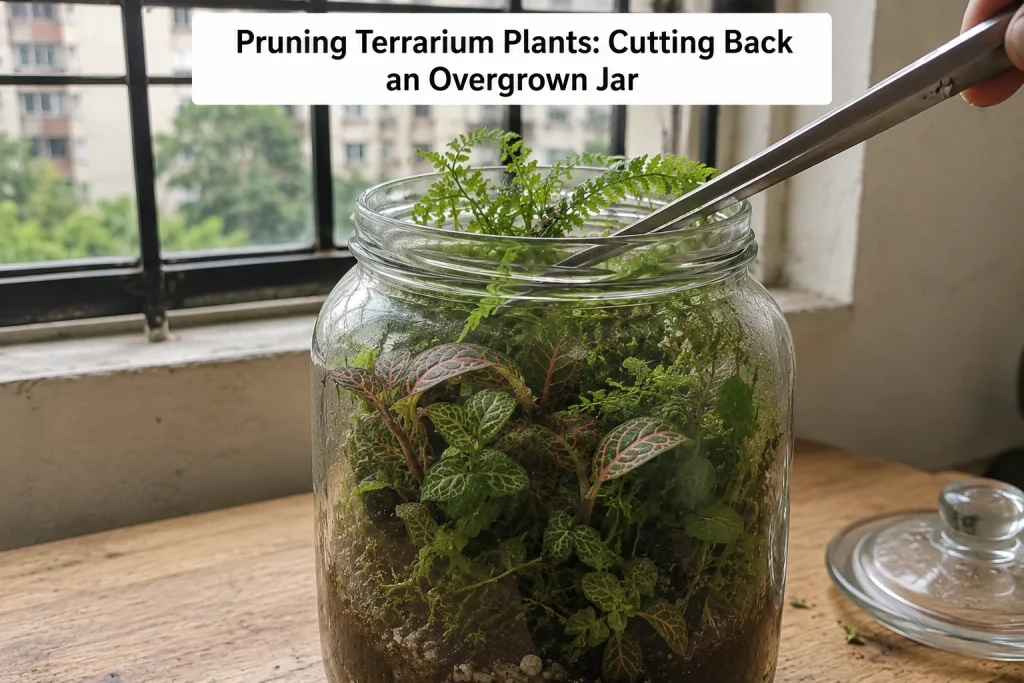
“In my own overgrown jars, I’ve found that pruning works best when I stop thinking about making the terrarium look neat and concentrate first on what is actually causing trouble. I start with leaves pressed against wet glass, growth reaching the lid, and anything dead or crowded underneath, then I remove every clipping instead of letting scraps disappear into the moss. I’m also much more cautious about closing the jar immediately afterward, especially in my humid room, because fresh cuts and trapped moisture are a poor combination. One habit that has helped me is watching how quickly a plant reaches the glass again after pruning: if I am repeatedly cutting the same plant back within a short period, I take that as a sign that the plant has simply outgrown the jar rather than needs another harder prune.”
Why an overgrown jar is a problem, not just a look
Overgrowth in a sealed container is a health issue before it is a design issue, for three reasons.
Leaves on the glass stay wet. Glass is where condensation forms. A leaf pressed against it sits in a film of water for most of the day, and that is where rot tends to start. The mechanism is covered on terrarium leaf rot.
Dense growth traps still air. A tight canopy holds moisture underneath, where the lower leaves yellow, drop and start to decay out of sight.
The tallest plant takes the light. Whatever reaches the top first shades everything below it.
The extension services frame it the same way. Mississippi State University Extension’s publication How to Design a Closed-System Terrarium (P3253, DelPrince and Bachman, read September 11, 2026) says: “You may need to prune a few leaves or stems if they touch the sides or lid of the container.” University of Vermont Extension (Deborah J. Benoit, January 2023, read September 11, 2026) says plants “may need to be groomed periodically with pruning to remove unhealthy or damaged growth or to maintain shape or size.”
Before you cut: tools and clean blades
Long, narrow scissors reach where fingers cannot, and long tweezers pick out what you cut. For narrow necks the Royal Horticultural Society (read September 11, 2026) notes you “may need to use improvised tools,” naming chopsticks, a spoon tied to a cane or barbecue tongs. Those were suggested for planting, and the same kind of improvising works for pruning.
Clean the blades before you start, and again after touching anything rotten. A pair of scissors that has just gone through a mushy stem carries that material to the next cut. In a sealed jar, where nothing dries out quickly, that matters more than it would in a pot on a windowsill.
Work with dry hands and dry tools. You are about to open wounds in a wet environment. Do not add more water.
Where to cut, in order
Work through the jar in this order and stop when it looks right. Not every jar needs every step.
1. Anything touching the glass or the lid. These cuts matter most, for the reasons above.
2. Dead, yellow or damaged growth. Take it out completely, not just the discolored tip.
3. Crossing stems and the crowded center. Thin it so air and light reach the lower leaves.
4. Shape. Only now, and only if you want to.
Cut just above a node. A node is the point on a stem where a leaf joins it. Cutting just above one gives the plant a growing point right at the cut, and many soft-stemmed plants branch from there. Cutting in the middle of a bare stem leaves a stub with no growing point, and in a humid jar a stub tends to rot back rather than regrow.
Do not take a plant down to nothing in one session. A plant with most of its leaves removed has little left to recover with. If a plant needs cutting that hard, it has probably outgrown the jar (see below).
Pruning by plant habit
Different growth habits need different cuts.
Creeping and trailing plants, the kind that spread across the substrate and climb the glass, respond well to having stems cut back to a node. Runners that have rooted where they touched the substrate can be cut free and lifted out whole.
Upright soft-stemmed plants can be pinched: take the growing tip off with tweezers or fingertips, and the stem is encouraged to branch lower down.
Ferns grow new fronds from the crown. A frond cut halfway along does not regrow its tip, it just looks cut. Remove a whole frond at its base instead, and choose the oldest or most crowded ones.
Moss can be trimmed with scissors where it has mounded up or climbed. Brown patches should come out rather than be left to recover in place.
After the cut: the sealed-jar step most guides skip
Pruning a pot is finished when you put the scissors down. Pruning a closed jar is not.
Remove every clipping. Every leaf, every stem end, every fragment that fell into the moss. Cut plant tissue is dead plant material, and the RHS’s reason for removing debris promptly is “to avoid mould.” Pruning produces more debris in ten minutes than a jar sheds in months. Leave it in there and you have fed the thing you were trying to prevent.
Leave the lid off for a while. Cut surfaces need to dry and callus, and they cannot do that in saturated air. The reasoning, and the other times opening the jar is the right move, are on opening a closed terrarium.
In an already humid room, venting takes longer. Moisture leaves an open jar because the room air is drier than the jar air. When the room is humid, that difference is small and drying is slow. Give it longer and judge by the glass, not the clock.
Watch the cut stems over the next days. Anything that turns soft or dark at the cut, or grows white fuzz, should come out. Terrarium mold identification helps you tell a real problem from harmless growth.
Do not water after pruning. Removing leaves means the plants lose less water than before. The jar will run wetter, not drier.
When pruning stops being the answer
Some plants are not overgrown. They are simply the wrong size for the container.
Iowa State University Extension (Aaron Steil, last reviewed January 2024, read September 11, 2026) says: “No plant can be a permanent addition to a terrarium as they will eventually outgrow the space.” Mississippi State says plants may “outgrow the container, necessitating pruning or removal,” and calls it “a great opportunity to refresh the design.”
The sign is speed. If a plant is back against the glass within weeks of every cut, pruning is only delaying a removal. Taking out one plant without disturbing the rest is covered in its own guide on this site, as is the question of which plants outgrow a jar in the first place.
If the whole jar is overgrown and rotting underneath, pruning will not rescue it. That judgment is on when to restart a terrarium.
Clippings, pets and small children
If a pet has already chewed or eaten clippings or a plant, call your veterinarian now, or the ASPCA Animal Poison Control Center at (888) 426-4435 (the ASPCA says a consultation fee may apply) or the Pet Poison Helpline at (855) 764-7661 (it charges a per-incident fee). Both lines were checked on September 11, 2026 and both run 24 hours. This site does not assess symptoms.
Before it comes to that, bag the clippings and put them straight in a closed bin rather than leaving them on a table or in an open bin. The ASPCA’s toxic and non-toxic plant list (read September 11, 2026) lets you look up the plants in your jar by name for cats, dogs and horses. It also notes that eating any plant material may cause vomiting and stomach upset in dogs and cats.
What this page does not publish
No pruning calendar and no “percentage of the plant” rule. The trigger is what the plant is touching, not the date, and the figures that circulate for this have no source we could verify.
No species-by-species cutting guide. Growth habit decides the cut, and habit is covered above.
No product names.
FAQ
How do I prune terrarium plants without disturbing the rest of the jar? Use long, narrow scissors and long tweezers, work from the outside in, and cut first whatever touches the glass or lid. Lift every clipping out as you go so nothing falls into the moss.
Where should I cut a terrarium plant? Just above a node, the point where a leaf joins the stem. The plant has a growing point there and many soft stems branch from it. A cut in the middle of a bare stem leaves a stub that tends to rot in humid air. For ferns, remove whole fronds at the base.
Should I open the lid after pruning? Yes, for a while. Cut surfaces need to dry, and they cannot in saturated air. In a humid room it takes longer. Do not add water afterward, because a pruned jar loses less water and runs wetter.
My plant is back on the glass a few weeks after every prune. What now? It has outgrown the container. Iowa State University Extension says no plant is permanent in a terrarium, and Mississippi State University Extension treats removal as the alternative to pruning. Replace it with something smaller rather than cutting harder.
The short version
Cut what touches the glass first, cut above a node, take out every clipping, and let the jar air before closing it. If a plant needs cutting back again within weeks, it has outgrown the jar.