
Fittonia Wilting in a Closed Terrarium: Real Cause

A wilting fittonia inside a closed terrarium is not always a thirsty plant. Outside a jar, wilting almost always means underwatering, and that rule gets repeated across nearly every fittonia care page online. Inside a sealed container it can mean the opposite: roots sitting in saturated, low-oxygen substrate can lose the ability to move water up to the leaves, which produces the same droop as genuine dryness. Check the substrate through the glass and how long it has been since the last watering before adding any water. Watering a drowning plant is the single most common mistake made in response to this symptom, and it is one specific case of the wider troubleshooting logic this site uses for reading a sealed build from the outside.
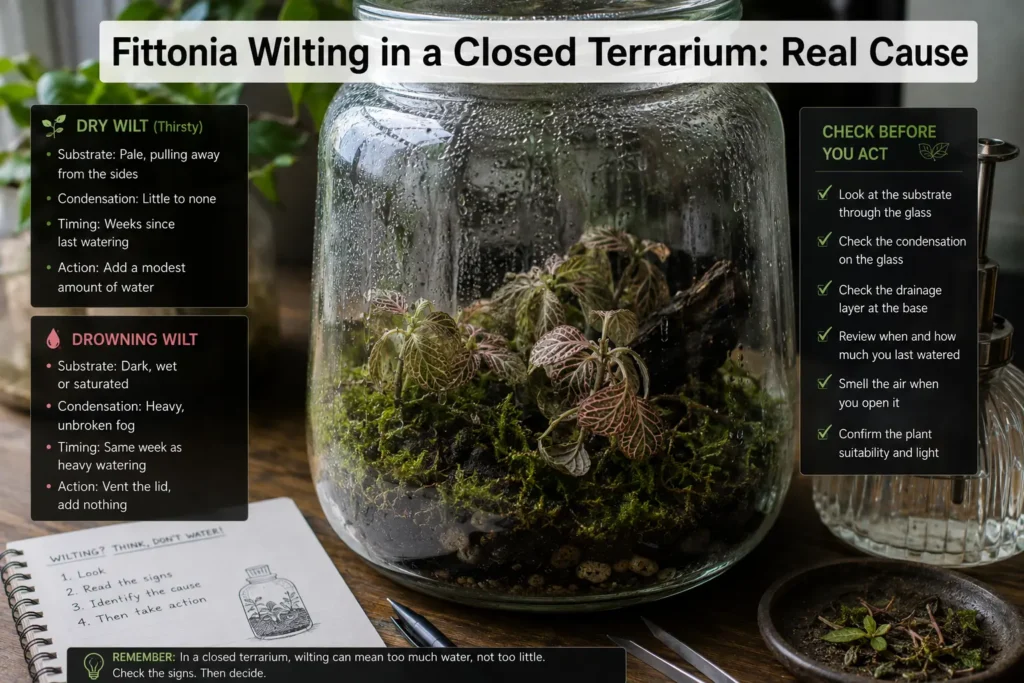
Why “wilting means thirsty” does not carry over behind glass
Fittonia (also called nerve plant) earned its reputation as a dramatic wilter in open pots for a reason: it has thin, wide leaves with a high surface area relative to their thickness, and it loses water through them quickly. In a pot with drainage holes and open air, a wilted fittonia is reliably a thirsty one, and a thorough watering usually brings it back within a day.
A closed terrarium changes almost every variable that rule depends on. There is no drainage hole. The air inside recycles its own moisture rather than exchanging with the room. Water that goes in mostly stays in, cycling between the substrate, the plants, and the glass. Wilting in that environment is not evidence of water loss from the system; it is evidence that something has gone wrong with how the plant is moving the water that is already there. That is a mechanically different problem, and it needs a different diagnosis before it gets a different fix.
The two wilts, and why they look identical from outside the glass
Both dry wilt and what is worth calling “drowning wilt” show up as the same droop: leaves losing their normal rigidity (turgor), stems softening, the plant leaning rather than standing. The visual symptom does not distinguish them. The mechanism behind each one does.
Dry wilt is straightforward: not enough water is available to the roots, cell turgor pressure in the leaves drops, and the plant physically deflates. This is genuinely rare inside a properly built closed terrarium, because the sealed water cycle is specifically designed to prevent it.
Drowning wilt happens when roots are sitting in substrate that holds too much water and too little oxygen. University extension services describe this mechanism directly: when soil pore space fills with water instead of air, roots cannot access the oxygen they need for normal function, as reported by the UC Statewide IPM Program’s guidance on aeration deficit in home gardens. Deprived of oxygen, roots lose their ability to take up and move water efficiently, even while sitting in a substrate that is objectively wet. The plant wilts from the inside out while surrounded by more water than it can use. This is functionally similar to what happens to any potted plant left in a saucer of standing water for too long, just harder to see because the substrate is hidden behind glass and gravel. In its most extreme form, this is the same mechanism behind a genuinely flooded build with standing water rather than just an overly wet substrate.
| Signal | Dry wilt | Drowning wilt |
|---|---|---|
| Substrate through the glass | Pale, pulling away from the sides | Dark, visibly damp or saturated |
| Condensation | Little to none | Heavy, unbroken fog |
| Timing since last watering | Weeks, with no recent watering | Same week as a heavy watering |
| Correct response | Add a modest amount of water | Vent the lid, add nothing |
The practical trap is that the correction for dry wilt (add water) is the exact wrong move for drowning wilt, and applying it makes the underlying anaerobic condition worse.
What to check before doing anything
Work through these in order. None of them require opening the terrarium or disturbing the roots.
Look at the substrate through the glass. Is it visibly dark and damp, or pale and pulling away from the sides of the container? A fittonia wilting next to substrate that looks obviously wet is the pattern this article exists for.
Check the condensation. Heavy, unbroken fog on the glass points toward excess water in the system generally. Little to no condensation, alongside dry-looking substrate, points toward genuine dryness. The too much condensation guide covers reading the fog in more depth.
Check the drainage layer. If the base layer of gravel or LECA is visible through the glass, look for water rising up into the substrate above it rather than sitting where it should. That is a stronger signal of a drowning cause than the wilt itself. The drainage layer guide covers how much drainage a jar its size actually needs.
Note how long it has been since the last watering. A fittonia wilting the same week it was watered heavily is far more likely to be drowning than dry. A fittonia wilting weeks after any water was added, in a build with light condensation, is a more plausible dry-wilt case. If the leaves are also yellowing rather than just drooping, the yellow leaves guide covers reading that combination specifically.
If it is genuinely the dry wilt
This is the less common case inside a sealed build, but it happens, usually from a seal that is not sealing properly or a build that was under-watered from the start. Add a modest amount of water, close the lid fully, and check the seal. Improvement is typically visible within a day or two once the water cycle re-establishes; if nothing changes, the cause was probably misdiagnosed and it is worth rechecking the substrate and drainage layer rather than adding more water on top of a wrong guess.
If it is the drowning wilt
Do not add water. That is the one instruction worth repeating, because it is the instinct every general houseplant guide has trained readers to reach for.
Vent the lid for several hours during the driest part of the day to let some surface moisture escape. Stop watering entirely until the substrate visibly looks less saturated. If the drainage layer is undersized or water has risen into the substrate, that is the structural cause and it will keep producing the same wilt until it is corrected, not just today’s symptom. Trim any leaves that have gone fully soft or translucent, since they will not recover and can encourage rot in the meantime.
Recovery from drowning wilt is slower and less certain than recovery from dry wilt, because it depends on the roots regaining function rather than simply rehydrating. Improvement, when it happens, is usually gradual over days rather than immediate.
Why fittonia specifically shows this pattern so clearly
Fittonia has shallow, fine, fibrous roots that sit close to the surface of the substrate rather than reaching deep, which puts them right in the zone most likely to become saturated after a heavy watering or a poorly drained build. Its thin, high-surface-area leaves also make wilting visually dramatic and fast to appear compared with a thicker-leaved terrarium plant, which is part of why it gets singled out for this symptom more than sturdier companions. That combination, shallow roots plus dramatic leaves, is exactly why fittonia is a useful “canary” plant for reading a terrarium’s water balance, once the two wilts are told apart correctly. It is also one of the reasons fittonia shows up so often on lists of plants suited to closed terrariums despite this sensitivity, since a plant that signals trouble early is genuinely useful in a sealed system where problems are otherwise hard to see.
What not to do
Do not water because a fittonia is wilting, at least not before checking the substrate. This is the single most common wrong response and it comes directly from open-pot habit.
Do not use the finger test to decide. Substrate inside a sealed terrarium is supposed to feel damp. A damp reading tells you nothing about whether that dampness is at a healthy level or a drowning one; the visible drainage layer and the condensation pattern are more informative.
Do not remove the fittonia to inspect the roots as a first step. Disturbing the root ball adds stress to a plant that may already be struggling, and the observable evidence through the glass is usually enough to make the call without digging.
Do not assume a single wilted fittonia means the whole build has failed. A localized wilt in one plant, with everything else looking normal, is often specific to where that plant sits rather than a system-wide problem.
FAQ
My fittonia is wilting but the substrate looks wet. Should I still water it?
No. Wet substrate with a wilting fittonia is the classic pattern for drowning wilt, not dry wilt. Adding more water worsens the underlying oxygen shortage at the roots. Vent the lid and hold off on watering instead.
How long does it take a fittonia to recover once the real cause is fixed?
It depends on which wilt it was. A genuine dry wilt often improves within a day or two of watering and resealing. A drowning wilt recovers more slowly, typically over several days, since it depends on root function returning rather than simple rehydration.
Can a badly wilted fittonia in a terrarium recover, or is it dead?
Often, yes, if the stem is still firm and at least some leaves are not fully translucent or mushy. Correct the underlying cause first, trim what will not recover, and give it time before deciding it is a loss.
Does misting help a wilting fittonia inside a closed terrarium?
Rarely, and it can make a drowning wilt worse by adding more surface moisture to a system that already has too much. Misting is more useful for a terrarium that has just been opened and cleaned, when moisture genuinely needs replacing.
Why does my terrarium look foggy and my fittonia is still wilting?
Heavy, unclearing fog points at excess water in the system, which lines up with drowning wilt rather than dryness. Read the condensation guide alongside the substrate check above before doing anything to the water level.