
How Often to Water a Closed Terrarium: The Real Answer

There is no watering schedule for a closed terrarium, and you should be suspicious of any page that gives you one. A sealed jar is not on a timetable, because it is not losing water on a timetable. It is recycling the water it already has, and the only reason you would ever add more is that some of it has left, which happens slowly, unevenly, and at a rate set by how well your particular lid seals and how warm your particular room is.
So the honest answer to “how often should I water my closed terrarium” is: possibly never, and if the answer is not never, the jar itself will tell you, in condensation. This page is about how to read that signal, and how to add water without undoing the balance that took weeks to establish.
Nobody publishes an interval, and that is a finding rather than a gap in our research
We looked for a watering frequency for sealed containers from a source that would be accountable for it, and we did not find one. University extension guidance on terrariums describes the closed system as one that recycles its own moisture and needs very little intervention, which is exactly the point: it stops short of an interval because an interval would be wrong. Mississippi State University Extension’s closed-system terrarium guide, publication P3253, takes the same posture on feeding, stating flatly that there is no need to add fertilizer to a closed system.
Meanwhile page one of this query is full of numbers. Once a month. Every three months. Twice a year. Those figures are not measurements of anything. They are somebody’s jar, in somebody’s room, generalized into an instruction, and they are the single most common way a healthy terrarium gets drowned. A jar that does not need water and gets watered anyway has no way to get rid of it, because the sealed container has no drainage hole and no exit for what you add. That asymmetry runs through everything below: under-watering a sealed jar is slow and correctable, over-watering it is fast and often terminal.
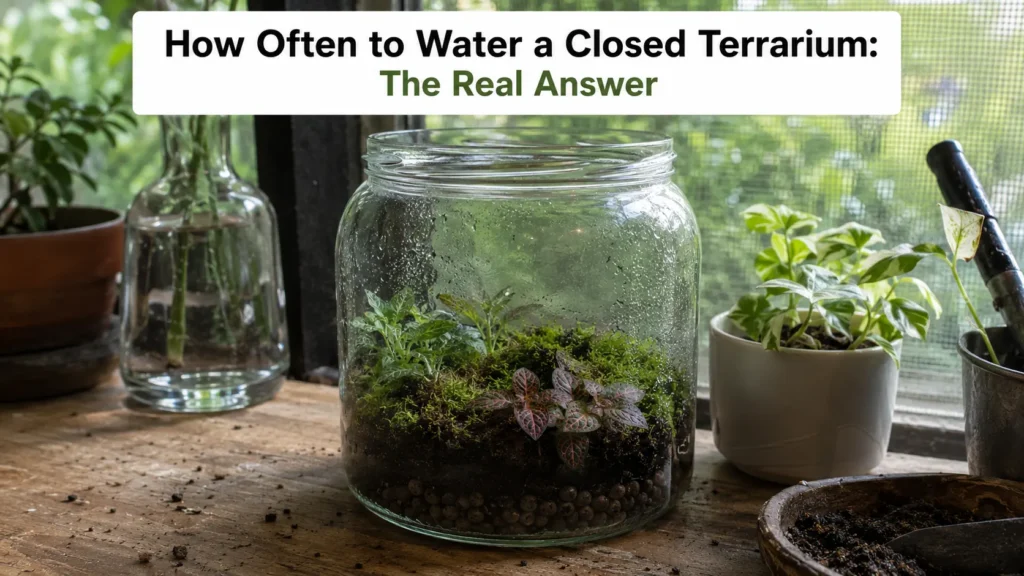
The condensation cycle is the instrument
A balanced closed terrarium runs a daily cycle. Water evaporates from the substrate and the leaves during the warm part of the day, meets the cooler glass, condenses, and runs back down. What you can see of that cycle from outside the jar is the most useful diagnostic you have, and it costs nothing.
A healthy jar fogs and clears. Light misting on part of the glass, usually in the morning or after the warmest part of the day, that thins or clears later. The glass is never permanently dry and never permanently streaming.
Too wet looks like this: heavy condensation that never clears, water running down the glass in visible streams, droplets standing on the leaves for most of the day, visible water pooled in the drainage layer. This jar does not need water. Adding any is the wrong move.
Too dry looks like this: no condensation at any point in the day, on any part of the glass, for several days in a row, with substrate that has gone pale and pulled slightly away from the glass at the edges. This jar may need water.
Notice the asymmetry in those two lists. Too wet is diagnosable from the glass in a single morning. Too dry needs several days of watching before you act, because a jar that fogs even a little is still cycling and does not need you.
Two things change how the fog reads and are worth accounting for before you conclude anything. Direct sun on the glass will produce dramatic condensation in a jar that is not overwatered at all, so read the glass out of direct sun. And a genuinely humid room will keep a jar cycling for far longer than a dry one, which is one of several reasons the standard advice written for a heated European apartment travels badly to a tropical one; if you are building and keeping jars in a hot, humid climate, the climate adjustments that actually matter change your baseline for what normal looks like.
The three checks, in order, before you add anything
One: watch the glass for a week. Not a day. A jar that showed nothing on Tuesday may fog on Friday because the weather changed. Seven days of no condensation at any hour is the threshold this site uses before treating a jar as genuinely dry, and it is a deliberately conservative threshold rather than a published one.
Two: look at the substrate, at the side of the glass. You can usually see the substrate profile through the glass without opening anything. Damp substrate is dark. Substrate that has gone uniformly pale from the surface down, and has shrunk back from the glass, is dry. Substrate that is pale on top and dark below is normal and is not a reason to water.
Three: check the drainage layer. If there is standing water sitting in the drainage layer, the jar has water, whatever the surface looks like. This is the check that stops the most mistakes, because a dry-looking surface over a full reservoir is common and looks exactly like a jar that needs watering. How much reservoir you have is a function of how deep that layer was built, and it varies a lot with container size; the depths this site works from are set out in terrarium layer depths by jar size.
If all three say dry, add water. If any one of them says wet, do not.
How to actually add it
Add a very small amount, then stop and wait. The correct quantity is smaller than instinct suggests: a light misting of the substrate surface, or a few milliliters trickled down the inside of the glass on a small jar. Then close it and leave it for two or three days. You are not trying to reach a target moisture level in one go. You are trying to nudge a system that will redistribute what you gave it.
Down the glass, not onto the plants. Water run down the inside wall reaches the substrate without flattening moss, without knocking small plants over, and without sitting in the crown of a plant that will then rot. It also lets you place water at the edge of the profile rather than in one heavy spot.
Use the right water if your tap water is hard. In a container that never drains, dissolved minerals arrive and stay, and over years they accumulate on the glass and in the substrate. Rainwater, distilled or filtered water avoids that. This matters more in a sealed jar than in a pot for the same reason everything else does: there is no flush.
Wait, then look, then decide. Two or three days later, read the glass again. If it now fogs and clears, you are done. If it still shows nothing, repeat with the same small amount. Two small additions a week apart are safe. One large addition is not.
Do not use the opportunity to feed it. A jar that has just been re-watered is not a jar that needs fertilizer, and the two decisions are unrelated.
If you added too much
Act the same day rather than hoping it evens out, because it will not: there is no exit.
Take the lid off and leave it off. Excess water leaves a sealed container only by evaporating out of an open one, and depending on the volume and your room this takes hours to a few days. Move the jar somewhere with moving air but out of direct sun, since sun on an open jar cooks the plants you are trying to rescue. Tilt gently to pour off any free-standing water if there is genuinely a pool, being careful not to dump the substrate. Blot standing droplets off leaves with a clean cloth or paper, because water sitting on a leaf overnight in warm air is how rot starts. Then close it again only once the glass fogs lightly instead of streaming.
Watch for mold over the following two weeks. A jar that was overwatered and then dried back out is at its most vulnerable in that window.
The special cases that break the general answer
A jar that has never been sealed properly. A cork, a cloth cover, a lid that only rests on top, a container with a chipped rim: none of these are sealed, and a jar that leaks vapor continuously will need topping up on something closer to a real schedule. If your jar dries out every few weeks, the lid is the problem, not the watering.
A jar that gets opened often. Every opening vents humid air and replaces it with room air. A terrarium you open weekly to prune, tidy or photograph is a semi-open system and behaves like one.
A jar in a hot room, or a jar in the sun. Heat drives the cycle harder. That does not by itself mean water is leaving, since a sealed jar recycles it, but heat plus an imperfect seal loses water much faster than cool plus an imperfect seal.
A jar in its first month. New builds are still settling and their condensation is genuinely unstable while roots establish and the substrate finds its equilibrium. Do not read a two-week-old jar the way you read a two-year-old one, and do not correct it on the basis of one dry-looking morning.
A jar with succulents or cacti in it. If that jar is sealed, watering frequency is not your problem. Those plants do not belong in a sealed container at all, and the fix is the build rather than the schedule.
The short version
A closed terrarium that fogs and clears needs nothing from you. Only a jar with no condensation at any point across a full week, pale substrate at the glass, and nothing in the drainage layer should be watered, and then only in small amounts, run down the glass, with several days between additions. There is no interval to memorize, and the pages offering you one are describing their jar rather than yours.