
How Long Before a Closed Terrarium Stabilizes

Ask this question online and two answers come back: about two weeks, and about four to eight weeks. Both numbers are in wide circulation, they are usually presented as competing answers, and the reason the question keeps getting asked is that nobody explains they are measuring different things.
They are milestones in a sequence, not rival estimates. The two week figure is the break-in period, the phase of opening and closing the lid. The four to eight week figure is the water cycle settling into a stable daily rhythm. And there is a third, longer phase nobody puts a number on, which is the build biologically settling: root systems establishing, moss knitting in, a cleanup crew if present reaching a steady population.
What “stabilized” actually means in a sealed jar
Stabilized does not mean nothing changes. It means the water cycle has found a level it returns to on its own.
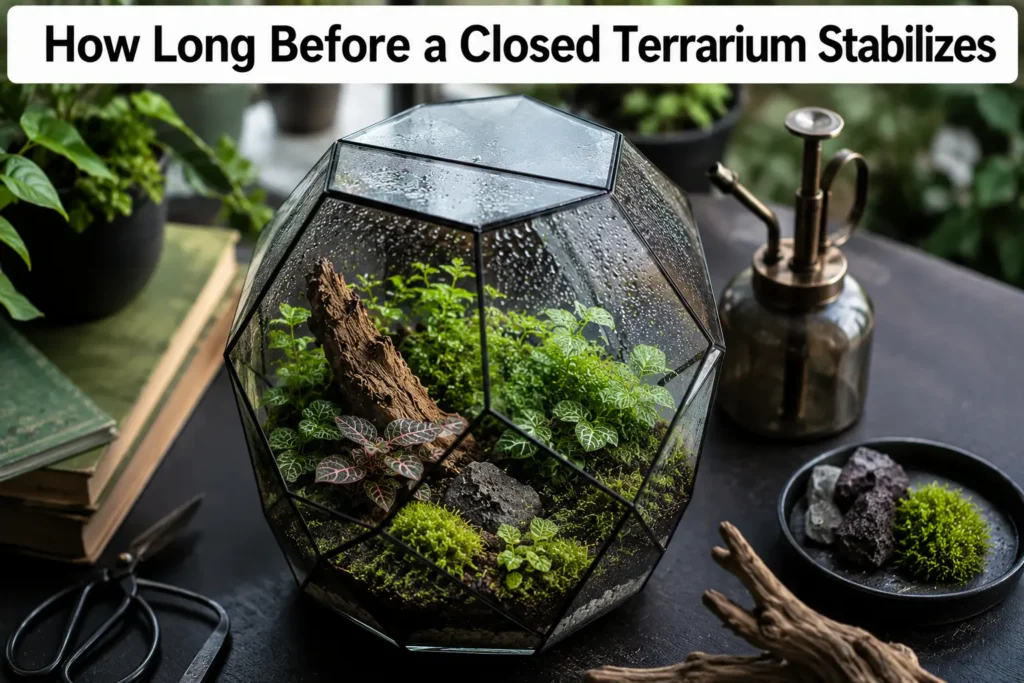
The recognizable end state is a daily condensation rhythm: light fog on the glass in the morning that clears through the day, without you doing anything to make it clear. The substrate stays evenly damp without pooling. Nothing needs venting, nothing needs watering, and the appearance of the glass on a given morning is roughly the appearance it had the morning before.
That is the whole definition. Not “the plants are thriving,” not “it looks finished,” not “it will never need attention.” A build can be perfectly stable and still be a bit sparse, still be growing into its space, still have a plant you are unsure about.
Three milestones, not one deadline
Separating these is the thing that makes the timeline make sense.
Milestone one: break-in, measured in days. Immediately after planting, the build is a jar of damp material with no established rhythm. The break-in period is a sequence of open and closed cycles that lets the excess moisture off and lets the cycle start. The end signal is that heavy all-day fog gives way to lighter fog that clears on its own. The break-in schedule covers the day-by-day pattern.
Milestone two: water cycle balance, measured in weeks. The lid is on for good and the daily fog pattern is repeating. This is what most sources mean when they say a terrarium has reached equilibrium, and it is the milestone the four to eight week range is describing.
Milestone three: biological settling, measured in months. Roots have taken hold in the substrate rather than sitting in the shape of the nursery pot they came from. Moss has attached and started spreading rather than sitting on the surface as placed. Growth rates have slowed from the initial burst into something steady. No source puts a firm number on this, and that is honest, because it varies with what is planted more than anything else.
Most people asking when they can stop worrying are asking about milestone two.
Why published timelines range from two weeks to two months
Setting aside the milestone confusion, there is still a genuine spread in the numbers, and the spread is not disagreement about method. Hobby sources and university extension material describe the same process. They differ on the number because they are describing different builds.
One thing worth flagging: at least one page ranking for this query states a specific percentage of terrariums that stabilize by a given week. There is no study behind a figure like that and no plausible way anyone measured it. Treat precise-sounding survival and success percentages in this hobby as decoration rather than data.
The three variables that decide where your build lands
Container volume. A larger build holds more air, more substrate and more water, and all of it has to settle. A small jar reaches balance faster simply because there is less of it. This is the most reliable of the three.
Planting density. A densely planted build with several plants and full moss coverage puts more moisture into the air through transpiration than a sparse build of the same size. More moisture entering the system for the same drainage and substrate to manage means a longer settling period. This is not an argument for planting sparsely, only a reason not to compare two differently planted builds and assume the slower one is failing.
Ambient climate. The wettest of the three variables and the least discussed, because most terrarium writing assumes a temperate room. Venting works by exchanging the jar’s saturated air for the room’s drier air. In a room that is already humid, each vent session removes less moisture, so the build takes longer to shed its excess. The humid-climate build guide covers the adjustments, and the monsoon build guide covers the extreme version of it.
A large, densely planted build in a humid room sits at the slow end of every published range at once. That is expected, not a fault.
What to look at instead of the calendar
The calendar is the wrong instrument, because it cannot see your jar. These can:
| What you observe | Where the build is |
|---|---|
| Heavy fog all day, running droplets, needs venting | Still in break-in |
| Fog that clears partway through the day without help | Approaching balance |
| Light morning fog that clears by midday, repeating daily | Water cycle balanced |
| Same pattern holding for several consecutive weeks, no intervention | Stable |
| New growth appearing, moss attaching and spreading | Biologically settling |
If the pattern is moving down that list, the build is on track regardless of what week it is. If it is stuck several rows up for a long stretch, the timeline is not the issue.
What “self-sustaining” does and does not mean
The phrase gets used loosely, and it is worth pinning down, because it sets expectations that later read as failure.
Self-sustaining is a claim about water. A sealed terrarium recycles its own moisture, which is why a stable build can go months without watering, and why long-lived sealed builds are cited as running for years.
It is not a claim about anything else:
- Light still comes from outside. The build needs an appropriate position and will decline without one.
- Pruning is still yours. Plants that reach the glass and stay pressed against it will suffer there.
- Dead material still needs removing when it is reachable, particularly in the first months.
- Nothing is permanent. Plants die, get replaced, outgrow the space. A stable terrarium is a system that holds its balance, not one that stops being a living thing.
The sealed jars that have run for decades and get cited in every article on this subject were kept in stable conditions and mostly left alone. They were not unattended.
What still needs doing after it stabilizes
Very little, which is the point of the hobby, but not nothing. Checking the glass occasionally rather than daily. Removing a dead leaf when one is visible and reachable. Trimming when a plant presses hard against the glass. Watching for a change in the condensation pattern, which is the earliest signal that something in the system has shifted.
That is roughly the whole maintenance load for a stable closed build.
When a slow timeline means something is wrong
Patience is the right default, and there is a point where it stops being the right answer.
Signals that the delay is a symptom rather than a slow settle:
- Heavy fog that has not lightened at all across many weeks of regular venting, in a build whose size and climate do not explain it.
- Visible standing water in the drainage layer that is not receding. That points at the amount of water in the system rather than at time. The drainage layer guide and the first watering guide cover the two build decisions most often behind it.
- No condensation at all, which is usually a seal problem or a genuinely dry build rather than a slow one.
- Spreading growth or a bad smell, which is a different problem entirely and is not waiting for time to fix it.
In each case the fix is in the build rather than in the calendar, and continuing to vent an unbalanced build indefinitely does not resolve it. The troubleshooting guide works from what you can see, and the mold and condensation guide covers the growth and smell cases.
FAQ
Is two weeks or two months the right answer?
Both, for different milestones. Two weeks is roughly the break-in phase of opening and closing the lid. Four to eight weeks is the commonly cited range for the water cycle settling into a stable daily rhythm afterward.
Does a bigger jar stabilize faster or slower?
Slower, generally. More air, more substrate and more water all have to reach balance, so a large build takes longer than a small one of the same design.
Will it ever need water again?
A stable sealed build can go a long time without it, and some go very long indeed. It is not a guarantee. A change in the condensation pattern, or substrate visibly drying and pulling away from the glass, is the signal to look rather than a date on a calendar.
Does stabilized mean I can ignore it completely?
It means the water cycle holds itself. Light, pruning and removing dead material are still yours, and they are a small load compared to a potted plant. See the build guide for how the choices made at planting affect how much of that load there is later.