
Too Much Condensation in a Terrarium: Reading the Fog

Heavy, all-day condensation that never clears, hides the plants behind running droplets, and has looked the same for a week or more means the system is holding more water than it can cycle. Light morning fog that clears by midday is normal and needs nothing. The fix for genuine excess is to vent the lid for several hours, stop watering, and check the drainage layer and substrate underneath the fog, since the glass is only reporting a condition that started somewhere else in the build.
Condensation is a gauge, not a symptom on its own
Most troubleshooting pages treat condensation as a problem to solve. It is more useful to treat it as an instrument reading. A closed terrarium is a small, closed water cycle: water evaporates from the substrate and the plants, meets the glass, cools, and runs back down. Some fog is proof the cycle is running. The question that actually matters is how much, for how long, and what else is happening alongside it, because condensation read in isolation tells you less than condensation read next to the smell, the substrate, and the leaves.
That pairing is the point of this guide. A heavy-fog reading means something different depending on what else you observe, and the sections below walk through the combinations rather than treating “too much condensation” as a single problem with a single fix.
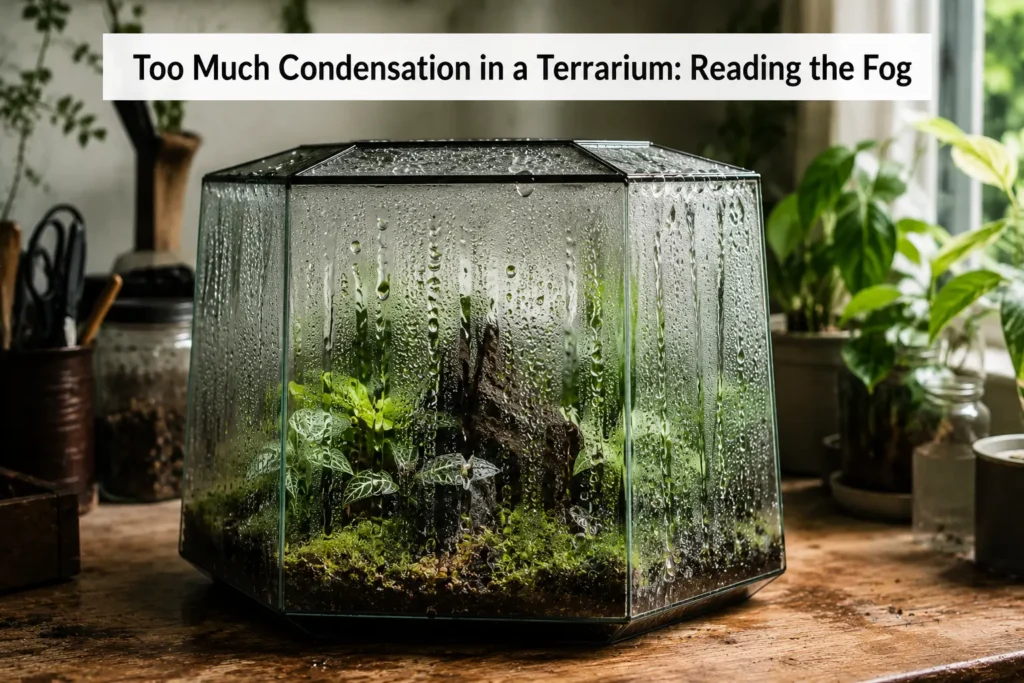
The fog gauge
| What you see | What it usually means |
|---|---|
| Light fog in the morning, clears by midday | Healthy water cycle. Leave it alone. |
| Patchy fog, partly clears through the day | Slightly wet, still within range. Watch it. |
| Heavy fog all day, running droplets, plants obscured | Excess water in the system |
| No condensation at all | A separate problem; see no condensation |
This guide covers the third row. If your glass looks like the fourth row instead, the cause and the fix are close to opposite, which is exactly why the two are kept as separate guides rather than one page trying to cover both.
What heavy, persistent fog actually indicates
Persistent heavy condensation almost always traces back to one of three build decisions, not to something going wrong spontaneously.
Too much water at planting or since. This is the single most common cause. A sealed jar recycles nearly all the water it starts with, so a heavy hand at the first watering, or repeated watering since, out of worry rather than evidence, adds up faster than it seems like it should.
An undersized or missing drainage layer. If there is nowhere for excess water to sit below the substrate, it stays in the substrate instead, and a substrate that is holding more water than it should evaporates more of it, continuously, into the air above it. The drainage layer guide covers how much drainage material a given jar size actually needs.
A substrate mix that holds too much moisture. Garden soil and moisture-retentive mixes hold water far longer than a purpose-built terrarium substrate, and they release it slowly and constantly rather than cycling it. The substrate mix guide covers what a properly draining mix looks like.
A build in an already-humid room adds a fourth variable: the air being vented in during a correction carries less drying capacity than a temperate guide assumes. The humid climate build guide covers how to adjust for that.
What to do about it today
Work in this order rather than changing several things at once, since changing everything together makes it impossible to know what actually fixed it.
- Vent the lid. Remove or crack it for 6 to 12 hours during the driest part of the day. This is the fastest correction and it costs nothing.
- Stop watering. If the glass is fogging heavily, the system has water to spare. Hold off until the substrate visibly looks less saturated.
- Wipe the glass. Not a fix by itself, but it lets you actually see the substrate and plants underneath while you assess the rest.
- Check the drainage layer through the glass. Standing water visible in the gravel or LECA at the base is normal in a shallow amount. Water visibly rising into the substrate above it is not, and is a stronger signal than the fog itself.
What not to do
Do not leave the lid off indefinitely. Venting is a targeted correction, not a new normal. A closed terrarium left open stops being a closed system, and the plants inside were chosen for constant high humidity.
Do not tear the build down over fog alone. Heavy fog in the first one to two weeks after building or repotting is common and often resolves as the system settles; see the stabilization timeline for what a normal early settling period looks like before assuming something is actually wrong.
Do not assume fog means mold is coming. Fog and mold are related (both point at excess moisture) but they are not the same reading. If fuzzy or web-like growth has actually appeared, the mold identification guide and the mold and condensation guide cover that separately.
Reading condensation alongside other symptoms
Condensation rarely appears alone. Reading it together with what else is happening narrows the cause faster than either signal on its own.
Heavy fog plus a sour or drain-like smell points at anaerobic conditions in waterlogged substrate, a step past ordinary excess water; see why does my terrarium smell bad for that combination specifically.
Heavy fog plus yellowing leaves is consistent with overwatering and possible root stress; the yellow leaves guide covers how to tell that apart from natural leaf aging or a light problem.
Heavy fog plus fuzzy growth on the substrate or wood is the pattern most beginners search for by name; the mold identification guide covers distinguishing that growth from harmless mycelium before assuming the worst.
When heavy condensation is actually fine
Right after building or right after a heavy first watering, several days of heavy fog is expected while the system finds its level, not a sign of failure. The distinction that matters is duration and trend: fog that is easing off over one to two weeks as the build settles is normal; fog that has looked identical for three weeks or more, with no change after venting and cutting water, points at one of the three causes above rather than at ordinary settling.
FAQ
How long is too long for heavy condensation to last?
More than one to two weeks of unchanging heavy fog, especially after venting and cutting back watering has been tried, points at an underlying cause (usually excess water or an undersized drainage layer) rather than ordinary settling.
Will venting the lid dry my terrarium out too much?
Not from a few hours of venting during the driest part of the day. A single venting session removes surface moisture without draining the substrate itself. Repeated venting over several days, combined with no additional water, is the standard correction.
Does heavy condensation mean my terrarium is drowning?
Not necessarily drowning, but it does mean there is more water in the system than it can currently cycle. Check the drainage layer through the glass for standing water actually rising into the substrate; that is a stronger signal of real trouble than the fog by itself.
My terrarium fogs heavily every day even though I built it weeks ago. What now?
Persistent heavy fog well past the settling period usually traces to the drainage layer or substrate mix rather than a one-time watering mistake. Check both guides before assuming a full rebuild is needed; both problems are commonly fixable without starting over.
Should I add more ventilation holes to stop the fogging?
Modifying a sealed container changes what kind of build it is. Venting temporarily by opening the lid solves the same problem without permanently changing the container’s ability to run as a closed system.