
No Condensation in a Terrarium: Dry or a Bad Seal?

Several consecutive days with no fog on the glass at all means one of two things: the lid is not sealing and moisture is escaping continuously, or the build genuinely does not have enough water in it. A closed terrarium with a working seal should show at least light fog somewhere on the glass most mornings. The two causes are easy to tell apart with one check: test the lid seal first, since it is the faster of the two to confirm, then look at whether the substrate itself is dark and visibly damp or pale and pulling away from the glass.
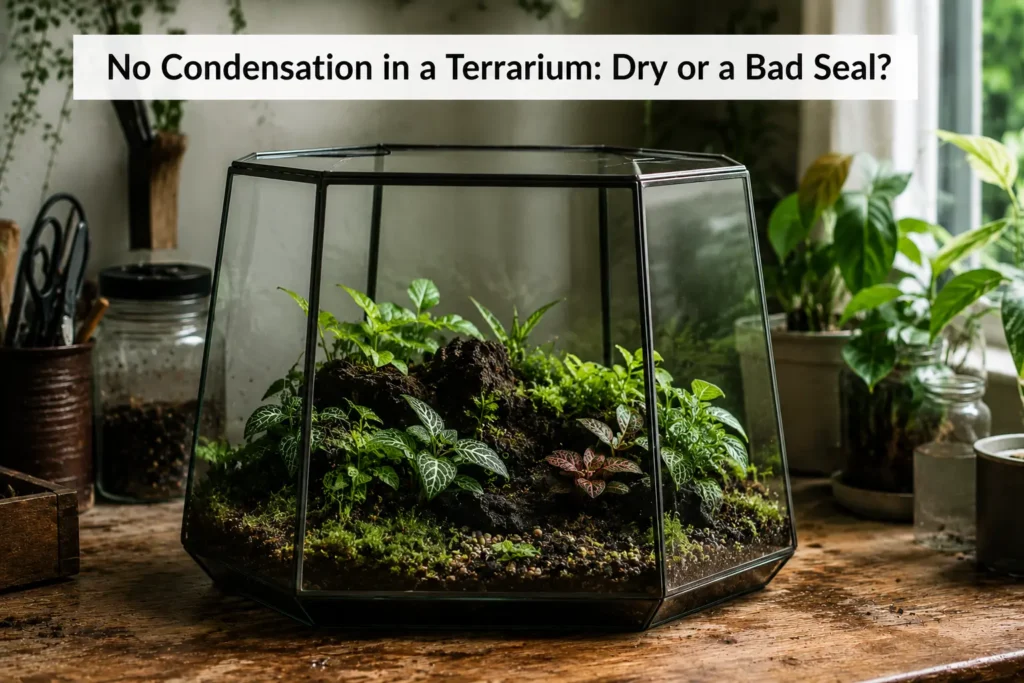
Why an absence of fog is a real signal, not a good sign by default
Some new builders read a clear jar as a success, since a fogged-up terrarium looks messy and a clear one looks tidy. In a sealed system, that instinct is backward. A closed terrarium runs on the same water it started with, recycled through evaporation and condensation. If that cycle has stopped producing any visible fog for several days running, the water either has nowhere to go (a genuine leak) or there is not enough of it left to cycle (a dry build). Neither is a sign the system has stabilized into something better than the norm; both are worth checking.
The exception is a light or intermittent fog pattern that appears at some times of day and not others. That variability is normal, driven by temperature and light changes through the day, and is different from a jar that has shown no fog at all for a week or more.
Test one: check the seal first
This is the faster check, so do it before assuming the build is simply dry.
Look at the lid closely. A gasket that has warped, a lid that does not sit flush, a container with a loose-fitting cork or clip that does not close all the way, or a design that was never truly airtight to begin with, all let moisture escape continuously rather than cycling inside the jar. If the seal is compromised, no amount of adding water inside will produce lasting condensation, because whatever evaporates simply leaves rather than condensing back down.
Different lid types fail in different ways. A screw-top or clamp-top lid with a rubber gasket usually fails when the gasket has hardened, cracked, or shrunk slightly with age, which can happen even on a lid that still looks fine at a glance; press it closed and check whether it meets the glass evenly all the way around. A cork stopper fails when it has dried out and shrunk enough to leave a visible gap, or when it was never quite the right size for the neck it is sealing. A clip-top jar with a rubber ring fails at the ring itself, the same way the gasket does. If any of these show a visible gap, a soft or brittle feel, or simply do not sit flush under light pressure, that is the likely explanation before anything about the build itself is considered.
If the seal looks and feels properly seated and the container is genuinely designed to close, move to the second test.
Test two: check the substrate
Look at the substrate through the glass, and if you can safely reach a corner of it, feel it.
Dark, visibly damp, slightly compacted substrate with no condensation on the glass is a less common but real pattern, and it usually means either the seal issue above, or a jar that was watered lightly enough that the substrate holds moisture without producing enough surface evaporation to fog the glass consistently. This is the milder of the two dry-reading outcomes.
Pale, shrunken substrate that has visibly pulled away from the glass is a clearer sign of genuine dryness. This pattern most often shows up alongside a confirmed seal problem, since a properly sealed jar with adequate starting water rarely dries out to this degree on its own.
What to do about it
If the seal is the problem, the fix is mechanical rather than about watering. Check whether the lid can be reseated properly, whether a gasket or seal needs replacing, or whether the container was never designed to close fully. Continuing to add water to a jar that cannot hold humidity treats the wrong variable and can lead to a cycle of repeated overwatering without ever producing a stable closed system, since every addition simply evaporates and escapes rather than cycling back down.
If the seal is fine and the build is genuinely dry, add a small amount of water along the inside of the glass rather than directly onto the plants, using a fine mist or a small amount poured carefully at the substrate line. Add less than instinct suggests. A common overcorrection here is adding a large amount of water at once out of worry, which then produces the opposite problem covered in the too much condensation guide a few days later. Add a little, wait a few days, and check for fog returning before adding more.
Reading no-condensation alongside other symptoms
No condensation plus brown, crispy leaf edges is a strong combination pointing at genuine dryness or heat stress rather than a normal early-weeks pattern; see the brown leaves guide for how heat and dryness are told apart inside a sealed jar.
No condensation plus a recently opened or long-vented lid is expected and not concerning; the jar simply has not had time to rebuild its cycle since venting. Reseal it and check again in a day or two before treating it as a genuine problem.
No condensation immediately after building is common in the first day or two, before the system has had time to establish its cycle, and is different from a jar that has run dry for a week after previously fogging normally.
When this is not actually a problem
A very lightly planted jar, or one with a large air gap above the substrate relative to its planting, can run with less visible surface fog than a densely planted one and still be functioning normally, simply because there is less leaf surface area contributing to the water cycle. If the substrate still reads as damp and dark through the glass and the plants show no stress, a lightly fogged or mostly clear jar is not automatically a fault.
Seasonal indoor conditions matter too. A room running an air conditioner or a dehumidifier can pull ambient humidity down enough to change how quickly a jar’s surface fog clears, even without any change to the seal or the substrate inside it. If a terrarium that fogged reliably for weeks suddenly clears up around the same time the room’s climate control changed, that timing is worth noting before assuming the jar itself is the problem.
FAQ
How many days without condensation is a real concern?
As a general guide, five to seven consecutive days with no fog at all, in a jar that previously showed a normal pattern, is worth investigating. A day or two, especially right after building or after venting, is not unusual.
Could a bad seal be the cause even if I never touched the lid?
Yes. Warped gaskets, lids that were never a perfect fit, and containers not actually designed for a sealed closed system can leak steadily without anyone having opened or disturbed the jar.
Is it possible for a terrarium to be too dry even though it is sealed?
Yes, most commonly from a combination of a compromised seal and a light initial watering. A fully intact seal with an adequate starting amount of water rarely dries out significantly on its own, since almost nothing escapes.
I added water and still see no condensation the next day. What now?
Give it a few days rather than adding more water immediately. The cycle needs time to re-establish after a change, and adding water repeatedly in quick succession is how a dry jar becomes an overwatered one.
Can I fix a leaking seal without replacing the whole lid?
Sometimes. A cork that has shrunk can occasionally be swapped for a slightly larger one, and a clamp-top jar’s rubber ring is usually a separate, replaceable part. A lid that was simply never designed to seal tightly, such as a decorative cover with no gasket at all, is a container mismatch rather than a repair job, and a different container is the more reliable fix.