
Mushrooms in a Terrarium: What They Mean, What to Do

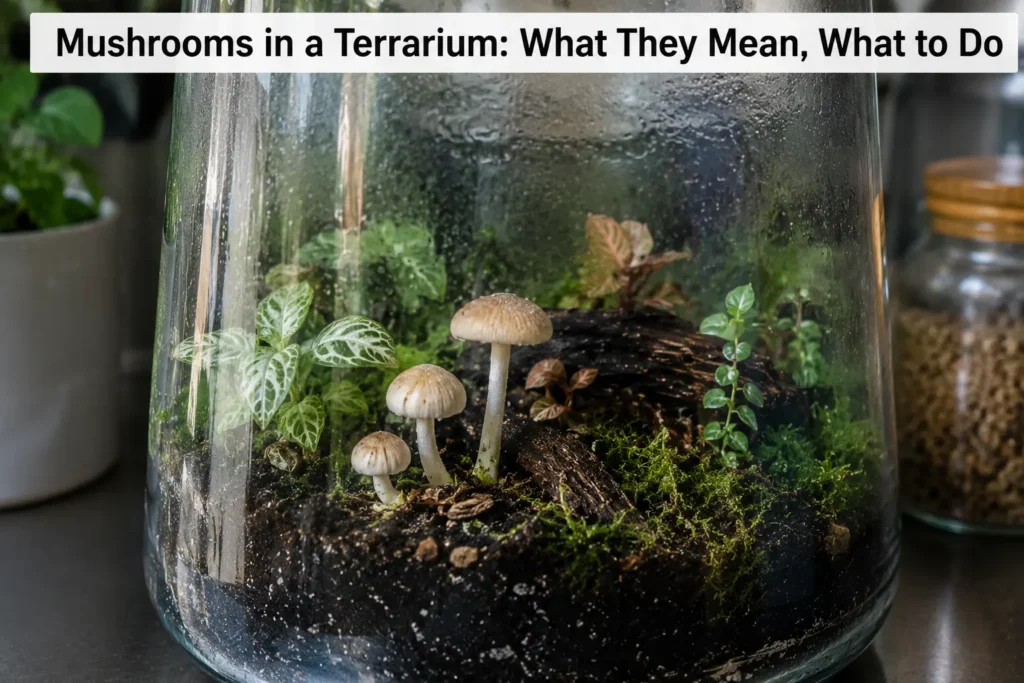
A mushroom in your terrarium is a fruiting body: the visible reproductive structure of a fungus whose thread-like body has been living in your substrate, unnoticed, for weeks. It is a moisture and decomposition signal, not a new invasion. Remove it with a tool rather than your fingers, take it out of the room, and keep it away from children and pets while you do. Do not try to work out what species it is, and do not let anyone eat it. No page, no photo app and no article, including this one, can tell you whether the mushroom in your jar is dangerous.
If anyone has already eaten it, call before you read on
If a child or an adult has swallowed any part of a mushroom from your terrarium, call a poison center immediately. In the United States that is 1-800-222-1222, and Poison Control’s own guidance is blunt: “If you think that someone has eaten a wild mushroom, call a poison center right away” (Poison Control, poison.org, read 2026-08-24). Outside the US, call your national poison information center.
If a dog or cat has eaten one, call your veterinarian or an animal poison line straight away rather than waiting for symptoms. The ASPCA runs its Animal Poison Control Center on (888) 426-4435 and states that a delay in treatment can be dangerous with some mushrooms (ASPCA, read 2026-08-24).
Keep a piece of the mushroom in a paper bag, not plastic, and refrigerate it. The North American Mycological Association advises exactly that so a specimen exists for identification in a poisoning case (namyco.org, Toxicology, read 2026-08-24).
Nobody can identify it for you, and that is the actual limit
Terrarium content usually skips this, so here it is plainly. Poison Control answers the question of how to tell a safe mushroom from a poisonous one with “Unless you are very experienced in mushroom identification, you can’t!!” and warns that look-alikes are common and that identification learned in one region does not transfer to another (poison.org, read 2026-08-24). The ASPCA makes the same point for animals: most toxic mushrooms are difficult to distinguish from nontoxic ones, so the practical control is keeping pets away from wherever mushrooms are growing (ASPCA, read 2026-08-24).
A photograph cannot show spore print color, smell, bruising reaction or the base of the stem, and several of the deciding features live there. So this page will not tell you what yours is, and I would treat any page that offers to as a liability rather than a resource.
The common one is not the safe one
It is worth knowing which way the odds run. The species extension services most often report in potting media is the yellow flowerpot mushroom, Leucocoprinus birnbaumii. North Carolina Extension Gardener Plant Toolbox lists it with medium poison severity, symptoms including vomiting, nausea and diarrhea, and its exact level of toxicity recorded as unknown (read 2026-08-24).
That is the single most likely candidate in a houseplant pot, and it is still listed as poisonous. Naming it is not identifying yours, and I am not suggesting you match your mushroom against it. The point is the opposite: even the expected, thoroughly documented one carries a warning, so a guess that lands on it buys you nothing.
Why a mushroom appeared in a sealed jar at all
The fungus did not arrive the night it fruited. Iowa State University Extension and Outreach explains that the thread-like body of the fungus, the mycelium, is usually introduced in the potting mix itself, or arrives as an airborne spore that lands in the pot (read 2026-08-24). It then lives on dead organic material rather than on your plants. North Carolina Extension describes the flowerpot parasol as working to break down organic matter in soil and notes that it does not harm living plants (read 2026-08-24).
So a mushroom is not an attack. It is a decomposer that has been quietly eating something dead in your build, most likely bark, a wood component, coir, a buried leaf or the organic fraction of the substrate, and has now had enough moisture and enough food to reproduce.
What the fruiting body is telling you
Read the mushroom the way you read the fog on the glass. Three things have to be true at once for a fungus to fruit, and each points at a build decision you can check tonight.
There is a real reserve of dead organic matter. Bark, wood, coir and leaf litter are all fungal food, and a build heavy on organic material decomposes faster; the terrarium substrate guide covers which components hold structure and which are essentially fungal groceries.
The substrate is sitting wetter than it needs to be. Fruiting takes water, and in a sealed jar surplus water has nowhere to go, which is what the drainage layer exists to buffer.
And nothing is competing hard for that food, which is what a thin or absent cleanup crew looks like from outside. None of that is an emergency. It is a build running warmer, wetter and more organic than you intended.
Removing it without spreading it or hurting anyone
There is no chemical step here. Iowa State Extension notes that fungicide treatments are generally not effective against mushrooms in any case (read 2026-08-24), so this is physical removal.
Work with long tweezers, chopsticks or tongs rather than fingers. Take the whole structure, cap and stem together, and lift the base out of the substrate rather than snapping the cap off, so nothing is left behind to decay in place. Bring it out in one movement without shaking it over the substrate, since a mature cap carries spores. Put it straight into a bag or a bin outside the room, then wash your hands. The mycelium stays behind either way, so treat a second flush as confirmation of the moisture reading rather than as a failed removal.
Then do the part that matters more than the removal, which is keeping the open jar out of reach while you work. Iowa State’s advice for potted plants is that where pets or small children live in the home, it is wise to remove mushrooms as they appear (read 2026-08-24). A closed terrarium is on your side here, because the lid is a physical barrier an open pot does not have. A jar on a low shelf with the lid off is not.
Why the standard houseplant fix does not work in here
Almost every page about mushrooms in soil ends the same way: let the top of the soil dry out between waterings, and repot with fresh mix if they persist. Both are sound for an open pot. Neither is available to you.
You cannot dry the top of a sealed terrarium on purpose. There is no evaporation route out of the container, so the water you have is the water you keep, and venting the lid is a slow partial lever rather than a switch. You also cannot repot without dismantling the build, and pulling every plant out through a narrow neck is a rebuild, not a fix.
What you can do is stop adding water, vent if the glass is streaming rather than lightly fogged, remove dead plant material promptly, and let a springtail population compete for the food. If white growth on wood is part of what you are seeing, the mold identification guide separates fuzz, cobweb mold, slime mold and ordinary mycelium, which is a different question from this one.
When the mushroom is not the story
If the mushroom arrived alongside a sour, drain-like smell, standing water in the drainage layer, or plants going soft from the bottom up, the fungus is a symptom and the mushroom is the least of it. That is a rot problem, and the substrate needs addressing rather than the cap plucking. The terrarium smell guide separates a musty forest-floor note, which is normal, from a sour one, which is not.
If you are starting a new build after this, sterilizing substrate and hardscape before assembly reduces the material that arrives already colonized, and the sterilizing guide is honest about what that achieves. It reduces what you introduce. It does not make a jar spore-proof, because spores are in the air of the room you build in.
FAQ
Should I leave the mushroom in, since it is part of the ecosystem?
That is a household decision, not a botanical one. Extension guidance is that these fungi break down dead organic matter and do not harm living plants, so the plants themselves do not need you to intervene. The reason to remove it anyway is the one Iowa State Extension gives: where small children or pets are in the home, it is wise to take mushrooms out as they appear.
Can you tell me if my terrarium mushroom is poisonous from a photo?
No, and neither can an identification app. Poison Control’s position is that unless you are very experienced in mushroom identification you cannot tell a safe mushroom from a poisonous one, and look-alikes are common. Photographs cannot capture spore print, smell or the base of the stem. Handle it as waste and assume it is not safe to eat.
Do springtails eat mushrooms or stop them appearing?
University of Minnesota Extension lists springtails as feeding on decaying plant material, fungi, molds and algae (read 2026-08-24), so a healthy population is competing for the same food the fungus in your substrate is living on. Whether that competition is enough to suppress fruiting inside a sealed container is a separate question, and I have not found a university source measuring it, so treat it as a reasonable expectation rather than a proven control.
My cat knocked the lid off and I do not know if she ate any. What now?
Call your veterinarian or an animal poison line and describe what happened rather than waiting to see if she becomes unwell. The ASPCA Animal Poison Control Center is on (888) 426-4435 and notes that delayed treatment can be dangerous with some mushrooms. Keep any remaining mushroom material in a paper bag in the refrigerator so it can be examined.