
Terrarium Root Rot: Diagnosing It Through the Glass

You can diagnose root rot in a terrarium without lifting the plant, and in a narrow-necked jar you usually should. The most reliable single sign is a plant that wilts while the substrate is visibly wet, because rotted roots cannot take up water even when water is sitting right there. Read that against the drainage layer, the smell when you open the lid, and whether the damage started at the lowest leaves. Digging a plant up is not a neutral test in a sealed container: it disturbs the root ball and spreads infected material through substrate every other plant is sharing.
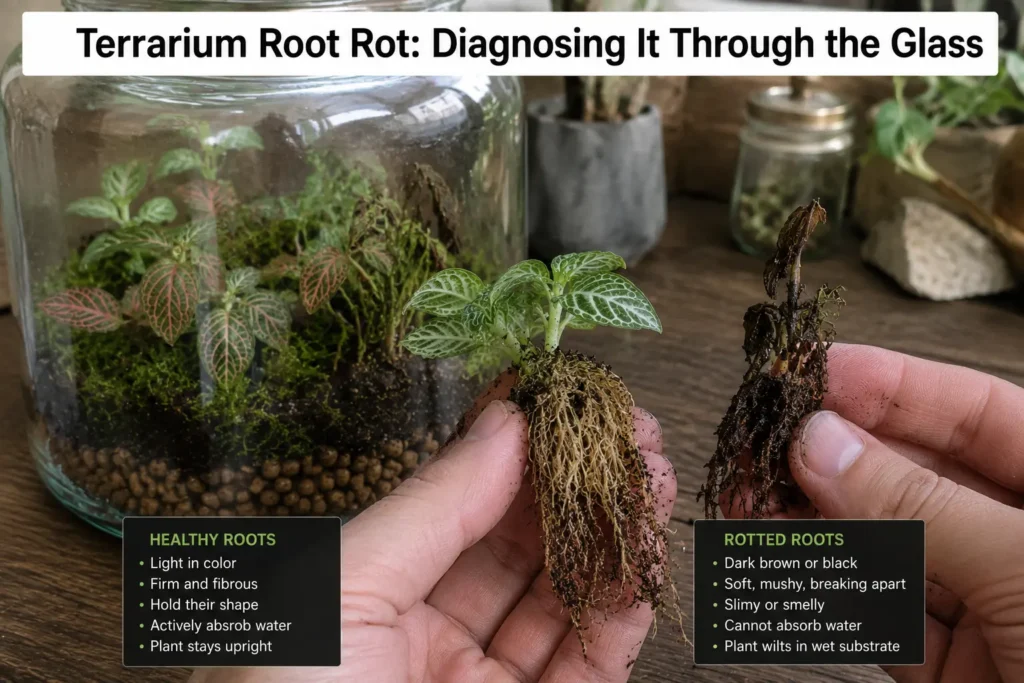
What root rot is, and why a sealed jar invites it
Root rot is not one disease. University of Maryland Extension lists three common causes in indoor plants, and they behave differently: Pythium root rot “causes stunting, yellowing and wilting of plants even when potting media moisture is adequate,” Phytophthora root rot “causes root tips to turn dark brown and rapidly turn soft and mushy,” and Rhizoctonia root rot “occurs when temperatures are warm and conditions are moist” (read 2026-08-24).
What all three share is low oxygen. Clemson Cooperative Extension’s Home and Garden Information Center describes these as opportunistic soil-borne pathogens that thrive under low oxygen or anaerobic conditions and take advantage of roots injured by excessive soil moisture, and notes that prolonged standing water or water-soaked soil causes soil oxygen to drop significantly (read 2026-08-24).
That is the risk profile of a closed terrarium in one sentence. Warm, permanently moist, unventilated, with no evaporation route for surplus water. Every terrarium runs near these conditions on purpose, and the margin between a healthy build and a rotting one is narrower than beginner guides admit.
Five readings you can take without opening anything
Take all five before concluding anything, because each one alone has an innocent explanation.
The drainage layer. Free water standing above the gravel or LECA, rather than beading between the pieces, means the reservoir has filled and the substrate above it is wicking rather than draining. The drainage layer guide covers how much headroom that layer needs.
The substrate surface. A slick, dark, compacted surface rather than a crumbly damp one, or substrate that has slumped well below its original line, is a decomposition signal.
Which leaves went first. Root problems typically move upward from the bottom. Damage starting at the top or on one exposed side is more likely light, heat or contact with the glass.
The stem base at soil level. Maryland Extension describes browning or blackening of the crown as a symptom, and the crown is usually visible without disturbing anything.
The smell, once, briefly. Open the lid, take one reading, close it. Sour, drain-like or sulfurous is a decomposition signal. Musty and forest-floor is not, and the terrarium smell guide separates them properly.
The sign that outranks the rest: wilting in wet substrate
If you take one idea from this page, take this one. A plant drooping while its substrate is obviously moist is telling you the delivery system has failed, not that it is thirsty.
Maryland Extension’s description of Pythium root rot names exactly this pattern: wilting “even when potting media moisture is adequate” (read 2026-08-24). The mechanism is simple. Roots that have gone brown, soft and mushy cannot move water into the plant, so leaves lose water faster than roots replace it and the plant wilts in the middle of a wet container.
This matters more in a terrarium than anywhere else because of what a wilting plant makes people do. Almost every houseplant page treats drooping as a watering cue, and the reflex is to add water. In a sealed jar that reflex is close to the worst move available, because you are adding water to a container that cannot lose it, into a substrate whose oxygen problem is the actual disease. Yellowing is worth reading alongside it rather than alone; the yellow leaves guide works through the other causes.
What the standard advice gets wrong inside sealed glass
Search for root rot and you get the same protocol everywhere: unpot the plant, wash the roots, cut away the brown mushy ones, repot in fresh mix, water less. That is correct for a plant in a pot. In a terrarium, three of those steps are impossible or actively harmful.
Unpotting means dragging a root ball up through a narrow neck, shedding infected substrate over every plant it passes. Maryland Extension’s management list includes removing and separating infected plants from healthy ones, which is far easier with pots on a bench than with plants wedged into one shared substrate. Letting it dry out has no mechanism here, since water leaving the substrate condenses on the glass and returns; venting is the only lever and it is slow. Repotting a planted terrarium is a teardown, not a repot. It can be the right call, but it is not a first response.
The step that does transfer is removing dead and rotted tissue promptly so it stops feeding the problem, above ground as well as below; the leaf rot guide covers that half.
On peroxide, fungicides and forum recipes
I would skip these. Clemson Extension’s position on root and crown rot pathogens is that cultural controls are more practical than fungicides, which are expensive and suppress rather than eliminate these diseases (read 2026-08-24).
There is a second reason specific to your container. A sealed jar has no ventilation, no runoff and no dilution over time, so whatever goes in stays in, at the strength it arrived, against your plants, your moss and a cleanup crew you deliberately introduced. If you use any product at all, its own label is the instruction that governs how it may be used, and no dilution written on a forum overrides it. I am not publishing one here.
If you decide to lift a plant anyway
Sometimes you have to look, and the case for it is a single plant clearly failing while the rest of the build looks fine, because that is where the answer changes your decision.
Choose the plant you are most willing to lose. Lift it with the substrate around it rather than pulling it clean, using long tweezers or chopsticks, and lift once rather than repeatedly. Maryland Extension describes Pythium-affected roots as “brown to black and soft or mushy,” with the outer portion easily pulled away from the core, leaving a fine hair-like thread (read 2026-08-24). Firm and pale is alive. Dark, soft and sloughing off its core is not.
Then decide in one go. Maryland Extension’s guidance for badly affected plants is to discard them and take cuttings only from healthy tissue. Replanting a substantially rotted root ball into the same substrate is how one failing plant becomes three.
When it is the build, not the plant
If more than one plant is wilting, the drainage layer holds standing water, and the jar smells sour rather than earthy, this is not a plant disease. It is a substrate that has gone anaerobic throughout, and plant-by-plant surgery will not outrun it.
The honest options at that point are draining the excess water out of the build, or tearing it down and rebuilding with the drainage and substrate corrected. Both are more work than trimming a root and less work than a month of triage that loses the build anyway. If the original mix was heavy and water-retentive, the substrate guide explains which components hold air and which compact into a wet, oxygen-poor mass over time.
FAQ
Can root rot be reversed in a terrarium, or is the plant finished?
It depends how much healthy root is left, and that is genuinely not knowable from outside the glass. Where damage is limited, removing rotted tissue and correcting the moisture and oxygen problem can let a plant recover. University of Maryland Extension’s advice for severely infected plants is to discard them and take cuttings only from healthy tissue, which is a reasonable rule for a terrarium too.
Is root rot contagious to the other plants in the same jar?
The pathogens involved are soil-borne and spread through wet substrate, and every plant in a terrarium shares one continuous body of substrate. That is why standing water in the drainage layer is a whole-build problem rather than a local one, and why disturbing an infected root ball inside the jar is worth avoiding.
Does adding springtails or isopods help with root rot?
No. A cleanup crew consumes decaying material on and near the surface. It does not restore oxygen to a saturated substrate and it does not act on a pathogen inside a living root. Treat a cleanup crew as maintenance, not as treatment.
My terrarium smells sour but the plants look fine. Is that early root rot?
It is a reason to check the drainage layer today rather than a diagnosis. A sour or drain-like smell points at anaerobic decomposition somewhere in the build, which could be a buried leaf, a piece of wood, or saturated substrate. Leaves often show the effect later than the smell appears, so an early sour reading is a useful warning rather than a false alarm.