
Low-Maintenance Terrarium Plants (Ranked by Neglect)

The most forgiving low maintenance terrarium plants are moss, peperomia, and small ferns for a closed, humid jar, and air plants (Tillandsia), haworthia, and jade for an open, dry setup. The single most important rule is matching the plant to the container: humidity-lovers go in a sealed jar, succulents and air plants go in an open one. Pair them the wrong way and even a “hard to kill” plant rots in a few weeks. Below I rank the easiest options by how much neglect they survive, and I tell you exactly what kills each one so you can dodge it.
The rankings below are about forgiveness rather than beauty: which plants survive a busy, forgetful owner in a hot, humid room. That last part matters, because most guides assume a cool Western apartment, and mold behaves very differently in heat and humidity.
What “low maintenance” actually means in a terrarium
Low maintenance does not mean the plant is immortal. It means three specific things. First, it tolerates irregular watering, so skipping a week does not kill it. Second, it handles the light you probably have, which is bright indirect light, not a sunny windowsill. Third, and this is the one nobody flags, it stays small and slow. A plant that thrives for a month and then outgrows the jar is not low maintenance. It is a trimming chore with a countdown timer.
The other honest caveat: the container decides everything. A closed terrarium traps humidity and stays moist on its own, which is paradise for moss and ferns and a death sentence for succulents. An open terrarium dries out and breathes, which suits succulents and air plants and slowly starves a fern. If you are still deciding, read open vs closed terrarium: which one to build before you buy a single plant.
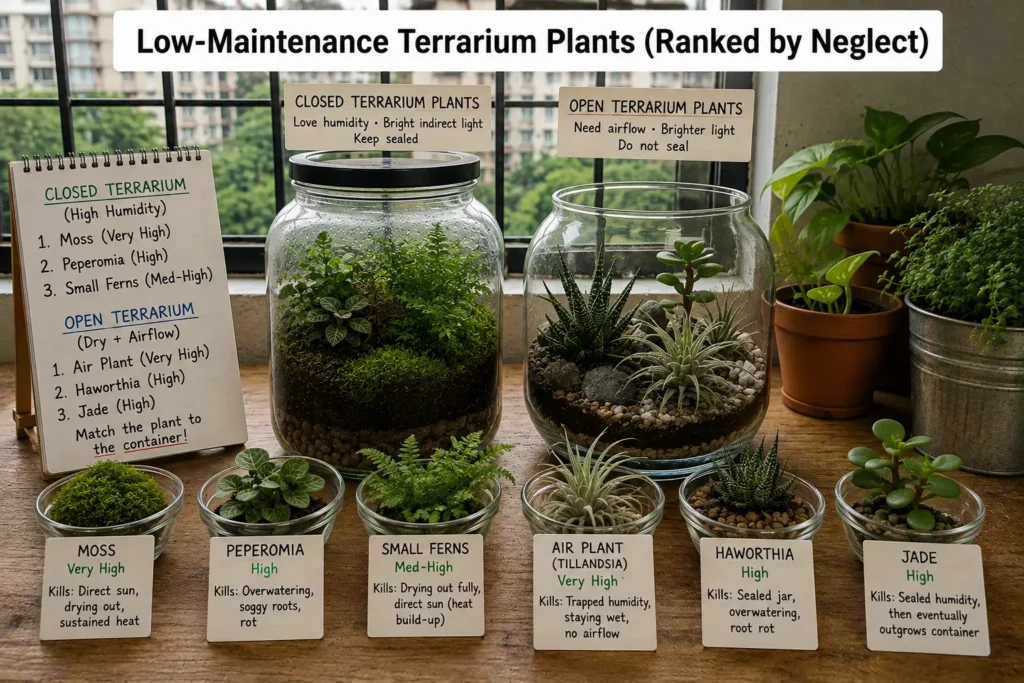
The most forgiving closed-terrarium plants (ranked)
These want a sealed or mostly-sealed jar with high humidity and bright indirect light. Ranked from most to least neglect-tolerant.
| Plant | Neglect tolerance | Stays small? | What kills it |
|---|---|---|---|
| Moss (cushion, sheet) | Very high | Yes | Direct sun, drying out, sustained heat |
| Peperomia (small types) | High | Yes | Overwatering, soggy roots, rot |
| Button / small ferns | Medium-high | Mostly | Drying out fully, direct sun cooking the jar |
1. Moss. Moss is the most forgiving thing you can put in a closed terrarium. It has no true roots to rot, it drinks humidity straight from the air, and in a sealed jar it can go a long time between any attention. What kills it is not neglect, it is the wrong spot: direct sun cooks it brown, a jar left to dry fully turns it crisp, and a hot windowsill in a tropical room bakes it. Keep it in bright indirect light, keep a little condensation on the glass, and moss largely runs itself. If yours is browning, that is almost always too little light or too little moisture, and it usually greens back up once you fix the spot.
2. Peperomia. Small peperomia varieties are compact, tolerate lower light, and hold water in their thick leaves, so a missed watering does not faze them. In a closed terrarium the danger flips: the usual killer is too much water, not too little. Sitting in soggy substrate rots the stems from the base. Plant it high in a well-draining layer, let the sealed humidity do most of the watering, and resist the urge to add more.
3. Small ferns. Once established in a humid closed jar, small ferns like button fern need very little from you, because the trapped moisture is exactly what they want. They are one rank lower only because they are less drought-forgiving: if the jar dries out, or if direct sun turns the glass into an oven, fronds crisp fast and do not always recover. In a sealed, shaded jar, though, a small fern is close to self-sustaining. For a fuller shortlist of what thrives in a sealed jar, see the best plants for a closed terrarium.
The most forgiving open-terrarium plants (ranked)
These want an open container with airflow, drier substrate (or no substrate at all), and brighter light. Do not seal these in a jar.
| Plant | Neglect tolerance | Stays small? | What kills it |
|---|---|---|---|
| Air plant (Tillandsia) | Very high | Yes | Trapped humidity, staying wet, no airflow |
| Haworthia | High | Yes | Sealed jar, overwatering, root rot |
| Jade | High (but grows) | No, outgrows | Sealed humidity, then eventually the container |
1. Air plants (Tillandsia). Air plants need no soil at all, which removes the most common beginner mistake in one move. They pull moisture from the air and an occasional soak, and they will happily sit in an open dish being ignored. The one thing that reliably kills them is trapped moisture: they are epiphytes that must dry out fully and fast after they get wet, so a sealed jar with no airflow rots them, often within a few weeks. Give them an open container, let them dry completely between waterings, and they are about as hands-off as a living thing gets.
2. Haworthia. Haworthia is a small, slow succulent that stays neatly in scale for an open terrarium and stores water in its leaves, so under-watering barely registers. The failure mode is the opposite of a fern: put it in a humid, sealed jar and it rots. Keep it in an open, well-draining setup, water sparingly and only when the substrate is dry, and give it bright light.
3. Jade. Jade is genuinely hard to kill through neglect. I rank it last here only because it does not stay small. It is forgiving for months, then it keeps growing and eventually outscales a small open container. Great starter succulent, just know that “low maintenance” for jade means occasional repotting later, not never touching it.
My pick for an absolute beginner
If you want the single most forgiving choice, start with an open dish of air plants. There is no soil to over-water, no lid to trap rot, no drainage to get wrong, and no substrate layering to learn. You mist or soak them now and then, let them dry, and that is essentially the whole job. It sidesteps every mistake that killed my early builds. Once you trust yourself, graduate to a sealed moss jar, which is the most self-sustaining closed setup and the natural next step from how to build a closed terrarium the tropical-proof way.
The “low maintenance” traps
Some plants get recommended as easy and technically are, until they betray the “low maintenance” promise a few months in. Watch for these:
- Jade and larger succulents: easy to keep alive, but they outgrow a small terrarium and need moving.
- Pothos and ivy: tough and beginner-safe, but vigorous. In a jar they become a trimming job every few weeks, which is the opposite of hands-off.
- Nerve plant (Fittonia): loved for color, but it wilts dramatically the moment humidity dips. In a stable sealed jar it is fine; in an open one it is a fainting drama queen.
None of these are bad plants. They just quietly move maintenance from “watering” to “cutting things back,” and a nervous beginner should know that before committing.
A no-fail starter combo
If you want one setup that survives real neglect, build a closed jar of cushion moss with one small peperomia tucked in. The moss handles the humidity and covers the ground, the peperomia adds a bit of height and holds its own water, both want the same sealed, shaded conditions, and neither races to outgrow the container. It is close to the sealed bottle gardens that ran themselves for decades. Keep it out of direct sun and leave it mostly alone.
Whatever combo you pick, the failure to watch for in a humid climate is mold and fog, not thirst. If white fuzz or heavy condensation shows up, do not panic and do not tear it apart. Diagnose it first with terrarium mold and condensation: read the fog, fix the fuzz.
Sourcing plants cheaply and locally
You do not need a specialty terrarium shop. Moss can often be found locally in shaded, damp corners (rinse it and check for pests before it goes in the jar). Peperomia, small ferns, and haworthia turn up as inexpensive small pots at ordinary nurseries; buy the smallest specimen, since terrarium plants should start tiny. Air plants are widely sold loose and travel well. Buying small is not just about budget: little plants settle into a terrarium far better than big ones crammed in, and they buy you more time before anything outgrows the container.
FAQ
What is the single easiest terrarium plant?
Air plants (Tillandsia) in an open container. They need no soil, tolerate irregular watering, and remove the most common beginner mistakes, as long as they get airflow and dry out fully after watering.
Which terrarium plants survive low light?
Moss, small peperomia varieties, and small ferns all tolerate bright indirect and lower light better than most. Avoid succulents and air plants in genuinely dim spots, since they need brighter conditions.
Do air plants go in an open or closed terrarium?
Open. Air plants are epiphytes that must dry out completely and quickly after they get wet. A sealed, humid jar with no airflow tends to rot them, sometimes within a few weeks.
How do I keep moss from turning brown?
Give it bright indirect light (never direct sun), keep light condensation in a closed jar so it never fully dries, and keep it out of sustained heat. Browning is almost always too little light, too little moisture, or too much heat, and moss often recovers once the spot is fixed.
What is the most forgiving beginner combo?
A closed jar of cushion moss with one small peperomia. Both want the same sealed, shaded, humid conditions, both hold up to neglect, and neither outgrows the container quickly.