
Terrarium Mold and Condensation: How to Fix It

Short answer: white fuzzy mold in a terrarium is common, usually harmless to your plants, and almost always fixable. It means something inside is too wet, too still, or rotting, not that your terrarium is dead. Remove the visible mold with a cotton swab or tweezers, crack the lid to vent for a day, cut back on watering, and take out any dead leaves. Then add springtails to eat whatever is left. As for the glass: if it fogs lightly in the morning and clears by midday, that is a healthy water cycle. Heavy fog that never clears is your warning sign, not the mold itself.
Mold is what kills most first terrariums in a hot, humid room, and it usually shows up within the first few weeks rather than months in. So before you throw anything out, here is what to do when the fuzz appears.
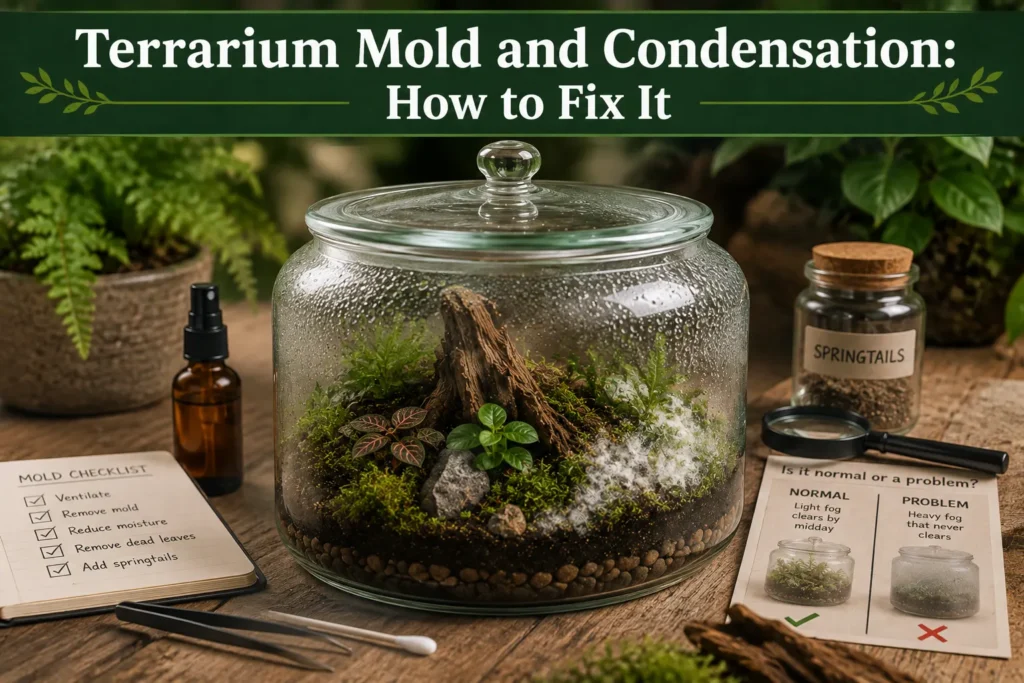
First, do not panic: is it even mold?
Three different white things show up in terrariums, and only one of them is a real problem. Naming what you are looking at is half the fix.
- True mold looks like cotton candy or a fine spiderweb sitting on top of the soil, on driftwood, or on a dead leaf. It is fuzzy, it lifts off the surface, and it spreads over days. This is what we are treating.
- Mycelium is different. These are fine white threads running through the substrate or webbing across a piece of wood, usually growing out of the wood itself. In a bioactive setup with a cleanup crew, mycelium is normal and mostly harmless. It often flushes once, looks alarming, then fades as the little ecosystem settles. Do not tear your whole build apart over it.
- Mineral film is not alive at all. It is a cloudy white haze on the glass, it does not move or spread, and it wipes off with a cloth. It comes from hard tap water drying on the inside of the jar. Annoying, cosmetic, not a health issue.
If it is fuzzy and on your soil or a dead leaf, treat it as mold. If it is threads in the substrate, watch it before you act. If it wipes off the glass, it is just water spots.
Why terrarium mold shows up in the first place
Mold is not bad luck. It is a signal, and it needs the same four things every time:
- Too much moisture. Waterlogged substrate is the number one cause. Most beginners, me included, drown a new terrarium.
- Stagnant air. A sealed jar with no cleanup crew and no gentle exchange traps humidity against every surface.
- Dead organic matter to feed on. A dropped leaf, a bit of dying moss, or a soft rotting stem is a buffet for mold spores that are already floating in your room.
- No cleanup crew. With nothing eating the dead matter, it just sits there and rots.
The first two to three weeks after a build are peak mold season, because the system has not balanced yet. That is exactly when panic sets in. Hold steady.
Reading your condensation: the fog gauge
Condensation confuses people more than mold does, because a little fog is supposed to be there. A closed terrarium is a tiny water cycle: water evaporates, hits the cool glass, and runs back down. Some fog is proof it is working. The question is how much and for how long. Use this as your gauge:
| What you see | What it means | What to do |
|---|---|---|
| Light fog in the morning that clears by midday | Healthy water cycle | Nothing. Leave it sealed. |
| Patchy fog that partly clears through the day | Slightly wet, still fine | Watch it. Vent a few hours if it lingers for days. |
| Heavy fog all day, running droplets, plants hidden | Too much water inside | Open the lid 6 to 12 hours, do not water, wipe the glass. |
| No condensation ever and dry-looking soil | Too dry, or the lid is not sealing | Add a little water and check the seal. |
The mistake is reading light morning fog as an emergency and adding ventilation it does not need. Let the gauge, not your nerves, decide.
Immediate triage: what to do today
Once you have confirmed real mold, act in this order:
- Remove the visible mold. Use a cotton swab, tweezers, or a gloved fingertip to lift it off. Use a fresh swab for each patch so you are not smearing spores around. Take out the moldy leaf or soft stem entirely rather than just wiping it.
- Vent the lid. Take the lid off, or crack it open, for 6 to 12 hours during the day to drop the humidity and let the surface dry a little. Repeat over a few days if the fog is heavy.
- Stop watering. This is the hardest one for worried beginners. If the glass is fogging heavily, your terrarium has plenty of water. Wait until the substrate looks and feels less soaked before you add a drop.
- Wipe the glass. Clear the inside so you can actually see what is happening and spot new growth early.
That combination, physical removal plus venting plus cutting water, resolves most first-time mold before it ever comes back.
Root-cause fixes so it does not return
Triage buys you time. These fixes end the cycle:
- Fix the drainage. If your build skipped a proper drainage layer, water pools at the bottom and keeps everything soaked. A gravel or LECA layer under the substrate gives excess water somewhere to go.
- Rethink the substrate. Garden soil holds too much water and often carries its own spores. A lighter, airier terrarium mix drains better and molds less.
- Prune dead matter on sight. Every dropped leaf and dying stem is future mold food. Removing overgrown or dying plants matters here, and choosing the right species from the start matters even more.
- Add a cleanup crew. Springtails are tiny detritivores that eat mold, decaying leaves, and other organic matter, and they do not harm your living plants. In a sealed terrarium they are the single best long-term mold defense, quietly grazing the surfaces you cannot reach. I now add them to every build from day one.
For the full method that prevents all of this, see my step-by-step guide on how to build a closed terrarium, which bakes drainage and a cleanup crew into the build itself.
The tropical and humid-room adjustment
Here is where most guides fail readers like me. Nearly every popular terrarium article assumes a cool Western room, so their standard advice is “just open the lid to dry it out.” In Dhaka, or any hot, humid climate, that advice is weaker, because the room air you are letting in is already damp. Venting does less, and it does it slower.
If you are fighting mold in a humid room, adjust like this:
- Vent during the driest part of the day, for example in an air-conditioned room or during the least humid hours, so the air you exchange actually carries moisture out.
- Add gentle airflow. A small fan near the open jar for an hour moves stagnant air better than a still open lid does.
- Build drier from the start. Use a slightly thinner substrate, a slightly deeper drainage layer, and less initial water than a temperate guide tells you to. Your ambient humidity is doing some of the watering for you.
- Lean harder on springtails, because passive drying is less reliable in your climate and a living cleanup crew is not.
This tropical reality is the whole reason I started experimenting in the first place, and it is why my first jar molded while the tutorials swore it would be fine.
When to reset and when to save it
You rarely need to start over. Save the terrarium if the mold is on the surface, on a few leaves, or on the wood, and the plants themselves still look alive. That covers the large majority of cases.
Consider a full reset only if the substrate has gone sour and sulfurous (that is anaerobic rot, a different problem from surface mold), the mold keeps returning aggressively after several rounds of triage, or the plants have clearly died and turned to mush. Even then, you can often rinse the hardscape, replace the substrate, and rebuild rather than bin everything.
Preventing it next time
Mold is easiest to beat before it starts. Get the water cycle right, keep a cleanup crew, remove dead matter early, and choose plants that thrive in a sealed, humid jar instead of ones that constantly die back and feed the mold. If you want a shortcut to a lower-drama terrarium, my guides on the best plants for a closed terrarium and on low-maintenance terrarium plants both point you toward species that stay healthy in humidity and give mold far less to eat.
And if you want the cautionary story that started all of this, my post on how I killed my first terrarium in two weeks is exactly the mistake I am trying to save you from.
FAQ
Is white mold in a terrarium dangerous to me or my plants?
For your plants, the common fuzzy white mold in a new terrarium is usually saprophytic, meaning it feeds on dead matter rather than attacking living, healthy plants. It is a sign of imbalance, not an infection to fear. For you, a sealed jar keeps it contained. Avoid deeply inhaling the air when you open a heavily moldy terrarium, and take extra care if you have known mold allergies or asthma. That is general common sense rather than medical advice; anyone with a respiratory condition should ask their own doctor.
Should I throw out a moldy terrarium?
Almost never. If the plants are still alive, remove the mold, vent the lid, stop watering, and add springtails. A reset is only worth it when the substrate has turned to foul-smelling rot or the plants themselves have died off completely.
How much condensation is too much?
Light fog in the morning that clears by midday is healthy and expected. Heavy fog that lasts all day, hides the plants, and drips constantly means there is too much water inside. Open the lid for several hours, hold off on watering, and let it rebalance.
Will springtails get rid of mold on their own?
Largely, yes, over time. Springtails eat mold and decaying organic matter and are the best long-term prevention in a sealed terrarium. They are not an instant fix for a heavy outbreak, though. Remove the worst of the visible mold and cut the moisture first, then let the springtails maintain it.
Can I use cinnamon or hydrogen peroxide on terrarium mold?
Both are popular home remedies, and both should be used lightly and honestly. Cinnamon has mild antifungal properties and can slow surface mold when dusted on a small spot, but it will not fix the underlying moisture problem. Hydrogen peroxide can be dabbed onto a mold patch with a cotton swab as a spot treatment. Do not pour bleach, vinegar, or peroxide across the whole terrarium, because at that scale it can harm your plants and the beneficial microbes in the soil. Fixing the water and airflow always matters more than any spray.