
Terrarium Flooded? How to Drain a Waterlogged Build

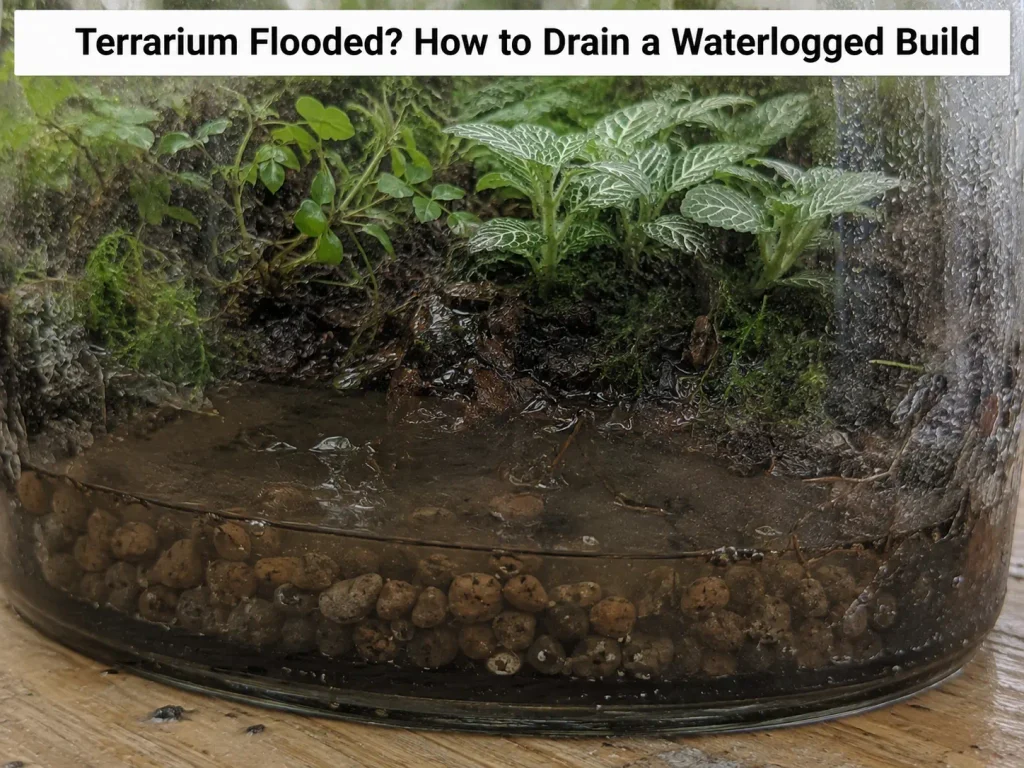
Visible standing water pooled in the gravel, water risen up into the substrate, or a plant sitting with its roots directly in a puddle is a different and more urgent problem than a foggy glass. Fog is a gauge; standing water is an active failure in progress. Remove what you can with a turkey baster, paper towel, or siphon right away, then vent the lid to let the system dry down. The reason this cannot wait: roots sitting in water with no available oxygen begin to fail within days, and the failure compounds the longer the water stays. This is the most urgent single case inside the wider troubleshooting framework this site uses for reading a sealed build.
This is not the condensation problem
If the glass is fogged and the substrate simply looks damp, that is a condensation read, and the too much condensation guide covers reading the fog and correcting it by venting and holding off on watering. This guide is for something more concrete: water you can actually see pooled in the drainage layer, rising up into the substrate above it, or standing around a plant’s roots or crown. The fix here is active removal, not passive venting, and the mechanism at risk is more serious than a foggy view.
Why standing water is dangerous, not just untidy
Plant roots need oxygen from the pore spaces in the substrate around them just as much as they need water. When those pore spaces fill entirely with standing water instead of a mix of water and air, roots lose access to that oxygen. University extension guidance on soil aeration describes this directly: excess soil moisture blocks the movement of oxygen through the substrate and leaves too few water-free pore spaces for roots to draw on, as reported by the UC Statewide IPM Program’s guidance on aeration deficit in home gardens. Deprived of oxygen, roots switch to a less efficient form of respiration that produces damaging byproducts and weakens root tissue, leaving the plant more vulnerable to the water-mold and fungal pathogens that specifically thrive in low-oxygen, saturated conditions.
The substrate itself changes too. Once it turns fully anaerobic, decomposition inside it shifts to a different chemical pathway that produces a sour, sulfurous smell rather than the earthy smell of healthy, aerobic breakdown. That smell, covered in more depth in the terrarium smells bad guide, is one of the clearest signs that standing water has already been sitting long enough to change the substrate’s chemistry, not just its moisture level.
Triage by how bad it actually is
Not every case of standing water needs the same response. Work out which of these you actually have before acting.
| What you see | Severity | What to do |
|---|---|---|
| Shallow water in the gravel or LECA layer only | Normal | Nothing. Note it, hold off on more water for a while. |
| Water risen into the substrate above the drainage layer | Act on it | Move to active removal below. |
| Water pooling at a plant’s crown or roots visibly sitting in it | Urgent, same day | Remove water immediately, then assess plant damage. |
How to physically remove the water
Work from the least invasive method up, stopping as soon as the water is gone.
Wicking with a paper towel. For water sitting on or just below the substrate surface, press a folded paper towel gently onto the wet area and let it draw the water up by capillary action. Repeat with a fresh section as it saturates. This is slow but disturbs nothing.
Turkey baster or a small siphon. For water pooled in the drainage layer or in a low corner of the container, a turkey baster reaches down between the substrate and the glass to draw water out directly, without needing to lift or disturb the substrate itself. This is the standard method for a build with a false bottom or a visible gravel layer.
Careful tilting. For a small, lightweight container with water genuinely pooled at one low point, tilting it gently to encourage the water toward a corner where it can be drawn out with a baster can help, but this risks shifting hardscape and substrate in a larger or heavier build, so it is a method for small jars rather than large enclosures.
A drilled drain, as a longer-term fix. For a build that floods repeatedly, drilling a small hole near the base and fitting it with a simple bulkhead or valve gives excess water somewhere permanent to go rather than relying on manual removal each time. This is a bigger intervention and worth doing only once the immediate flood is dealt with and the pattern of repeated flooding is confirmed rather than a one-time mistake.
After the water is out
Vent the lid for several hours to let surface moisture continue to drop, and hold off on any further watering until the substrate visibly looks less saturated, which may take several days. Check for the sour, drain-like smell described above; if it is present, the substrate has likely already gone anaerobic in places and removing the standing water is the first step rather than the whole fix; continued venting and, in some cases, replacing the worst-affected substrate may be needed. Watch any plants that had roots directly in the water more closely than the rest of the build over the following week, since they carry the most accumulated stress.
How this usually happens
Standing water is rarely a mystery once traced back. The most common cause is a single heavy watering, either at planting or as a “just in case” top-up, that exceeded what the drainage layer and substrate could hold. A close second is a drainage layer that was undersized or skipped for the container’s size; the drainage layer guide covers how much a given jar actually needs. A denser, more moisture-retentive substrate mix than the build calls for can also hold water higher than expected, effectively shrinking the usable drainage capacity underneath it.
When it is past saving
Most flooded terrariums recover once the standing water is removed and the system is given time to dry down. It becomes a harder call when the substrate has gone fully sour throughout, not just in one pocket, or when plant roots and crowns have been sitting in standing water for an extended period before the flood was noticed. In those cases, a partial or full rebuild, replacing the worst of the substrate and reassessing which plants are still viable, is often more honest than continuing to chase a fix in a build that has already turned anaerobic throughout. The reviving a dying terrarium guide covers how to judge what is worth saving once the immediate water has been dealt with.
What not to do
Do not add anything to “balance out” the excess water, such as more substrate or absorbent material poured in on top. It does not remove the water that is already there and can trap it further from the air.
Do not leave the lid off indefinitely as the fix. Venting is a targeted correction. A closed terrarium left open stops functioning as one, and the plants inside it were chosen for consistently high humidity.
Do not ignore the smell test. A sour or drain-like smell after removing standing water means the substrate chemistry has already shifted, and that needs a different response than moisture level alone.
Do not wait to see if it resolves on its own once you can see standing water rather than just fog. Fog can be watched. Standing water is already acting on the roots.
FAQ
How do I know if my terrarium is actually flooded or just has normal condensation? Condensation is fog on the glass; flooding is water you can see pooled in the drainage layer, risen into the substrate, or standing around plant roots. If you can see actual liquid water sitting somewhere it should not be, treat it as flooding, not condensation.
Can I use a turkey baster to remove water from a terrarium without taking it apart? Yes, this is the standard method for water pooled in a drainage layer or a low corner. Work the tip down along the glass to reach the pooled water without disturbing the substrate above it.
Is it safe to tip my terrarium to pour water out? For a small, light container, gentle tilting toward a corner can help concentrate water for easier removal. For a large or heavy build, tilting risks shifting hardscape and substrate, so a baster or siphon is the safer choice.
How long can roots sit in standing water before real damage happens? Damage accumulates the longer roots are deprived of oxygen rather than at a single fixed point, so there is no safe countdown. Treat any standing water around roots as worth acting on the same day rather than waiting to see how the plant responds.
Should I drill a drain hole in my terrarium? Worth considering only if flooding keeps happening in the same build despite correcting the watering amount and drainage layer size. For a one-time flood, manual removal and a review of what caused it is usually enough on its own.