
Building a Terrarium in a Humid Climate

Nearly every terrarium guide online tells you to trap moisture, mist more, and seal tighter. That advice assumes your room starts dry. In a hot, humid climate, where ambient relative humidity regularly sits above 80 percent during the wet season, the room is not the problem to solve, it is already most of the way to the terrarium’s target condition before the lid goes on. The job changes from building humidity into a dry system to managing a system that starts saturated. That single inversion, more than any single ingredient or product, is what most Western-written build guides miss entirely.
The advice that is backwards for your room
Search “terrarium humidity” and the results converge on the same handful of instructions: mist more, seal tighter, add a humidifier, use more sphagnum moss to hold moisture. Every one of those instructions is written for a room somewhere around 40 percent relative humidity, a cool Western house with central heating or air conditioning running most of the year. Follow that advice in a room that is already at 80 percent or higher, and the “fix” pushes the system further toward the failure mode it was meant to prevent: a sealed jar with too much water and nowhere for it to go.
This is not a small nuance. It is the reason a first attempt at a closed terrarium, built by the book from a guide written for a different climate, can mold out within two weeks while the guide swears the method is foolproof. It is not the method that fails. It is the assumption underneath it.
Why this matters more than people think
Mold is not an occasional risk in a humid-climate build, it is close to the default outcome if the build is not adjusted for it. A sealed glass jar traps whatever moisture goes in with the substrate, the plants, and the air itself at the moment of sealing. In a room already running warm and wet, every one of those inputs starts higher than a temperate-climate build guide expects. Add the standard “generous mist” instruction on top of that starting point, and mold has every condition it needs from day one: moisture, warmth, and organic matter to feed on.
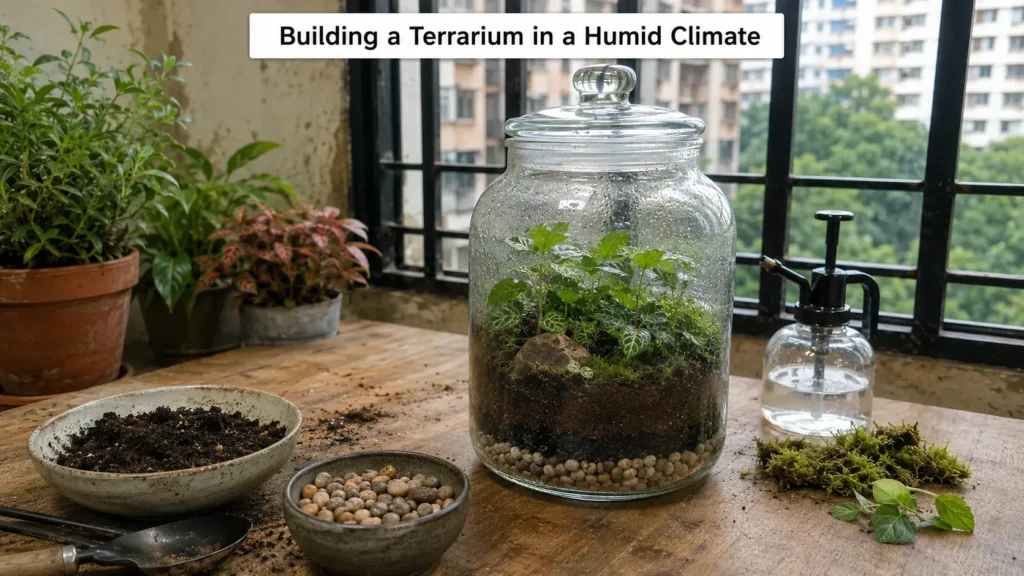
What changes in the build itself
Three adjustments matter most when the ambient air is already humid:
- Start drier. Where a temperate guide recommends a generous first mist, a humid-climate build should aim for noticeably less water at the substrate stage. The ambient air will contribute moisture to the sealed system over the following days regardless of how little is added at planting. The first watering piece has the concrete test for how much is actually enough.
- Build in more drainage margin. A drainage layer sized at the upper end of the recommended range, rather than the minimum, gives excess moisture somewhere to go instead of pooling against the substrate. See terrarium layer depths by jar size for the ratio.
- Treat organic hardscape with more caution. Driftwood, bark, and other found organic material carry more ambient mold pressure before they ever go into a sealed jar in a humid climate, simply because the surrounding air already has more moisture and airborne spores available to colonize a damp surface. Sterilizing the jar and substrate covers the prep work that matters more here than in a drier climate.
The break-in period in a humid room
The general advice, open the lid until the fog on the glass clears, then close and re-check, works everywhere, but “until the fog clears” takes on a different meaning when the room supplying that fresh air is already carrying significant moisture. Venting a sealed jar by opening it to a room that is itself at 85 percent relative humidity removes less excess moisture per hour than venting to a 40 percent room does. Practically, that means the break-in period in a humid climate often needs longer or more frequent venting sessions to reach the same “light morning fog that clears by midday” balance point that a temperate build reaches faster. The full break-in schedule walks through the day-by-day version; the adjustment here is patience and repetition, not a different method.
Ventilation and airflow around the terrarium, not just inside it
Venting the lid only solves half the problem if the terrarium then sits in a corner of a room with no air movement at all. Stagnant air around a jar in a humid room means the air being exchanged during venting is not being replaced quickly, so each vent session does less work than it would with even mild airflow nearby, such as a fan angled past the jar or a spot near a window that gets a cross-breeze. This does not need to be elaborate: the goal is that the room air around the terrarium is actually turning over, not sitting as still and saturated as the terrarium’s own internal air.
Signs you are losing the fight against ambient humidity
A build that is struggling against its climate rather than working with it usually shows a specific pattern: heavy condensation that never clears to a light morning fog no matter how long the vent sessions run, a persistent damp smell even after visible mold has been removed, or organic hardscape that develops fuzz again within days of being cleaned. When that pattern shows up repeatedly, the fix is rarely “vent once more.” It is usually one of the structural adjustments above, deeper drainage, a drier starting substrate, or better airflow around the jar, applied together rather than one at a time. If mold has already taken hold, the full troubleshooting guide for mold and condensation covers the identification and removal steps in detail.
FAQ
Should I use less water than a guide recommends if my room is already humid?
Yes. Standard first-watering guidance is written for drier rooms. In an already-humid climate, aim for the lower end of any recommended range, since the ambient air will add moisture to the sealed system on its own over the following days.
Does a closed terrarium even make sense in a humid climate, or should it stay open?
A closed terrarium can absolutely work in a humid climate; it just needs the adjustments above rather than the standard build. An open terrarium is a genuinely reasonable alternative if managing excess moisture feels like more upkeep than wanted. See open vs closed terrarium for the full comparison.
How is monsoon season different from year-round humid conditions?
Monsoon season typically pushes ambient humidity higher than the already-elevated year-round baseline in a tropical climate, and it can persist for weeks without a dry stretch to vent into. Builds started or maintained during that window may need extra drainage margin and more frequent venting than the same build during a comparatively drier month.
Can air conditioning in the room change any of this?
Air conditioning generally lowers a room’s ambient humidity while it runs, which can make venting more effective during those hours. It is not a substitute for the structural adjustments above, since a terrarium in an air-conditioned room during the day but a humid room overnight still needs the drainage and substrate margin built for its harder hours, not just its easier ones.