
Everything Died in Two Weeks: The Post-Mortem Checklist

This is not a rescue guide. If there is anything green left in your jar, you are in the wrong article and you want the terrarium troubleshooting pillar instead.
This one is for the build where it is all gone. Every leaf brown, nothing firm, and a jar you are about to empty into the bin. Before you do, it is worth twenty minutes, because a dead terrarium is unusually honest about what killed it and the evidence disappears the moment you tip it out.
Two weeks is the classic window, and there are only about five things that kill a build that fast. Each leaves a different mark.
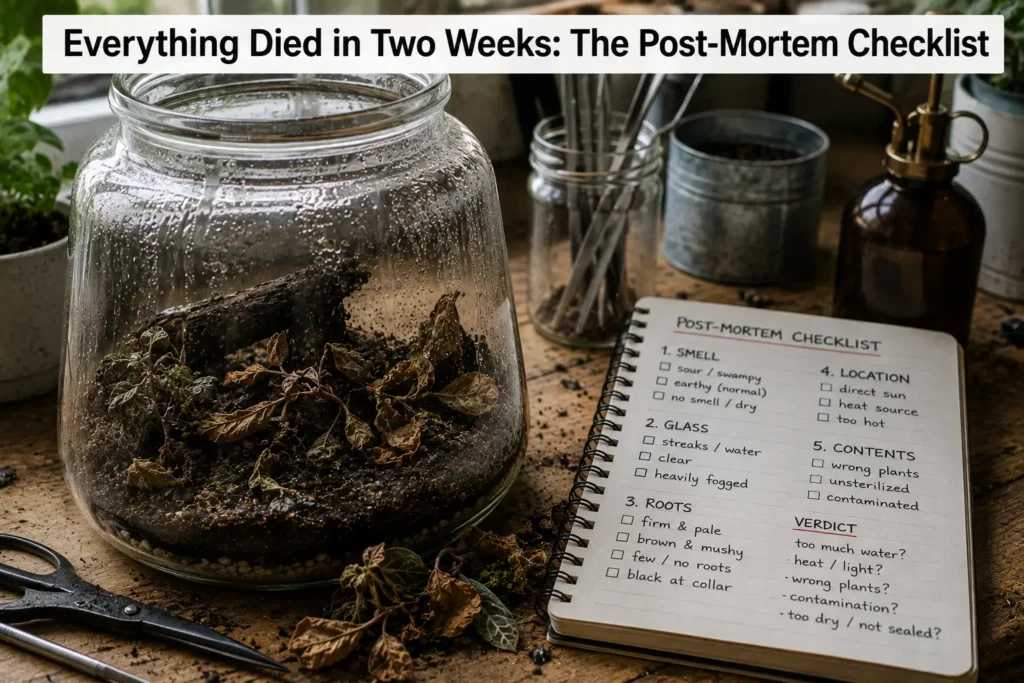
First, Open It and Use Your Nose
Do this before you look at anything, because the smell changes within minutes of opening.
Sour, swampy, or like a drain. That is anaerobic decay in the substrate, which means water sat in the bottom with nowhere to go and the bacteria that took over do not need oxygen. This is the most common two-week death and the most preventable. The full version of that diagnosis is in why a terrarium smells bad.
Earthy and mushroomy but not unpleasant. Normal. That is not what killed it, and you should keep looking.
Almost nothing at all, and the substrate is light and dry to the touch. Then you are looking at the opposite problem, and you can skip most of what follows.
Second, Look at the Glass Before You Wipe It
The condensation pattern from the last few days is still readable.
Water running down the inside in visible streaks, or pooled at the bottom. Too much water in the system, and combined with a sour smell it is the whole answer. What that looks like while it is happening is in too much condensation.
Completely clear glass, no fogging anywhere. A closed terrarium with no condensation is not sealed, or has nothing left alive to transpire. If it was clear from early on, the build dried out. No condensation covers how to tell those apart.
Fogged so heavily you could never see in. That is a sealed jar that was too wet from day one, usually because it was watered like a houseplant rather than a closed system.
Third, Dig Out One Plant and Look at the Roots
This is the single most informative thing in the whole post-mortem, and people skip it because the plant is obviously dead.
Pull one out gently and look at the roots against the light.
| What the roots look like | What it means |
|---|---|
| Pale, firm, still holding their shape | The roots outlived the leaves. Something above the substrate killed it: heat, light, or the plant was wrong for a sealed jar. |
| Brown, soft, sliding off between your fingers | Root rot. The kill happened below the surface and the leaves were a symptom. |
| Barely any roots at all, short and stubby | It never established. Either it was planted into substrate it could not root into, or it died before it had the chance. |
| Blackened right at the substrate line, roots fine below | Stem rot at the collar, usually from a leaf or stem buried too deep and staying wet. |
Firm roots and dead leaves point in a completely different direction from mushy roots, and confusing the two is why so many second builds die the same way as the first. The rot version is described in more detail in terrarium leaf rot.
Fourth, Check Where It Was Sitting
Go back to the spot and think about the last two weeks rather than about right now.
Direct sun at any point in the day is the fastest killer on this list. A sealed glass jar in sunlight is a greenhouse with no vents. It does not need to be sunny all day; an hour of direct afternoon sun through a window is enough to cook the inside, and the plants will look scorched and collapsed rather than rotted.
The tell is that the damage is often worse on the side that faced the window, and the leaves nearest the glass are the worst affected. Roots stay firm, because the roots were the last thing to die.
A radiator, a heat vent, or the top of an appliance does the same thing more slowly.
Fifth, Ask What You Put In There
Two questions, and they account for most of the deaths that are not water or heat.
Were the plants suited to a closed jar? Succulents and cacti die reliably in sealed terrariums, usually inside two weeks, and they die of rot in an environment that is doing exactly what it is supposed to do. This is not a build failure, it is a plant choice failure, and it is extremely common because succulents are what most shops sell as terrarium plants. What actually survives is in best plants for a closed terrarium and low maintenance terrarium plants.
Did anything come in from outside unsterilized? Garden soil, moss lifted from a wall, wood picked up on a walk. All of them bring in fungi and larvae that behave very differently once sealed in a warm humid box with no predators. Sterilizing the jar and substrate is the step that gets skipped most often, and mold blooms in the first two weeks are the usual result. Telling harmless mold from the kind that signals a real problem is in terrarium mold identification.
Reading the Verdict
Put the five answers together and the cause is usually obvious:
- Sour smell plus wet glass plus mushy roots. Too much water, no working drainage. The next build needs a proper drainage layer and a much lighter first watering.
- Firm roots plus collapsed, bleached leaves plus a sunny windowsill. Heat. Move the next one, and nothing else needs to change.
- Rot on succulents. Wrong plants. The build was probably fine.
- Mold everywhere from week one plus wild-collected material. Contamination on the way in.
- Dry substrate, clear glass, crisp brown leaves. It was never sealed properly or never watered enough to start the cycle.
It is worth writing down which one it was, because the second build usually dies of the same thing when nobody names the first cause out loud.
Before You Rebuild
Two things are worth knowing so the next one does not worry you unnecessarily.
A new terrarium does not look settled for weeks. Some leaf drop, some yellowing and a burst of mold in the first two weeks are normal rather than a repeat of the disaster, and the difference is covered in how long a terrarium takes to stabilize and the break-in schedule.
The most common overcorrection is underwatering the next one. Having drowned a build, people go dry, and then the second one fails in the opposite direction. The first watering gives an actual amount rather than a feeling.
When you are ready, the step-by-step first build starts from an empty jar.
The Short Version
- Do the post-mortem before you empty the jar. The evidence goes with the substrate.
- Smell first, glass second, roots third. Those three answer most cases.
- Firm roots with dead leaves means heat or light. Mushy roots means water. They lead to opposite fixes.
- Succulents in a sealed jar are not a failed build, they are the wrong plant.
- Name the cause in one sentence before you start again, or the next build tends to die the same way.