
Glass vs Plastic Terrarium Containers: What Plastic Actually Costs You

Plastic is cheaper, lighter, will not shatter and is easier to find in large sizes. Those are real advantages and they are the reason the question keeps coming up.
Plastic works. It costs you four things, and three of them only show up months later, which is why most comparisons of this get it wrong: they weigh purchase price against a failure that has not happened yet.
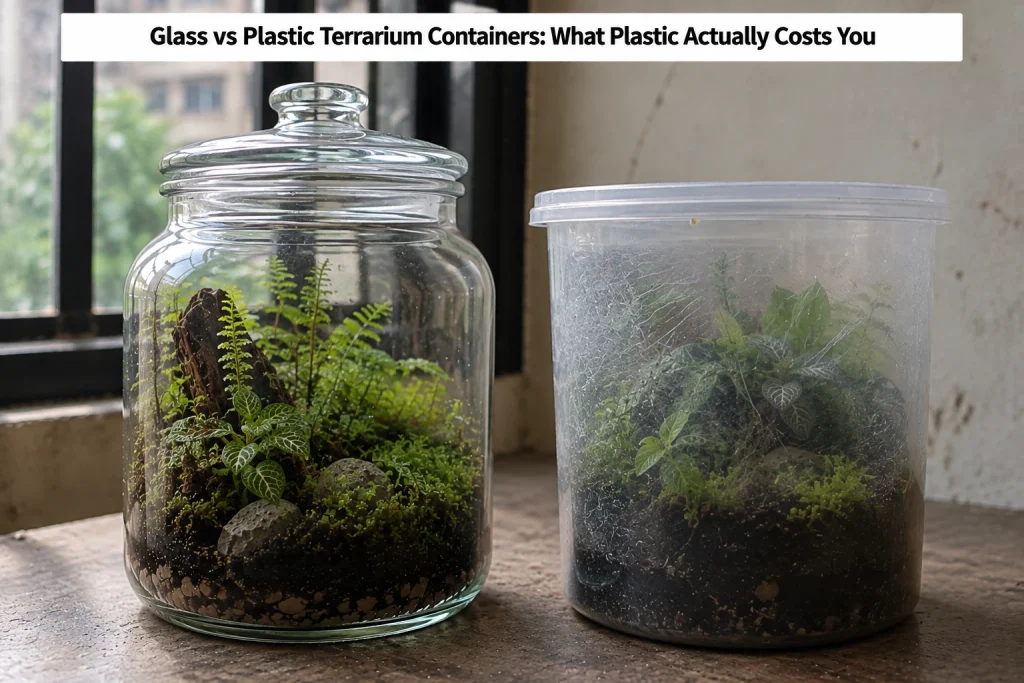
“In my side-by-side builds here, glass wins for anything I expect to keep and inspect for years, while plastic earns its place when weight, size, or breakage matters more. One extra cost I watch for with plastic is cleaning itself: conservation guidance notes that acrylic can build static charge when wiped, attracting more dust, while uncoated plastics scratch more readily than glass. That creates an awkward cycle where a surface that needs more cleaning is also less tolerant of repeated cleaning, which is another reason I prefer glass for a long-term display terrarium.”
The four costs
1. It hazes, and it does not come back
This is the decisive one. Clear plastic clouds over time. Sunlight, heat, cleaning, and the abrasion of ordinary handling all contribute, and the change is gradual enough that you do not notice until you compare it with something new.
Glass does not do this. A glass jar that looks cloudy is dirty, and dirt comes off; the causes and the fixes are on cloudy terrarium glass. A hazed plastic container is permanently changed and no amount of cleaning restores it.
That matters for two reasons beyond looks. Less light gets to the plants, and you can no longer inspect the build properly, which is how mold, rot and pests get caught early.
2. It scratches
Every wipe with anything slightly abrasive leaves marks. Every tool that touches the inside wall leaves marks. Over a year of maintenance a plastic container accumulates a haze of fine scratches on both faces, and each one catches film and holds algae, which makes the surface harder to keep clear. The algae side of that is on algae on the glass.
3. It cannot be sterilized the same way
Sterilizing the container before you build is not optional in a sealed system, because anything living that starts inside has an uninterrupted run at it. The method is on sterilizing the jar and substrate.
Heat is the standard tool, and most plastics will not take it. They warp, cloud or deform. That leaves chemical methods on a material that is more porous and more scratched than glass, which is a less reliable starting point.
If you use plastic, sterilize by whatever method the material tolerates, and accept that you are starting from a slightly less clean position.
4. It insulates differently, and in a hot climate this matters
Glass and plastic conduct heat differently, and the container’s thermal behavior is part of the build.
Condensation forms where the glass is cooler than the air inside, so how quickly a container sheds heat to the room affects where and how much condensation appears. A plastic container behaves differently from glass here, and the pattern you learn to read on one will not transfer exactly to the other.
In a warm climate the direction that matters is heat retention, and a container that holds heat is a container that runs warmer inside than the room. That is the same climate consideration that runs through building in an already-humid room, where the temperate advice about maximizing light and warmth is already the wrong instruction.
What plastic is genuinely better at
Not a one-sided argument.
Weight. A large glass container full of wet substrate is heavy, and a large plastic one is not. For anything above a certain size this is the difference between a build you can move and one you cannot.
Safety. It will not shatter. In a home with young children, or on a high shelf, that is a serious consideration and it may simply settle the question.
Availability in large sizes, cheaply. Big clear plastic containers are common and big glass ones are expensive.
Shipping and moving. Nothing to break.
The middle answer nobody mentions
Glass container, plastic or acrylic lid.
Most of the disadvantages above apply to the walls you look through and clean. The lid is not a viewing surface and is rarely scrubbed, so a sheet of acrylic over a glass vessel gives you a light, unbreakable, easily cut cover with none of the visibility cost.
That is a genuinely good combination and it is what a lot of open-topped vessels end up with.
Choosing
Choose glass when the build is a display you will keep for years, when you want to inspect it easily, when it will sit in good light, and when the size is manageable.
Choose plastic when the container needs to be large and liftable, when breakage is a real risk in your household, or when this is a first experiment you may not keep. A plastic first build is a perfectly sensible way to find out whether you enjoy the hobby.
And be honest about the timescale. A plastic container is fine for a season and shows its age over years. If you already know you want the build to outlive that, buy the glass.
One thing to check before using any reclaimed container
Whichever material, this applies:
Do not use a container whose previous contents you cannot identify. A sealed terrarium has no way of getting rid of anything, so any residue is in the system permanently. Food containers are fine. Anything that held a solvent, a cleaner or something unlabeled is not worth the saving, and this matters more for plastic than for glass because plastic absorbs and holds residues that glass does not.
FAQ
Can a terrarium be built in plastic at all? Yes. Plastic works, and it is cheaper, lighter, unbreakable and easier to find in large sizes. What it costs you is haze, scratching, a harder sterilization job and different thermal behavior, and three of those four only show up months after you build.
Can hazed plastic be cleaned back to clear? No. A glass jar that looks cloudy is dirty, and dirt comes off. A hazed plastic container has been permanently changed by sunlight, heat, cleaning and ordinary handling, and no amount of cleaning restores it. Less light reaches the plants and you can no longer inspect the build properly.
How do I sterilize a plastic container? By whatever method the material tolerates, and heat is usually not it, because most plastics warp, cloud or deform. That leaves chemical methods on a surface that is more porous and more scratched than glass. Sterilizing is not optional in a sealed system, so accept that plastic starts from a slightly less clean position.
Which should I use for a large build? Weight and breakage usually decide it. A large glass container full of wet substrate is heavy, a plastic one is not, and above a certain size that is the difference between a build you can move and one you cannot. Plastic also will not shatter, which can settle the question on its own in a home with young children or on a high shelf.
Is there a way to get both? A glass container with a plastic or acrylic lid. The disadvantages of plastic apply to the walls you look through and clean, and a lid is neither a viewing surface nor something you scrub, so an acrylic sheet over a glass vessel gives you a light, unbreakable, easily cut cover with none of the visibility cost.
What this page does not publish
No brands, no product names and no prices. We have bought nothing.
No claim about which specific plastics are safe or unsafe for plants. That would require testing we have not done and a source we did not find.
No haze or scratch timelines. We have measured nothing and no source publishes a figure.