
Container Size: How Small Is Too Small for a Closed Terrarium?

You have a jam jar and a fern and a reasonable question: is this going to work, or is it doomed?
We are not going to give you a minimum volume, because no source publishes one. Search for it and you will find numbers, and following them back leads to other pages repeating them rather than to anything measured. So instead of an invented figure, here is what actually sets the floor, so you can look at the jar in your hand and judge it.
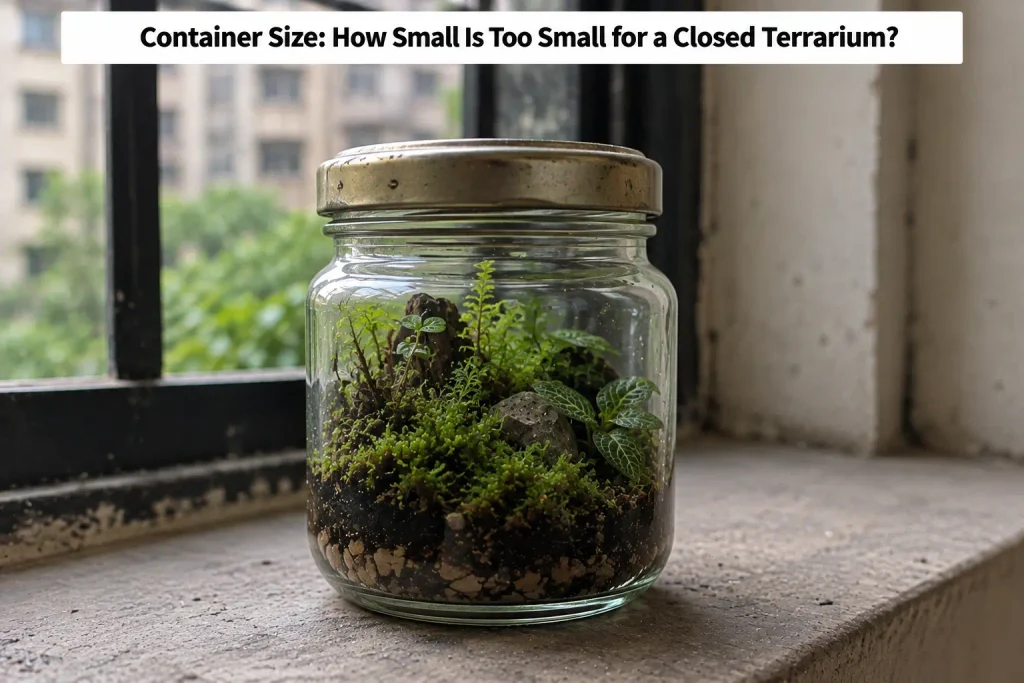
“I judge a small jar by whether there is still enough room for proper layers, usable air space, and future plant growth rather than by a minimum volume number. I keep the planting restrained, usually moss or one genuinely small, slow-growing plant, because every extra plant or piece of hardscape steals space the system needs. I also treat small jars as less forgiving, not easier: with less substrate and water mass, the same small watering mistake represents a much larger change to the whole system, so placement and restraint matter even more than they do in a larger build.”
Four things get harder as the container gets smaller
1. The layers do not scale down
A closed build is a stack: drainage, a separation layer, substrate, then the plant, then air above it. Each layer has a minimum useful thickness that does not shrink with the jar.
A drainage layer thinner than the water it is supposed to hold is decoration, and what it is for is on the drainage layer. A substrate layer too shallow for roots is a pot that is too small.
In a small jar the stack takes almost all of the height, and what you end up with is substrate to the brim, a plant touching the lid, and no air. How the proportions change with size is on layers by jar size, which is the page to read before committing to something small.
2. Air volume is where the water cycle happens
The empty space above the planting is not spare room, it is part of the machine. Water evaporates into it, moves through it, and condenses on the glass around it.
Squeeze that space and the cycle gets abrupt. Instead of a gentle daily fogging and clearing, a very small jar goes from clear to completely fogged and back, which makes it harder to read and harder to correct. What a healthy pattern looks like is on too much condensation.
3. A small volume cannot buffer anything
This is the real reason small builds fail, and it is not about the plant at all.
A large jar has thermal mass. It warms slowly, cools slowly, and rides out a warm afternoon. A small jar has almost none, so it tracks the room, and if it catches sun it heats fast with nowhere for the heat to go.
Water behaves the same way. In a small build, a slightly too-generous watering is a much larger proportional error, and in a sealed container there is no drainage to correct it.
Small builds are less forgiving in every direction at once, which is exactly the opposite of how they are usually sold: as the easy beginner option.
4. You cannot get your hand in
Practical rather than physical, and it decides whether you will maintain the thing. Planting, pruning, removing a dead leaf and cleaning glass all happen through the opening, and a small jar usually has a small opening.
What is actually possible in a small jar
Small builds work. What changes is what goes in them.
A moss-only build is the honest small-jar answer. Moss has no deep root system, does not outgrow the space, and tolerates the swings a small container produces. The smallest builds that survive long term are almost always moss.
One small plant, not three. A tiny jar planted with a community is a jar where the community will fight within months.
Slow growers, not vigorous ones. Anything that grows quickly will be pressed against the glass in weeks, and choosing for restraint is the same logic as low-maintenance terrarium plants.
No large hardscape. A stone or piece of wood in a small jar is volume you no longer have.
The honest test, in place of a number
Look at your container and ask four questions.
- Can I fit the layers and still have real air space above the planting? If the stack fills most of the height, it is too small for what you are planning.
- Can I get a hand or a tool in, and out, without wrecking things?
- Where will it live? A small jar in a warm or bright spot is the failure case, because it has no buffer. A small jar in a stable, cool, indirect position is a much better prospect than its size suggests.
- Am I planting for this jar, or for a jar I wish I had? Most small-build failures are plant choices, not container choices.
Where the floor genuinely is
There is a point below which a closed system stops being a system, and it is where there is no meaningful air volume for water to cycle through. At that point you have a sealed container of wet soil with a plant in it, and it will behave like one: no cycle to read, no buffer, and a fast route to either sodden or dried out.
Where exactly that point falls depends on the shape as much as the volume, which is another reason a single number would mislead. A tall narrow jar and a wide shallow one of identical volume behave differently, because the glass area available for condensation and the depth available for layers are both different.
The alternative worth considering
If the jar is very small, run it open rather than closed. An open build has no water cycle to fit into the air space, so the volume constraint largely disappears, and you water it by hand like any small planting. That is a different system with different failures rather than a compromise, and it may be the honest match for the container you actually have.
FAQ
What is the minimum size for a closed terrarium? No source publishes one, and the pages that give a figure cannot tell you where it came from. Use the test instead: can you fit the layers and still have real air space above the planting, can you get a hand or a tool in and out, is the spot stable and out of sun, and are you planting for this jar rather than for one you wish you had.
Are small terrariums easier for beginners? No, and this is the reverse of how they are usually sold. A small jar has almost no thermal mass, so it tracks the room and heats fast if it catches sun, and a slightly too-generous watering is a much larger proportional error with no drainage to correct it. Small builds are less forgiving in every direction at once.
What can I actually plant in a jam jar? Moss is the honest small-jar answer, since it has no deep root system, does not outgrow the space and tolerates the swings a small container produces. Otherwise one small plant rather than three, a slow grower rather than a vigorous one, and no large piece of wood or stone, because hardscape is volume you no longer have.
Does the jar’s shape matter as much as its volume? Yes, which is another reason a single number would mislead. A tall narrow jar and a wide shallow one of the same volume behave differently, because the glass area available for condensation and the depth available for layers are both different.
My container is very small. Is there an alternative to sealing it? Run it open. An open build has no water cycle that has to fit into the air space, so the volume constraint largely disappears and you water it by hand like any small planting. That is a different system with different failures rather than a compromise.
What this page does not publish
No minimum volume, height or diameter. No source publishes one for a sealed planted container, and the pages that give you a figure cannot tell you where it came from.
No plant list by jar size, because it depends on the plant’s growth rate more than on the numbers.
No product names. We have bought nothing.