
Terrarium Drainage Layer: Gravel or LECA

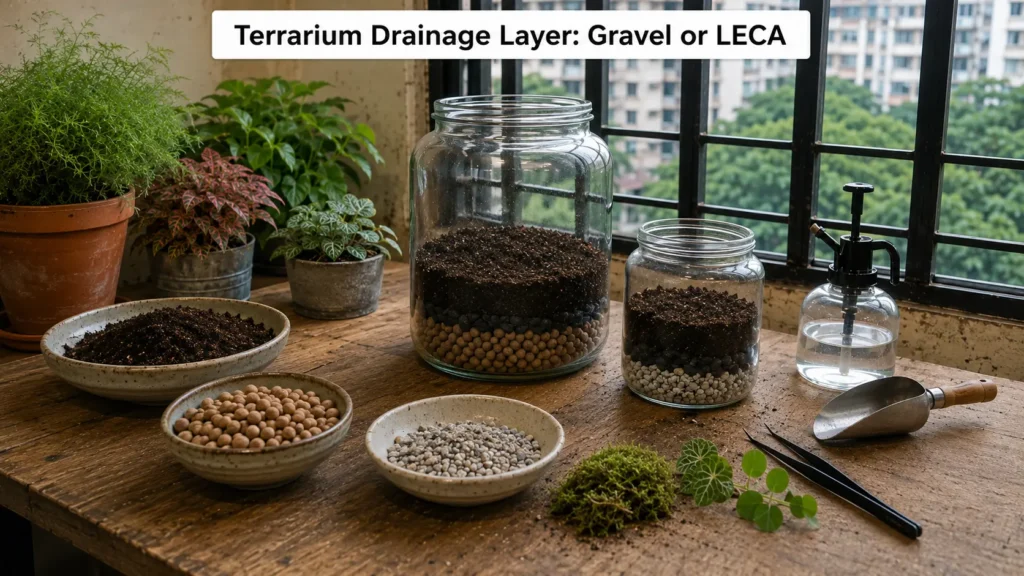
A drainage layer gives excess water somewhere to collect below the root zone in a sealed jar with nowhere else for that water to go. Skip it, and water pools directly in the substrate, roots sit in standing moisture, and anaerobic rot follows within weeks. Gravel provides purely structural drainage at low cost; LECA (lightweight expanded clay aggregate) is lighter and absorbs roughly 15 to 20 percent of its own weight in water, which buffers moisture swings rather than just channeling water downward. Both work; the right one depends on budget, what is already on hand, and the container’s size.
What the drainage layer is actually for
A closed terrarium has no drainage holes, so every drop of water that goes in stays inside the system permanently, cycling between the substrate, the air, and the glass through evaporation and condensation. Without a reservoir at the bottom, that water has only one place to sit: directly in the substrate around the roots. A drainage layer creates a physical gap below the root zone where excess water can collect and later be reabsorbed slowly, rather than sitting against roots that need periods of relative dryness to stay healthy.
What happens if you skip it
Skipping the drainage layer does not cause an immediate problem, which is exactly why it is tempting to skip. The failure develops over one to a few weeks: water added at planting and through the ongoing water cycle has nowhere to go but the substrate itself, which gradually becomes saturated. Roots sitting in saturated, oxygen-poor substrate stop functioning properly and begin to rot. Anaerobic bacteria that thrive in that low-oxygen, waterlogged environment produce the sulfurous, rotten-egg smell that signals a terrarium has gone seriously wrong, well past ordinary surface mold. This is the standing-water failure mode, and it is one of the more serious problems a build can develop, since it is harder to reverse than surface mold once it sets in.
Gravel: pros, cons, when to use it
Gravel (including clean aquarium gravel) is inexpensive, widely available, and provides straightforward structural drainage: water passes through it and collects below, with no additional moisture-holding behavior. Its main drawback is weight; a deep gravel layer in a large container adds significant mass, and gravel offers no buffering if the substrate above it dries out, since it does not release stored moisture back upward the way LECA does. Gravel is a reasonable default when budget is the main constraint or when a build already tends toward excess moisture, such as a build in an already-humid climate, where extra moisture buffering is the last thing the system needs.
LECA: pros, cons, when to use it
LECA is a lightweight, porous fired-clay material that absorbs roughly 15 to 20 percent of its own weight in water and releases it back gradually, which nudges humidity up slightly during dry stretches. It is considerably lighter than gravel per unit of drainage depth, which matters more in larger or taller containers where weight adds up. Its main tradeoff is cost relative to gravel, and its moisture-buffering behavior, useful in a drier room, is generally less necessary and occasionally counterproductive in an already-humid build. Rinse LECA before use to remove dust from the manufacturing process.
Can you use anything else?
Coarse aquarium gravel, river pebbles, and glass beads all function the same way gravel does: structural drainage with no moisture-holding behavior. Sand is a poor substitute; its particle size is too fine, and it packs down into something closer to substrate than to an open drainage reservoir, defeating the purpose entirely. Whatever material is chosen, the requirement is the same: particles large enough to leave open space between them for water to collect, with no organic content that could rot inside a permanently damp layer.
A real decision framework, not just a comparison table
Rather than picking a side in the gravel-versus-LECA debate abstractly, the choice comes down to three practical questions:
- What is already on hand? Clean aquarium gravel left over from a decommissioned fish tank works exactly as well as gravel bought new for the purpose. There is no reason to buy LECA specifically if suitable gravel is already sitting in a garage.
- How large and heavy is the build? A tabletop jar can carry gravel’s extra weight without issue. A larger or hanging container benefits more from LECA’s lighter weight, particularly if it will ever be moved.
- Does the room already run humid, or dry? In a room that tends dry, LECA’s moisture buffering is a genuine asset. In a room that already runs humid, that same buffering works against the goal, and gravel’s purely structural drainage, with no extra moisture held in reserve, is the better fit.
None of these questions has a universally correct answer. They are the actual constraints a builder is working with, and the honest recommendation is to answer them for the specific build in front of a builder rather than defaulting to whichever material a given article happens to sell.
How deep does it need to be?
Depth scales with container size rather than following one fixed number. The working rule is 10 to 15 percent of the container’s total height. A full breakdown with worked examples for small, medium, and large jars is in terrarium layer depths by jar size; use that as the reference rather than a flat “one inch” instruction, since a small jar and a large bowl need genuinely different depths to keep the same ratio intact.
Signs your drainage layer has failed
A drainage layer that has been overwhelmed shows a specific pattern: water visible pooling above the drainage material rather than sitting cleanly below it, a sulfurous or rotten smell developing over one to two weeks, and substrate that stays visibly wet or dark long after the last watering. If any of that shows up, the flooded-terrarium recovery guide covers immediate steps, and the underlying fix is usually a deeper drainage layer and drier watering going forward, covered in the first watering.
FAQ
Can I use sand instead of gravel or LECA?
No. Sand’s fine particle size packs down and behaves more like substrate than an open drainage layer, so it does not create the gap needed for excess water to collect below the root zone.
Does LECA need rinsing before use?
Yes. LECA is fired from clay and typically carries dust from manufacturing and shipping. A quick rinse under running water before it goes into the jar prevents that dust from clouding the water cycle once the terrarium is sealed.
Can I reuse aquarium gravel?
Yes, provided it is rinsed thoroughly first to remove any residue from its previous use. Aquarium gravel functions identically to any other clean gravel for terrarium drainage purposes.
How do I know if my drainage layer is already flooded?
Look for water visibly pooling above the gravel or LECA line rather than staying contained below it, along with substrate that stays dark and wet well past when it should have started drying at the surface. Either sign means the reservoir has taken on more water than it can hold.
Can I mix gravel and LECA in the same drainage layer?
Yes. A combined layer is a reasonable middle ground, using LECA for most of the depth to save on weight while topping it with a thin band of gravel if a heavier, more stable base is wanted under a taller build. There is no functional downside to mixing the two.