
What to Build Your Terrarium In: The Four Things a Container Must Do

Almost anything transparent that holds substrate can be a terrarium, and most of what is in your kitchen should not be one. Both of those are true and the gap between them is what this page is about.
The market answer is a purpose-made vessel at a purpose-made price. The honest answer is that four requirements decide whether a container works, none of them costs money, and a jar you already own passes or fails on the same test as a jar you buy.
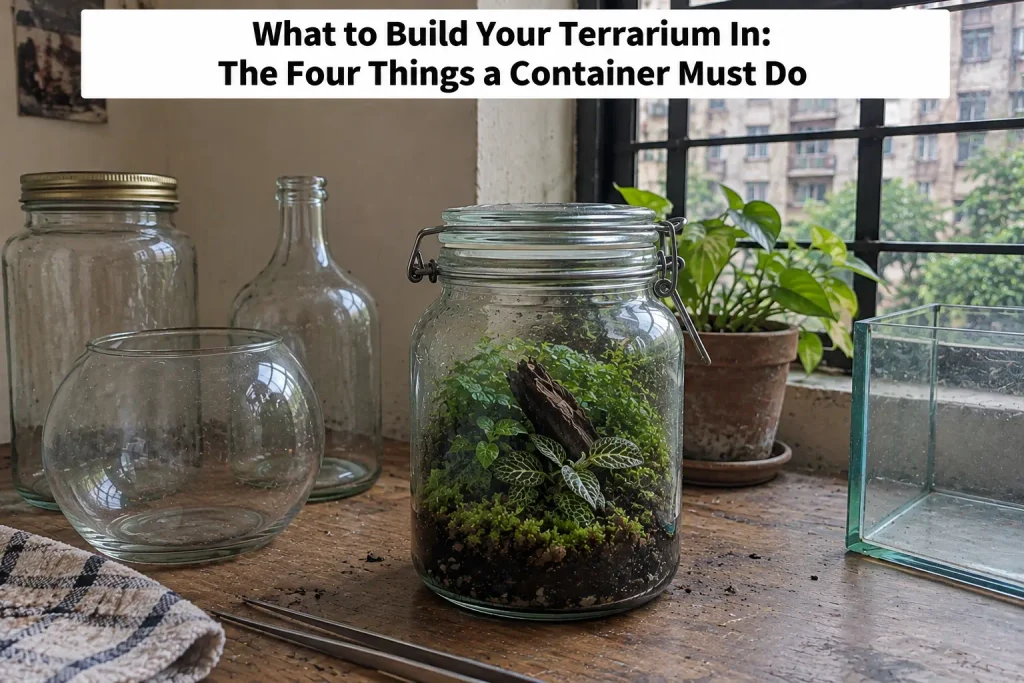
“I choose a terrarium container by four things before appearance: clear glass, enough usable volume, an opening I can actually work through, and a lid that reliably holds humidity. I also check the inside shoulder of the jar, not just the mouth width, because a wide opening that immediately narrows can still make planting, pruning, and glass cleaning frustrating. For a first build, I would take an ordinary clear, wide-access food jar like this over a beautiful narrow-necked vessel every time.“
The four requirements
1. Transparency, and it matters more than it sounds
Light has to get in and you have to be able to see in.
Being able to see is not vanity. It is how you catch mold, rot, pests and die-back early, and every one of those is much easier to fix caught early than caught late. A tinted, frosted, embossed or heavily patterned container is one you cannot inspect.
Colored glass is the common trap. A green or brown bottle looks wonderful and it removes both the light and the inspection.
2. Enough volume for the layers, plus a plant
A closed terrarium is a stack: drainage, separation, substrate, then the plant, then air above it. The layers do not scale down indefinitely. A very small container ends up as substrate to the brim with a plant pressed against the lid, and it has no air volume to run a water cycle in.
How the stack proportions change with jar size is on layers by jar size, and it is the page to read before committing to something small.
3. An opening you can actually work through
This is the one people discover at the wrong moment: after buying a beautiful demijohn and before trying to get a fern into it.
The opening decides the difficulty of every future action: planting, pruning, removing a dead leaf, cleaning glass. A wide-mouthed jar is a pleasant afternoon. A narrow neck is a project requiring improvised tools and patience.
Neither is wrong. Choose knowingly, and if you are building your first one, wide is kinder.
4. A lid, or a decision not to have one
This is the fork in the whole hobby, not merely a container feature.
A closed build needs a cover that substantially limits air exchange. It does not have to be laboratory-airtight; it has to be enough for the water cycle to run.
An open build has no cover and no water cycle, which means you water it and it dries at the rate of the room. That is a genuinely different system with different failures, set out on open versus closed terrariums.
Deciding this first saves you from the most common category error in the hobby, which is treating a lidless bowl as though sealed-jar advice applied to it.
What passes, from what you already own
Kitchen storage jars with clamp or screw lids. The default answer for a first closed build: wide mouth, good seal, cheap, and you can see everything.
Large pickling and preserving jars. Same, with more volume.
Cookie and sweet jars. Often the best size-to-opening ratio available.
Wide vases with a glass or acrylic sheet laid on top. The cover does not have to be original to the vessel.
Old aquariums and fish bowls, with a sheet of glass or acrylic over the top. Well suited by volume, though a tank is a different shape of problem from a jar and the covering is your own solution.
Demijohns and carboys, for a builder who wants the challenge and knows they are choosing it.
What fails, and why
Anything you cannot see through properly. Colored, frosted, patterned.
Anything too small to hold the layers.
Plastic that has clouded or scratched. Plastic is workable, and used plastic that has hazed is transparency you have already lost.
Anything that held something you cannot identify. This one is not aesthetic. A container that held a solvent, a cleaning product or an unknown chemical is not worth the saving, because whatever residue is in it is going into a sealed system that has no way of getting rid of anything.
Anything with a lid that will not sit reliably. A cover you have to balance is a cover that will be knocked off.
And anything precious. A build is semi-permanent. Do not commit an heirloom to a jar of wet soil.
The one preparation step that is not optional
Whatever you choose, new or reclaimed, it gets cleaned and sterilized before anything goes in it.
A sealed jar is a closed system, and anything living that starts in there has an uninterrupted run at it. Residue from a previous contents is the same problem from the other direction. The method is on sterilizing the jar and substrate, and it is the step most first builds skip and most mold outbreaks trace back to.
Choosing for a first build
If you want the short version:
A wide-mouthed glass jar with a clamp or screw lid, big enough to get your hand into, clear, and previously used for food. That is the container that gives a beginner the highest chance of a working build, and there is a very good chance one is already in the house.
Once the container is chosen, the build itself is on how to build a closed terrarium.
FAQ
Can I use an ordinary kitchen jar? Yes, and for a first closed build it is the default answer. Storage jars with clamp or screw lids, large pickling and preserving jars, and cookie or sweet jars all pass: wide mouth, a cover that seals, clear glass, and cheap. Cookie jars often have the best ratio of volume to opening size of anything in the house.
Does the lid have to be airtight? No. A closed build needs a cover that substantially limits air exchange, not a laboratory seal. It has to be enough for the water cycle to run. What it must not be is a cover you have to balance, because a lid that will not sit reliably is a lid that gets knocked off.
Can I use a colored or frosted bottle? Not for a build you want to keep. Tinted, frosted, embossed and heavily patterned containers block light and, just as importantly, stop you inspecting the inside. Seeing in is how you catch mold, rot, pests and die-back early, and a green or brown bottle removes both the light and the inspection.
Is plastic acceptable? Plastic is workable. Used plastic that has clouded or scratched is not, because that is transparency you have already lost. The same test applies as to glass: if you cannot see in properly, it fails.
Does a brand-new jar still need sterilizing? Yes. Whatever you choose, new or reclaimed, it gets cleaned and sterilized before anything goes into it. A sealed jar is a closed system, so anything living that starts in there has an uninterrupted run at it, and residue from previous contents is the same problem from the other direction. This is the step most first builds skip.
What this page does not publish
No product names, no brands and no prices. We have bought nothing.
No minimum or maximum size figures. No source publishes them for a sealed container and the physics rather than a number sets the floor.
No claim about which jar brands seal well. That is a question about specific products which this page cannot answer honestly.