
Moving House With a Terrarium: What Actually Breaks in Transit

The instinct is to worry about the glass breaking. The glass is rarely what goes wrong. What goes wrong is inside: layers shift, a piece of hardscape falls, and the sealed jar spends two hours in a car in the sun.
Those are three different problems and they have three different answers.
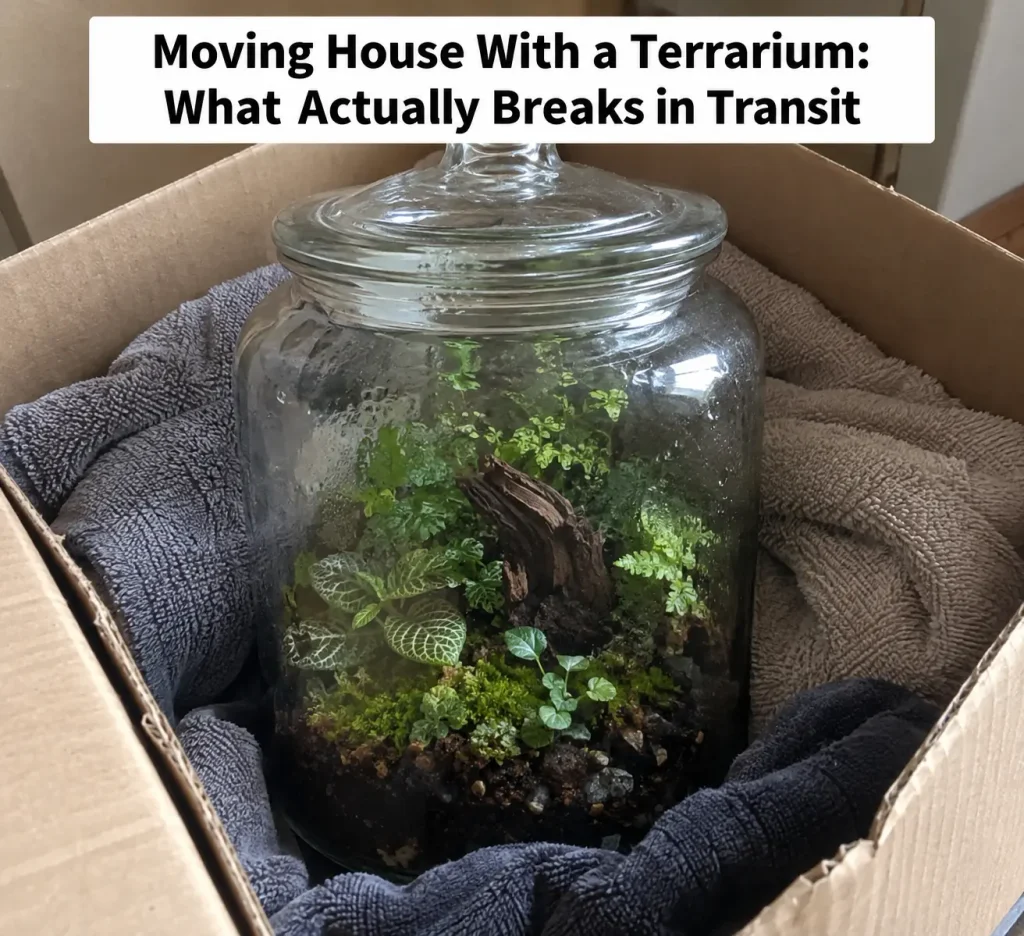
“I would move the terrarium upright in a snug box, padded around the outside, with any unstable hardscape secured or removed before the journey. I worry more about the layers shifting and the jar overheating than about the glass itself. Even if the container never tips, sudden braking can still load a tall piece of wood or stone sideways and make it shift, so I treat hardscape stability as part of packing, not just keeping the jar vertical.”
Problem one: the layers move
A terrarium is a stack of loose materials held in place by nothing but gravity and friction. Drainage layer at the bottom, a separating layer, substrate, plants, hardscape.
Tilt it and the stack tries to become one layer. Substrate falls into the drainage layer, and once it is down there it does not come back. That matters because the drainage layer’s whole function depends on staying open, which is set out on the drainage layer: fill it with fines and the build has lost its reservoir and its buffer against a saturated root zone.
The answer is simple and it is the whole of moving a terrarium well: keep it upright, at all times, in every stage of the move.
Not “mostly upright”. Not “on its side for the short bit down the stairs”. Upright, continuously.
Problem two: the hardscape topples
A piece of wood or stone standing in a jar is held by friction against the substrate. It will move.
A falling piece of hardscape crushes plants and can crack glass from the inside, which is the one way the glass genuinely does break.
Before you move it, decide whether the hardscape is stable. If a piece is tall, top-heavy, or resting rather than bedded in, the honest options are to bed it deeper, wedge it with something soft, or take it out and put it back at the other end. Taking it out is not a defeat. The wood-selection and stability question is on hardscape wood in a terrarium.
Soft packing inside the jar is a bad idea in a sealed build, because whatever you put in has to come out and anything left behind is in a system with no exit.
Problem three: heat, and this is the one that kills builds
A closed terrarium in a car is a greenhouse inside a greenhouse.
A parked car in sun gets far hotter than the air outside, and the jar inside it then traps that heat with no ventilation at all. A move that takes an hour, plus loading and unloading, is long enough to cook a build in warm weather.
The rules, and they are not optional:
- Never leave it in a parked car. Not for ten minutes, not in shade.
- Move it in the passenger cabin, not in a trunk or in the back of a van, where there is no cooling and often no ventilation.
- Move it early or late in the day if you can choose.
- Cover it from direct sun during transit, with a cloth or a box open at the top, so that it is shaded but not sealed inside something dark and hot.
In a hot climate this is not a footnote, it is the main risk of the whole exercise, and it outranks every packing consideration on this page.
Should you open the lid for the journey?
No, for a short move. Sealed is the stable state, and opening it introduces the risk of spillage and of losing water you cannot easily replace.
Consider it for a long, hot journey, because a sealed container in heat with no gas exchange is worse than a briefly vented one. If you do open it, keep the lid with the jar and close it as soon as it is in place, and expect to watch the condensation pattern for a few days afterwards to see where the balance landed.
We publish no threshold for how long or how hot is “long and hot”. No source publishes one. If you are uncertain, cooling the transport is a better lever than venting the jar.
Packing, practically
Wedge the jar so it cannot tip. A box slightly larger than the jar, packed around the outside with towels or crumpled paper, is the whole method. The box also shades it.
Do not pack anything on top. Nothing goes above it, ever.
Carry it separately and put it in the vehicle last, so it comes out first.
One person carries it, with both hands, from underneath. Not by the lid, and not by the rim.
And put it somewhere it cannot be knocked at the other end, before you unload anything else.
After the move
Do not intervene for a few days. The build has been shaken and possibly warmed, and it needs to re-establish its cycle. The temptation to open it, water it, or rearrange it on the first evening is strong and it is a mistake.
Watch the glass. The condensation pattern is your instrument, and what a normal pattern looks like is on too much condensation.
Expect some leaf drop. Movement, temperature change and a new light position all produce some, and it is not automatically a failure.
And the light position is the thing to get right, not the packing. A jar that survived the journey perfectly and lands in a west-facing window is a jar with a new problem. Work out where it is going before it arrives.
If the layers did mix
It happens, and the honest answer is not comforting.
Substrate that has fallen into the drainage layer cannot be removed without dismantling the build. A small amount is survivable and the build will run slightly wetter at the bottom than it did. A lot of it means the drainage layer is no longer a drainage layer, and the build will hold water it cannot shed.
If it is bad, rebuild rather than nurse it. A build you dismantle and remake is a weekend and a settled result. A build that is quietly waterlogged from the bottom up is months of symptoms, and the break-in period you would run on a fresh build is on the break-in schedule.
FAQ
Can I lay the jar on its side to fit it in the car? No. A terrarium is a stack of loose materials held by gravity and friction, and tilting it lets the stack become one layer. Substrate that falls into the drainage layer does not come back. Keep it upright continuously, including the short bit down the stairs.
Can it travel in the trunk? Move it in the passenger cabin instead. A trunk or the back of a van has no cooling and often no ventilation, and a closed terrarium in a hot vehicle is a greenhouse inside a greenhouse. Never leave it in a parked car, not for ten minutes and not in shade.
Should I take the hardscape out before moving? If a piece is tall, top-heavy, or resting rather than bedded in, yes, or bed it deeper, or wedge it with something soft. A falling piece of wood or stone crushes plants and can crack the glass from the inside. Taking it out and putting it back at the other end is not a defeat. Avoid soft packing inside a sealed jar, because anything left behind is in a system with no exit.
Should I open the lid for the journey? Not for a short move. Sealed is the stable state, and opening it adds the risk of spillage and of losing water you cannot easily replace. For a long, hot journey it is worth considering, since a sealed container in heat with no gas exchange is worse than a briefly vented one. We publish no threshold for what counts as long and hot, and cooling the transport is the better lever if you are unsure.
Leaves dropped after the move. Did I kill it? Not necessarily. Movement, temperature change and a new light position all produce some leaf drop, and it is not automatically a failure. Leave it alone for a few days, watch the condensation pattern, and resist the urge to open, water or rearrange it on the first evening.
What this page does not publish
No temperature limits and no journey-length figures. Nothing publishes them and we have measured nothing.
No packing product recommendations. A box and towels do this.