
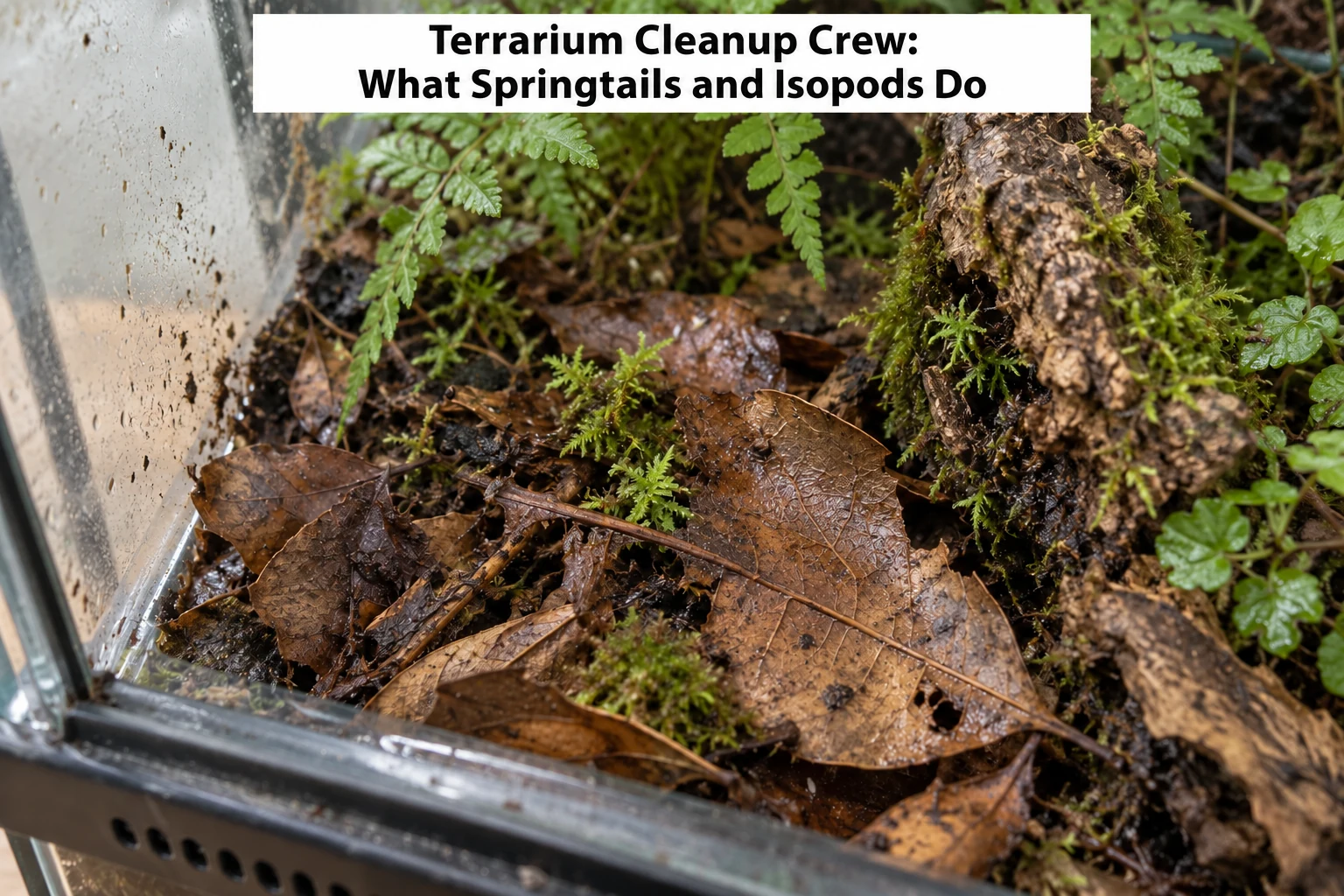
Terrarium Cleanup Crew: What Springtails and Isopods Do

A terrarium cleanup crew is a small population of decomposer animals, usually springtails, sometimes isopods, that you add to a terrarium to eat the mold, fungus and decaying plant matter that build up inside. Springtails are tiny and graze on fungi and decay across the soil surface. Isopods are larger crustaceans that break down dead leaves and other bigger debris. Neither is a cure for a jar that is too wet or badly built. Think of them as a maintenance team that keeps small problems small, not a rescue service.
That is the core idea. The rest of this guide explains what each animal does, what the university extension services say about them, where they help, where they cause trouble, and how to decide whether a sealed jar on your shelf needs any crew at all.
“I see a cleanup crew as help with the ordinary decay a terrarium produces, not a substitute for getting the moisture right. Springtails suit the small scraps and fungal growth around leaf litter, while larger isopods need a more substantial habitat and food supply. If debris is turning soggy faster than it disappears, I would investigate the conditions before adding more animals.”
Why Add a Terrarium Cleanup Crew on Purpose?
A closed terrarium is a small, damp, warm box full of organic matter. Leaves drop, roots die back, and moss sheds bits of itself. In a forest, all of that is eaten by a huge community of fungi, bacteria and small animals. In a jar, most of that community is missing, so dead material sits there and mold moves in.
The cleanup crew idea is to put back a small part of the forest floor’s recycling system. Instead of you picking out every dead leaf and wiping every patch of fuzz, the animals eat it, and what they leave behind goes back into the soil as nutrients for the plants.
It helps to know that the same animals appear in garden pest literature. Extension services write about springtails and pillbugs mainly because people find them in damp basements, overwatered pots and vegetable beds. That is not a contradiction. The traits that make them nuisances in a house, a love of damp and decay, are exactly what makes them useful in a jar.
Springtails: The Small, Constant Grazers
Springtails are the crew member most terrarium keepers start with, and for small closed jars they are often the only one.
The University of Maryland Extension’s springtails fact sheet (updated August 4, 2023, read on 2026-09-27) describes them as “very small insects, 1 to 2 millimeters long,” “whitish or grayish in color,” with “a forked appendage at the rear that enables them to jump.” It says they “primarily feed on algae, fungi, pollen, and decaying organic matter and are an important part of soil ecosystems,” and that “springtails do not bite or cause damage.”
In a terrarium, that translates into a few useful habits:
- They graze mold early. Springtails move constantly across the soil surface, leaf litter and wood, eating fungal growth before it can build into a visible fuzzy patch.
- They eat decay in small pieces. Tiny bits of dead leaf and root are exactly their scale.
- They stay out of sight. Most of the time they live in the top layer of soil and under leaf litter. You notice them when you lift a leaf or look closely at the glass at soil level.
- They leave plants alone in normal conditions. Their food is fungi and decay, not living leaves.
What springtails tell you about moisture
The same University of Maryland fact sheet notes that springtails indoors “generally suggest some kind of moisture problem” and that infestations “are usually associated with dampness, organic matter, and mold.” In a house, that is a warning. In a terrarium, it is a useful gauge. A springtail population that explodes usually means there is a lot of damp decay to eat. A population that vanishes can mean the jar has dried out. Watching their numbers gives you a second reading on the water balance, alongside condensation.
Isopods: The Bigger Recyclers
Isopods are the other half of the classic pairing. Pillbugs, sowbugs and woodlice are all isopods.
The UC Statewide IPM Program’s pillbugs and sowbugs page (read on 2026-09-27) explains that they are “soil-dwelling crustaceans,” not insects, and that adults have “seven pairs of legs” and measure “about 1/3 to 3/4 inch long.” They “feed primarily on decaying plant material.” The same page adds an important caveat: they “occasionally feed on seedlings, new roots, lower leaves, and fruits or vegetables touching the soil.” It also notes that adults “can live for 2 to 5 years.”
In a terrarium, isopods:
- Break down larger debris. Whole dead leaves, soft rotting wood and larger plant scraps are their food.
- Turn over the top layer of soil as they move and feed.
- Need a steady supply of decaying material. In a large, planted, leaf-littered enclosure there is plenty. In a small sealed jar with a few plants and some moss, there often is not.
That last point is where the trouble starts. The feeding UC IPM describes in gardens, on seedlings, new roots and lower leaves, is exactly the kind of tender growth a small jar is full of: fresh moss, new shoots and soft roots. The less decay there is to eat, the more of that living tissue is within reach. For most small closed jars, this makes isopods a riskier choice than springtails.
Springtails vs Isopods at a Glance
| Springtails | Isopods | |
|---|---|---|
| What they are | Tiny six-legged soil animals | Small land crustaceans with seven pairs of legs |
| Size (per the extension sources above) | 1 to 2 millimeters | About 1/3 to 3/4 inch |
| Main food | Fungi, algae, pollen, decaying matter | Decaying plant material |
| Risk to plants | Described as causing no damage | Occasionally feed on seedlings, new roots and lower leaves |
| Best fit | Almost any closed jar with damp soil | Larger enclosures with plenty of leaf litter |
| How visible | Mostly hidden, seen at the soil line | Easy to see, active under litter and wood |
The practical takeaway: springtails suit nearly every closed terrarium. Isopods suit some, especially larger builds, and are a poor match for many small jars.
What a Cleanup Crew Can and Cannot Fix
A cleanup crew is often sold, in shop blogs and videos, as the answer to mold. It is only part of the answer.
What a crew helps with:
- Small, early patches of mold and fungal fuzz on the soil or wood.
- A steady trickle of dead leaves and plant debris.
- Keeping the top layer of soil from turning into a stale mat.
What a crew cannot fix:
- A waterlogged jar. If the soil is saturated, mold will grow faster than any population can eat it, and roots will rot anyway. Draining the jar comes first; see our guide to a flooded, waterlogged terrarium.
- Rot from the wrong plants. Succulents and other dry-climate plants rot in a closed jar whatever lives in the soil.
- Fungus gnats on their own. Springtails are often recommended against gnats, but gnats are driven by wet soil. Our guide to fungus gnats in a terrarium explains why the usual fix fails.
- Mushrooms. A fruiting mushroom is the visible part of a fungal network in the soil. Springtails may graze the surface, but they will not remove the fungus. Our guide on mushrooms in a terrarium covers what they mean.
If you are not sure whether what you are seeing is harmless fungus, true mold or slime mold, identify it first. The crew is a slow, background help, not an emergency response.
When to Add a Cleanup Crew
Many terrarium keepers wait until the jar has settled rather than adding animals on day one. A freshly built jar can swing between too wet and too dry while it finds its water balance, and small animals do not cope well with those swings. Our guide on how long a closed terrarium takes to stabilize explains what “settled” looks like.
Others add springtails at build time, reasoning that they get a head start on any mold from new soil and wood. Both approaches are common. What matters more is that the jar has damp soil, some decaying material for them to eat, and no standing water.
Where Cleanup Crews Come From
There are three routes:
- Buying a live culture from a shop that sells them. In many countries, reptile and terrarium shops stock springtails and several isopod species. In places where no shop stocks them, this route is closed.
- Culturing your own from a small starter population, which keeps a supply ready for future builds.
- Collecting from the wild, which is possible but carries a real risk of bringing in pests, predators and pathogens along with the animals you wanted. It needs a quarantine step, not a straight transfer into a planted jar.
Buying is the simplest where it is available. Culturing takes patience but pays off if you build often. Wild collection costs nothing but asks the most care.
Looking After the Crew Once It Is In
A cleanup crew in a closed jar mostly looks after itself, as long as the conditions that suit the plants also suit the animals:
- Keep the soil damp, not wet. Both springtails and isopods need moisture. Neither survives standing water.
- Leave some leaf litter. A few dead leaves on the soil surface give food and shelter. A perfectly tidy jar starves the crew.
- Avoid pesticides and strong cleaning products inside the jar. Anything that kills fungus gnats or mites can kill springtails and isopods too.
- Expect population swings. Numbers rise when there is plenty to eat and fall when food runs short. That is normal and self-correcting in most jars.
Do You Need a Cleanup Crew at All?
Many closed terrariums run for a long time without any added animals. The plants recycle much of the moisture on their own, and you can remove dead leaves by hand with long tweezers. A crew is most useful when:
- The jar has lots of organic material, such as leaf litter, wood or moss.
- You see recurring small patches of mold that you keep having to remove.
- The jar is hard to reach into, such as a narrow-necked bottle.
A crew is least useful in a very small jar with little decaying material, where there is not enough food to keep a population going.
Frequently Asked Questions
What is a terrarium cleanup crew?
A cleanup crew is a population of small decomposer animals, usually springtails and sometimes isopods, added to a terrarium to eat mold, fungus and decaying plant matter. They recycle waste into the soil so dead material does not pile up and rot.
Do springtails harm terrarium plants?
The University of Maryland Extension states that springtails “do not bite or cause damage” and that they feed mainly on algae, fungi, pollen and decaying organic matter. In a normal, damp terrarium they eat decay and fungus rather than living plants.
Do I need both springtails and isopods?
No. Springtails alone suit most small closed jars. Isopods need more decaying material, and UC IPM notes they occasionally feed on seedlings, new roots and lower leaves, which can be a problem in a small jar with little leaf litter.
Will a cleanup crew get rid of mold in my terrarium?
It helps with small, early patches of mold, but it cannot keep up with a jar that is waterlogged or full of rotting plants. Fix the moisture problem first, then let the crew handle the ongoing background decay.
Can springtails escape and infest my home?
Springtails need damp conditions, and the University of Maryland Extension links indoor springtail problems to dampness, organic matter and mold. A few that escape from a jar into a dry room are unlikely to find what they need, though a damp spot in a home can support them.