
Air Plants Are Not Terrarium Plants (Mostly): Why the Jar Kills Them

Tillandsias are sold in sealed glass globes constantly, they are photographed in them constantly, and the arrangement is genuinely beautiful.
It is also, for a closed container, a slow way of killing the plant, and the reason is specific enough to be worth understanding rather than just being told.
How an air plant actually works
A tillandsia has no functional root system for feeding. The roots, where they exist, are anchors. Everything the plant takes in, it takes in through its leaves, through specialized scales that absorb water and then release the plant back to a dry state.
That cycle has two halves and both are necessary. Wet, then dry. In its native habitat the plant is soaked by rain or heavy dew and then dried by moving air, and the drying is not a period of deprivation the plant tolerates. It is part of how it lives.
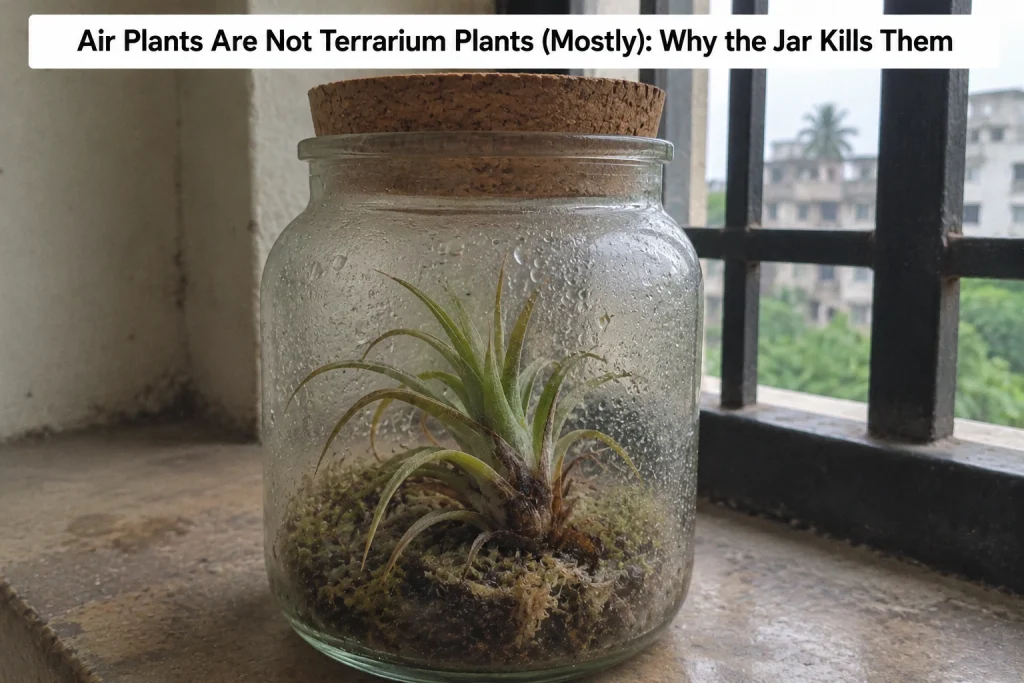
“In my own setup, the frustrating thing about keeping an air plant sealed in glass was how normal it looked before the decline became obvious. The outside leaves could still look reasonably healthy while the base stayed damp and began deteriorating, so checking only the visible foliage gave me false reassurance. That experience changed what I look at first with Tillandsia: I lift the plant and inspect the base rather than judging it from the top. I now treat the drying period as part of watering itself, which is why I would keep an air plant in an open, airy display where I can remove it, wet it properly, let it dry completely, and only then put it back.”
Why a closed jar breaks it
A sealed terrarium is built to keep humidity permanently high and airflow permanently low. That is not a fault of the format; it is the format.
So the drying half of the cycle never happens.
The plant sits at high humidity with water resting in the crown and between the leaves, indefinitely. What follows is rot, and it starts at the base where water collects, which is why an air plant in a jar usually fails from the inside outward: the outer leaves look acceptable while the center has already gone. That is the same still-air mechanism described on leaf rot.
And it takes weeks, which is the trap. The plant looks fine, then looks slightly dull, then pulls apart at the base when you lift it. By then nobody connects the outcome to the container.
Two other problems the jar creates
Light. Many tillandsias want bright light, and a closed jar cannot be put in strong light because it would cook. So even a plant that somehow avoided the rot would be slowly stretching and fading.
Watering. An air plant needs to be properly wetted and then drained and dried. Doing that inside a sealed container is impossible: you cannot soak it in place, and any water you add stays in the jar with nowhere to go.
What actually works
The honest answer is not “never put an air plant in glass”. It is that the container has to be open.
An open globe, bowl, or vessel with a wide mouth, positioned somewhere with real air movement. This is the arrangement that works and it is the one the photographs are usually of, whatever the caption says.
Removable. Take the plant out to water it, let it dry properly, and put it back. This is the whole technique, and it is why a jar that traps the plant is the wrong object even when it is open.
No substrate around the base. An air plant sitting in damp soil or damp moss is an air plant with a wet base, which is the failure this page is about. It sits on the surface, on wood, on stone, or on nothing.
Not sealed. Ever. No lid, no cork, no cling film.
The difference between the two formats is set out on open versus closed terrariums, and the watering logic for an open vessel, which is not the sealed-jar logic, is on watering an open terrarium.
Reading the plant
Since air plants fail slowly, the signals are worth knowing.
Leaves pulling away easily at the base, or the center coming out when lifted. That is rot and it is generally past saving.
A soft, dark base. The same, earlier.
Curling or a papery, wrinkled texture points the other way, toward not enough water rather than too much, which is the opposite problem and much easier to fix.
A dull, stretched, faded appearance with no rot is a light problem.
The most useful habit is to lift the plant and look at the base, because it is the part that fails first and the part a display arrangement hides.
The “mostly” in the title
There are edge cases and the honest ones are narrow.
A very open vessel in a genuinely airy position blurs the line between a container and a shelf, and that is fine, because it is not really a closed system.
A large open terrarium with strong air movement can host one, sitting on hardscape rather than on substrate, well away from anything damp.
What does not work at any scale is a lid. The moment the container retains humidity, the drying half of the cycle is gone, and no positioning inside the jar compensates for that.
What to put in a closed jar instead
If the sealed globe is the object you want to fill, the plants for it are the ones from humid, shaded, still-air habitats: small tropical foliage, ferns and mosses. Permanently damp and dim is their normal rather than a stress, which is the exact inverse of a tillandsia. The selection is on the best plants for a closed terrarium, and the broader test for which plants a sealed jar rules out is covered separately on this site.
FAQ
Can an air plant live in a closed terrarium? No. A tillandsia takes everything in through its leaves and its cycle has two halves, wet and then dry, both of which are necessary. A sealed terrarium is built to keep humidity permanently high and airflow permanently low, which is the format rather than a fault in it, so the drying half never happens. The plant sits with water resting in the crown and between the leaves indefinitely, and rot follows.
Why did my air plant rot in the middle while the outer leaves looked fine? Because rot starts at the base, where water collects, so the plant fails from the inside outward and the display hides the part that goes first. It takes weeks, which is the trap: the plant looks fine, then slightly dull, then pulls apart at the base when you lift it, by which point nobody connects the outcome to the container. Leaves that pull away easily at the base, or a center that comes out when lifted, are rot and generally past saving, and a soft dark base is the same thing earlier. Get into the habit of lifting the plant and looking at its base.
How often should I soak an air plant? This page gives no soaking time and no frequency. Those depend on the species and on your climate, general figures circulate widely without a source, and this is not an air plant care site, so a schedule here would be padding rather than help. What the format demands is the shape of the cycle rather than a number: the plant has to be properly wetted, then drained, then dried in moving air, and it has to be somewhere you can take it out to do that.
Can I sit an air plant on moss or soil? No. An air plant sitting in damp soil or damp moss is an air plant with a permanently wet base, which is the exact failure this page describes. It sits on the surface instead: on wood, on stone, or on nothing. In a large open terrarium with strong air movement one can work, placed on hardscape rather than substrate and well away from anything damp.
Is an open glass globe all right? Yes, and that is the arrangement the photographs are usually of whatever the caption says. An open globe, bowl or wide-mouthed vessel works if it sits somewhere with real air movement and if the plant is removable, because taking it out to water, letting it dry properly and putting it back is the whole technique. A jar that traps the plant is the wrong object even when it has no lid. What fails at any scale is a lid: the moment the container retains humidity the drying half of the cycle is gone, and no positioning inside compensates.
What this page does not publish
No soaking time or watering frequency for air plants. Those depend on species and on your climate, and general figures circulate widely without a source. This is not an air plant care site, and a page giving you a schedule for a plant it does not otherwise cover would be padding.
No species list. Tillandsias vary and the point of this page is the container, not the taxonomy.
No product names.