
Plants That Should Never Go in a Closed Terrarium

A closed terrarium is a permanently humid, low-airflow, low-light, evenly warm environment where the substrate never fully dries. That description is a paradise for a narrow set of plants and a slow death sentence for most of the ones sold to go in one.
Rather than a list you have to memorize, here are the four properties that decide it. Once you can see them, you can judge any plant on a shelf, including the ones this page has not thought of.
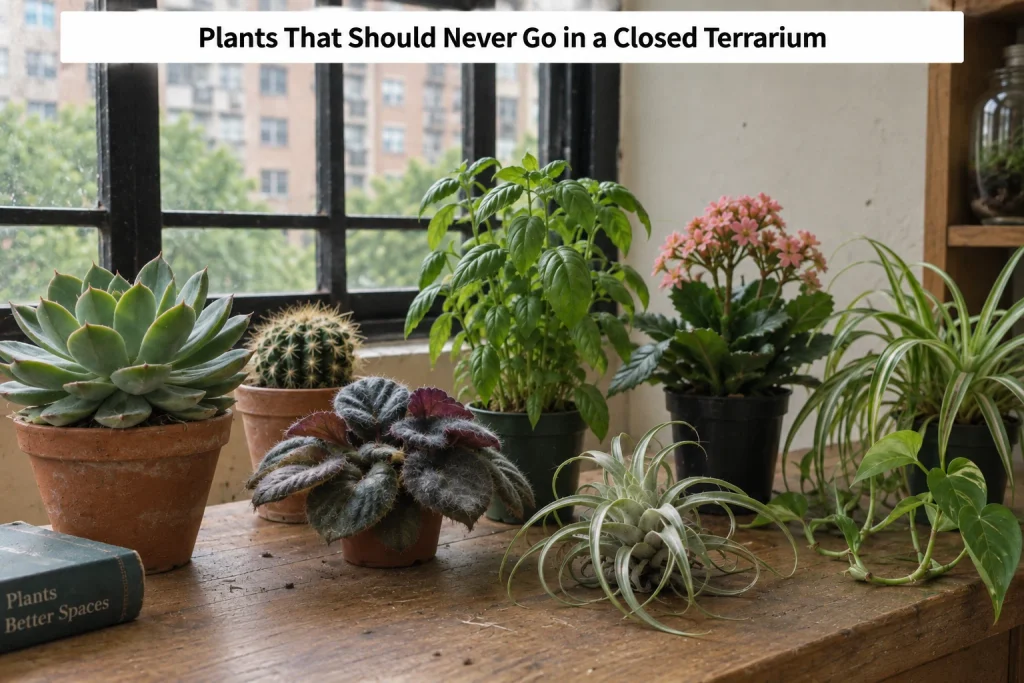
“I have become much stricter about plant choice than I was about how small or attractive a plant looks on the nursery shelf. I ask whether it naturally tolerates continuously damp roots, still humid air, modest light, and restricted growth before it gets anywhere near the jar. The plants in my photo here are good examples of ones I would leave outside, even though several are routinely marketed for terrariums. One distinction I find especially useful is that “tropical” does not automatically mean “closed-terrarium suitable”: some tropical plants still depend on strong airflow, brighter light, or drying around their roots. For me, failing even one of those environmental checks is enough reason to choose something else.”
The four disqualifying properties
1. It needs its roots to dry out
This is the single biggest one and it rules out the largest group.
Any plant adapted to dry periods depends on the substrate drying between waterings, because its roots have no defense against being permanently wet. In a sealed jar the substrate never dries and there is no drainage hole to help.
The result is root rot, which is not a possibility but a schedule. What that looks like as it happens is on root rot in a terrarium.
Everything with succulent leaves or stems, everything from an arid habitat, and most bulbs and tubers, fail on this property alone.
2. It needs airflow, or it rots in still humid air
Some plants tolerate humidity and still need air moving across their leaves. In stagnant, saturated air, water sits on the leaf surface and does not evaporate, and a leaf that stays wet develops soft rot and fungal problems. That mechanism is on leaf rot.
Fuzzy, hairy or felted leaves are the visible warning. Hair holds water against the surface, which is exactly what you do not want in a closed jar.
Thick fleshy leaves are the other warning, for the same reason at a different scale.
3. It gets too big, too fast
Not a rot problem, a physical one. A plant that will be pressed against the lid in three months is a plant you will be cutting back constantly, in a container that makes cutting back awkward.
The failure is slow and it is real: the build becomes a single overgrown plant, the light to everything below is gone, and the arrangement you made is a memory. The selection logic that avoids this is on low-maintenance terrarium plants.
4. It wants strong light
A closed terrarium cannot be given strong light, because the container in direct sun becomes an oven with no ventilation. So the light budget inside a sealed jar is permanently limited, whatever the plant would prefer.
A plant that needs high light will not die dramatically. It will stretch, go pale, lose its markings, and slowly decline, which is harder to diagnose than a rot because it looks like the plant simply being unimpressive.
The groups that fail, and which property fails them
Succulents and cacti. Property one, decisively, and property four as well. They are sold in sealed jars constantly and it is simply wrong. They belong in an open container with airflow, drying substrate and strong light, which is the opposite environment on every axis.
Anything with felted or very hairy leaves. Property two.
Most herbs. Property four, and property one for the Mediterranean ones. A sealed jar of basil is a sad thing within weeks.
Anything sold as a full-sun plant. Property four.
Most flowering houseplants. Flowers need light and flowers rot in still humid air, so properties two and four together. Spent blooms rotting in a sealed jar are also a mold source you then have to reach in and remove.
Vigorous climbers and fast trailers, unless you have accepted a maintenance commitment. Property three.
Anything with a woody structure that wants a dry winter. Property one.
Air plants, which are their own case: they need airflow and they rot in saturated still air. Property two, and it is a hard fail rather than a marginal one.
The trap: it looks fine at first
This is why bad terrarium plants keep being sold and keep being recommended.
Almost every plant looks healthy in a sealed jar for the first few weeks. Nothing has run out of anything, nothing has rotted yet, and the humidity is if anything flattering.
The failures on this page take one to three months to appear, which is long enough that the reader has stopped connecting the outcome to the choice and starts looking for something they did wrong to the water. There is no watering technique that saves a succulent in a sealed jar, and that is the useful thing to know before you buy rather than after.
What passes instead
The mirror image: plants from humid, shaded, low-airflow habitats. Forest floor plants, small tropical foliage, mosses and small ferns. What they have in common is that permanently damp and dim is their normal, not a stress they are enduring. The selection is on the best plants for a closed terrarium.
The test to apply in the shop
Four questions, in order.
- Would this plant, in a pot, want to dry out between waterings? If yes, it fails.
- Are the leaves hairy, felted or thick and fleshy? If yes, be very cautious.
- How big will it be in six months? If the answer is bigger than the jar, it fails.
- Does the label say full sun or bright light? If yes, it fails.
A plant that passes all four is a candidate. A plant that fails one is a plant that will look fine for a month and then start telling you.
A note on pets
Some plants are toxic to cats and dogs, and that is a separate question from whether they suit a terrarium. It is a real consideration if a jar is somewhere an animal can reach, particularly since a curious cat can knock a jar over and reach everything in it.
We are a terrarium site, not a veterinary clinic. If an animal has eaten a plant, call your vet, or ASPCA Animal Poison Control, or the Pet Poison Helpline, and take a piece of the plant or a photograph with you. This page diagnoses nothing and gives no treatment guidance.
FAQ
Can succulents live in a closed terrarium? No, and they are sold in sealed jars constantly anyway. They fail on the first property decisively, because a plant adapted to dry periods depends on the substrate drying between waterings and its roots have no defense against being permanently wet, while a sealed jar never dries and has no drainage hole. They fail on the light property too. Succulents belong in an open container with airflow, drying substrate and strong light, which is the opposite environment on every axis, and no watering technique rescues one from a sealed jar.
Why does my terrarium plant look fine and then decline? Because almost every plant looks healthy in a sealed jar for the first few weeks. Nothing has run out of anything yet, nothing has rotted yet, and the humidity is if anything flattering. The failures described here take one to three months to appear, by which time most people have stopped connecting the outcome to the plant they chose and start looking for something they did wrong with the water. The choice, not the watering, is usually what decided it.
Can I put air plants in a sealed jar? No, and this is a hard fail rather than a marginal one. Air plants need airflow, and in saturated still air they rot. They are their own case among the groups that fail, and the property that rules them out is the airflow one rather than the root one.
How do I judge a plant in the shop? Four questions, in order. Would this plant, in a pot, want to dry out between waterings, in which case it fails. Are the leaves hairy, felted or thick and fleshy, in which case be very cautious, because hair holds water against the surface and that is exactly what you do not want in still humid air. How big will it be in six months, and if the answer is bigger than the jar, it fails. Does the label say full sun or bright light, in which case it fails. A plant that passes all four is a candidate; one that fails a single question will look fine for a month and then start telling you.
Are terrarium plants safe around cats and dogs? Some plants are toxic to cats and dogs, which is a separate question from whether they suit a terrarium, and it is a real consideration if the jar sits somewhere an animal can reach, since a curious cat can knock one over and get at everything inside. This is a terrarium site rather than a veterinary clinic, so it names no plant as safe or unsafe. If an animal has eaten a plant, call your vet, or ASPCA Animal Poison Control, or the Pet Poison Helpline, and take a piece of the plant or a photograph with you.
What this page does not publish
No exhaustive species blacklist. The properties are more useful than a list, because a list cannot cover what is on your local nursery’s shelf.
No light figures. No source publishes a target for a sealed container, and the pages that give one cannot say where it came from.
No product or nursery names.