
Best Plants for a Closed Terrarium (What Survives)

The best plants for a closed terrarium are humidity-loving, slow-growing tropicals that stay small and cope with low light: mosses, compact ferns like lemon button fern and rabbit’s foot fern, fittonia (nerve plant), peperomia, and a few genuine miniature orchids. Avoid succulents, cacti, and air plants. They need dry, moving air and will rot in a sealed, humid jar within weeks. If you only remember one rule, it is this: a closed terrarium is a warm rainforest floor in miniature, so choose plants that would live on a rainforest floor, not in a desert.
Most closed terrarium failures come down to plant choice rather than technique, and that is even truer in a hot, humid room than in the cool Western apartment most plant lists quietly assume. So this is not another list of 35 options. It is a short list that holds up in heat and humidity, with honest notes on what thrives sealed, what sulks, and what will outgrow your jar faster than you expect.
What makes a plant right for a closed terrarium
A sealed jar creates four conditions at once: constant high humidity, warm still air, filtered low light, and a soil that stays evenly moist. A plant earns its place only if it wants all four. In practice that means:
- Humidity tolerance: it should love damp air, not just survive it.
- Slow growth: fast growers hit the glass and turn the jar into a tangle.
- Small mature size: the plant should stay in scale with the container.
- Low-light tolerance: a closed terrarium sits in bright indirect light, never direct sun, which cooks the inside.
Miss any one of these and the plant either rots, outgrows the space, or slowly starves. The table below is how I rank my regular picks by the two things beginners get wrong most: how reliably they survive sealed, and how fast they push against the glass.
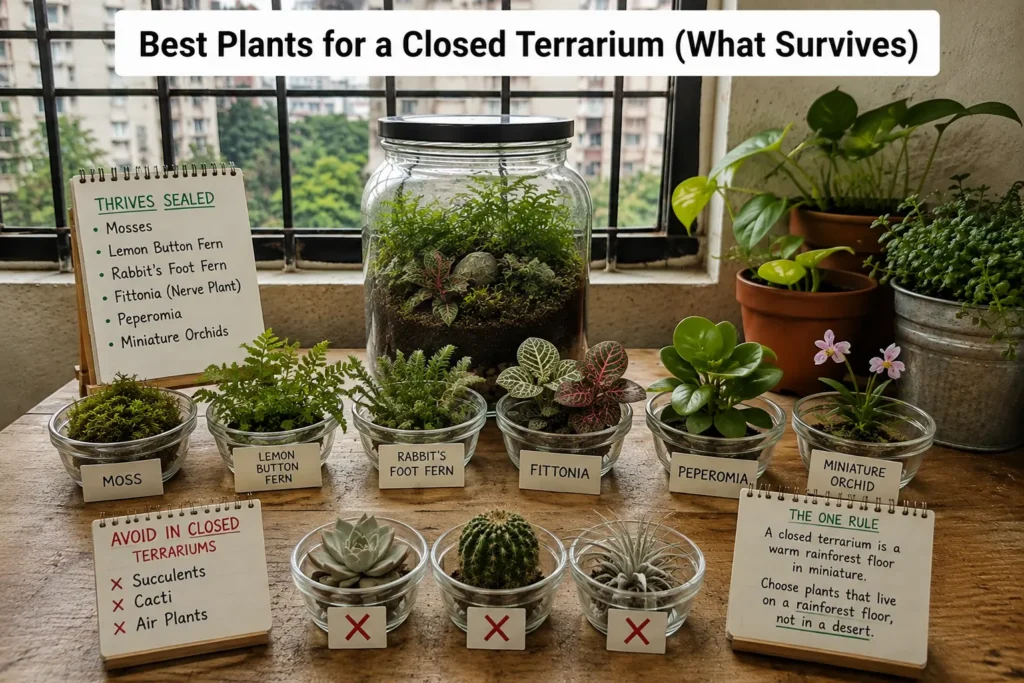
The closed terrarium plant shortlist at a glance
| Plant | Sealed survivability | Growth speed | Best for |
|---|---|---|---|
| Moss (cushion, carpet) | Very high | Very slow | Any jar, any beginner |
| Lemon button fern | High | Slow to moderate | Small and medium jars |
| Rabbit’s foot fern | High | Moderate | Medium jars, texture |
| Fittonia (nerve plant) | High if kept moist | Moderate | Color, foreground |
| Peperomia (compact types) | Medium to high | Slow | Low-light corners |
| Miniature orchids | Medium (fussy) | Slow | Experienced builders |
| Succulents, cacti, air plants | Very low | N/A | Open setups only |
Mosses: the safest plant you can start with
If you are nervous, start with moss. It is the closest thing to a guaranteed win in a sealed jar. Mosses have no true roots and no vascular plumbing, so they drink humidity straight from the air, which is exactly what a closed terrarium overproduces. They stay low, spread slowly into a green carpet, and shrug off the damp, shaded conditions that kill everything else.
Cushion moss forms tidy mounds for a hilly look, while carpet-forming mosses knit into a lawn across the substrate. In my builds, moss is also the early-warning system: when it stays deep green and springy, the jar is balanced. When it browns or goes leggy and pale, the terrarium is either too dry or getting too much direct light. Locally I collect moss from shaded brick walls and pot bases after rain, rinse it, and quarantine it for a week to watch for pests before it goes in.
Ferns that stay small (and the one that will not)
Ferns are made for this. They evolved on humid forest floors, and the compact species stay in proportion for months. My reliable picks:
- Lemon button fern: small, tidy fronds, genuinely humidity-hungry, and forgiving of low light. My default fern for a small jar.
- Rabbit’s foot fern: named for the furry rhizomes that creep over the surface, it loves damp air and adds real texture. It grows a little faster, so give it a medium jar.
The honest warning: do not plant a Boston fern. It is the fern most shops sell and it gets large, fast, filling a jar and then browning as it crowds itself. Button fern (the round-leaved Pellaea type) is often listed for terrariums too, and it does stay small, but in my experience it dislikes a permanently soggy substrate more than the others here, so it is a “keep it moist, not wet” plant rather than a soak-and-seal one. When a fern starts pressing against the glass, that is your cue to trim or move it up, which I cover in the build guide.
Fittonia (nerve plant): the color, and the drama
Fittonia (Fittonia albivenis), the nerve plant, is how you get color without flowers. Its leaves carry bright pink, red, or white veining that pops against all that green. It genuinely thrives in high humidity, which makes a closed terrarium close to its ideal home.
The catch is temperament. Fittonia is the drama queen of the jar: the moment the substrate dries even slightly, it collapses into a dramatic, theatrical wilt that looks like death. It almost always recovers within an hour or two of moisture, but in a sealed terrarium this doubles as a useful signal that the whole jar is drying out. It also grows outward at a moderate pace, so plant it in the foreground where you can pinch it back easily.
Peperomia: compact and forgiving
Peperomia is the pick I hand nervous beginners after moss. The compact species (the rippled-leaf and trailing types) stay small, grow slowly, and tolerate the lower light in a closed setup better than most. They add solid leaf shapes that contrast nicely with feathery ferns and flat moss.
One honesty note: many peperomias are semi-succulent, storing water in their thick leaves. That makes them tougher than fittonia, but it also means they do not want to sit in waterlogged soil. In a closed terrarium I keep them toward the top of the substrate and never let the base go swampy. Treated that way, they are close to hands-off.
Miniature orchids: the honest advanced pick
Yes, some orchids belong in closed terrariums, but only true miniatures, and only if you are ready to fuss. The terrarium-viable genera are the pleurothallids: Masdevallia, Lepanthes, Pleurothallis, and Restrepia. These are small, humidity-dependent orchids that struggle in a normal dry room and can genuinely prefer the sealed environment.
The trade-offs are real. Many of these miniatures want cool to intermediate temperatures, which is a fight in a hot tropical room like mine, where the inside of a sunny jar climbs quickly. They also need good, gentle air movement and are less forgiving of stagnant conditions than moss or ferns. I would not make an orchid your first closed-terrarium plant. Get moss, fern, and fittonia thriving for a few months first, then experiment.
The plants people wrongly seal in (and why they rot)
This is the mistake I see most, so I will name it plainly: succulents, cacti, and air plants do not belong in a closed terrarium. They come from dry, breezy places and need low humidity plus air that moves and dries between waterings. Seal them into a warm, saturated jar and they cannot dry out, so the water sits in their tissue and they rot from the inside, often within a couple of weeks. Air plants (Tillandsia) are the same story: they absorb moisture from the air but must dry fully afterward, and stagnant sealed humidity never lets them.
These plants are not bad, they are just built for the opposite environment. They shine in an open terrarium with airflow. If you are still deciding which style to build, my open vs closed terrarium comparison walks through which setup suits which plants before you commit.
How to combine plants and where to source them
Design by scale and speed. Use moss as the foreground carpet, low plants like fittonia and peperomia in the mid-ground, and a fern as the taller back-of-jar feature. Match growth speeds so one plant does not smother the rest, and always plant fewer than you think you need. A small jam-sized jar comfortably holds moss plus two or three small plants with room to grow. Crowding is not just an aesthetic problem: overgrown and dying plant material is one of the most common triggers for the fuzz and rot I cover in the terrarium mold and condensation guide.
For sourcing, you do not need a specialist shop. Moss is free after rain from shaded walls and pot bases. Fittonia, peperomia, and small ferns turn up cheaply at ordinary local nurseries, usually as full-size nursery pots you can split into several terrarium-scale pieces. If you want the hardest-to-kill options ranked by how much neglect they forgive, see my guide to low-maintenance terrarium plants for beginners. And once you have your plants, the step-by-step closed terrarium build guide covers the planting order that keeps them alive in a hot, humid room.
FAQ
Can succulents go in a closed terrarium?
No. Succulents and cacti need dry soil, low humidity, and air that moves so they can dry out between waterings. A closed terrarium traps warm, saturated air, so the plant stays wet and rots, often within a couple of weeks. Put succulents in an open terrarium with airflow instead.
What is the easiest closed terrarium plant for a beginner?
Moss. It has no true roots, drinks humidity from the air, stays low and slow, and tolerates the damp shade of a sealed jar better than anything else. It also doubles as a health signal: deep green means the jar is balanced, browning means it is too dry or getting too much light.
How many plants fit in a small jar?
Fewer than you expect. A small jam-sized jar comfortably holds a moss base plus two or three small plants, with deliberate empty space so they have room to grow into the scene. Overcrowding leads to plants crushing each other and to decaying material that invites mold.
Do closed terrarium plants need fertilizer?
Rarely. A sealed terrarium is a closed loop where decaying leaves and the substrate recycle nutrients, and you actually want to limit growth so plants do not outgrow the glass. Adding fertilizer usually causes overgrowth and algae rather than healthier plants. Skip it unless a plant shows a clear, sustained deficiency.
Why does my fittonia keep wilting in the terrarium?
Fittonia collapses dramatically the moment its soil dries even slightly, then usually recovers within an hour or two of moisture. In a closed terrarium a persistent wilt is a useful warning that the whole jar is drying out. Check the substrate, add a light mist if needed, and keep the lid sealed to hold humidity.