
Demijohns and Carboys: Big Glass, Small Opening, Big Commitment

You have found a large glass vessel with a neck you can barely get two fingers into. It is usable, it is the most rewarding container in the hobby, and it is the least forgiving decision you can make, and it is worth understanding which of those you are signing up for before the substrate goes in.
The good news first, because it is real
Volume is the friend of a closed terrarium. A large vessel has thermal mass, so it rides out a warm afternoon instead of tracking it. It has real air space for the water cycle. It has depth for a proper layer stack. It buffers a watering error that would be fatal in a small jar.
A carboy is, on every physical measure, an excellent closed terrarium. Everything difficult about it is the neck.
The neck decides everything
Every action you will ever perform on this build happens through that opening: planting, adjusting, pruning, removing a dead leaf, cleaning glass, correcting a mistake.
So before you begin, accept the consequence. Whatever you plant is essentially permanent. Not literally, but changing it is a project rather than a moment, and a plant you can no longer reach is one you cannot save.
That single fact should change your plant choices more than any other consideration.
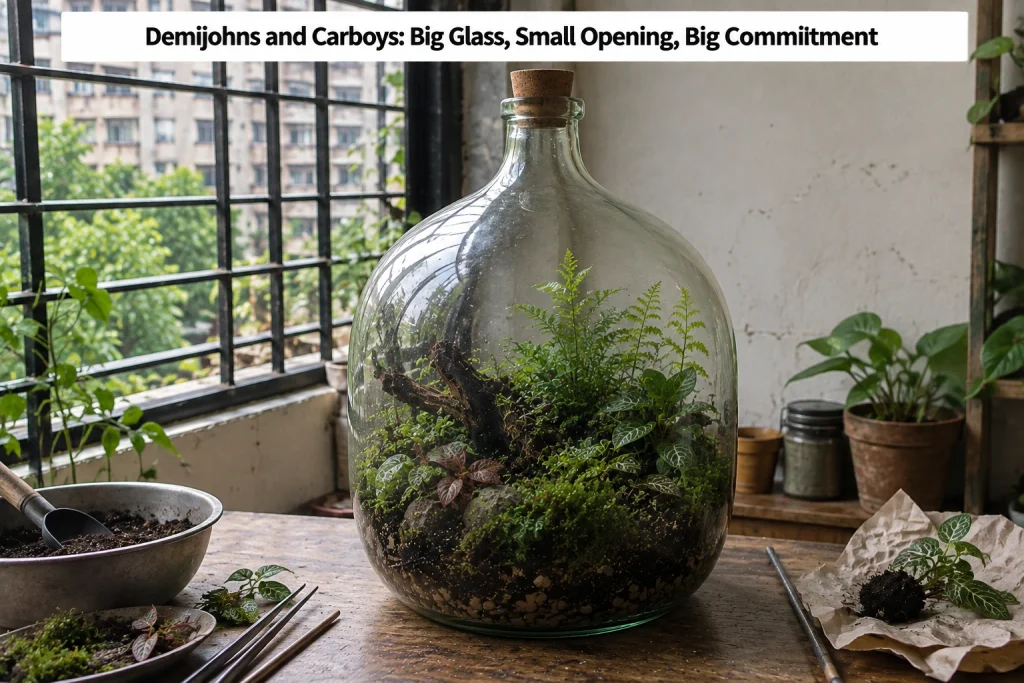
“In my demijohn builds, the generous volume gives me a stable closed system, but the narrow neck means I plan everything around future maintenance before anything goes inside. I use fewer, slower-growing plants, keep the hardscape low, and leave a clear viewing area because every later correction has to happen through that same opening. One thing I also consider is shoulder geometry, not just neck width: a vessel that widens abruptly below a narrow neck severely limits the angle of long tools, making plants near the outer glass much harder to reach than plants directly beneath the opening.”
Plan the build backwards from maintenance
This is the approach that makes a carboy succeed, and it is the opposite of how most people build one.
Choose plants that will not need intervention. Slow, small, restrained. Anything that grows fast will be against the glass in months and pruning it through a narrow neck is unpleasant. The selection logic is on low-maintenance terrarium plants, applied harder.
Choose fewer plants than the space suggests. A carboy looks like it wants a landscape. A landscape in a sealed vessel becomes a competition you cannot referee.
Consider moss-dominant. Moss needs almost nothing done to it, tolerates everything, and fills space in a way that looks intentional rather than sparse.
Keep the hardscape low and bedded. A tall piece of wood or stone in a carboy is a piece you cannot reposition if it shifts, and if it falls it crushes planting you cannot reach. The selection question is on hardscape wood.
Leave a clear panel. You will want to see in, and if planting reaches the glass all the way round, you have lost your only diagnostic.
Getting things in
Sterilize first, and this is more important here than anywhere, because you cannot get in later to fix a mold problem. The method is on sterilizing the jar and substrate.
Use a funnel or a rolled paper tube for the drainage layer and the substrate, so material goes where you want rather than down the walls.
Pour slowly. Material dumped into a narrow neck bounces and coats the inside of the glass, and cleaning that off is the first difficult job you will have given yourself.
Shape the substrate with a long tool before planting. A stick, a spoon tied to a cane, a length of dowel. Getting the contours right first is much easier than adjusting around plants later.
Plant with improvised long tools. Chopsticks, bamboo, stiff wire. Two tools are far better than one, because one holds and one places, and the whole difficulty of narrow-neck planting is having nothing to hold with.
Wrap the roots to get them through. A small plant rolled loosely in a strip of paper passes through an opening that its foliage would not, and the paper unrolls once it is inside.
Firm the substrate around each plant with a long tool before moving on. A plant sitting on the surface rather than in it will not root.
And clean the glass as you go, not at the end. Reaching down a carboy to clean a smear near the base after planting is exactly the job everybody regrets.
The layer stack
The proportions do not change because the vessel is tall; the stack works the same way and the depths scale with the container rather than with the neck. That is set out on layers by jar size.
One caution specific to tall vessels. A deep substrate in a tall container holds water low down where you cannot see it and cannot reach it. Build with a coarse, structural mix rather than a fine one, so that the lower layer stays open, and be conservative with water at the build, because a saturated bottom in a carboy is a rebuild.
Closing it
A cork is the traditional stopper and it is slowly permeable, which means a corked carboy loses a little water over time. On a large vessel that is usually a feature rather than a problem, because it gives a slow-running system somewhere to shed a slightly over-wet start.
A tighter closure runs a fuller cycle and gives you less margin at the beginning.
Either works. Choose knowing which way it errs.
When not to use one
Do not use a carboy for a first build. Not because you would fail, but because a first build is where you learn to read a system, and the container that punishes every intervention is the wrong place to learn.
Do not use one for plants you are unsure about. The whole point of the format is that the planting is close to permanent.
Do not use one you cannot see through properly. Many demijohns are tinted green or brown, which removes both the light and your ability to inspect, and on a vessel this hard to open that is a build you cannot diagnose.
FAQ
Is a carboy a good container for a first terrarium? It is an excellent closed terrarium on every physical measure and a poor place to learn. A first build is where you learn to read a system, and this is the container that punishes every intervention. The volume is genuinely on your side. The neck is the whole of the difficulty.
How do I get a plant through a narrow neck? Roll it loosely in a strip of paper. The wrapped roots and gathered foliage pass through an opening the plant would not otherwise fit, and the paper unrolls once it is inside. Use two long tools rather than one, so that one holds while the other places, and firm the substrate around each plant before moving on, because a plant sitting on the surface rather than in it will not root.
What should I plant in one? Slow, small, restrained plants, and fewer of them than the space seems to invite. Anything fast will be against the glass in months and pruning through a narrow neck is unpleasant. Moss-dominant plantings work well here, since moss needs almost nothing done to it and fills space in a way that looks intentional. Leave one panel clear so you can still see in.
Cork or a tighter stopper? Either works, so choose knowing which way it errs. Cork is slowly permeable, so a corked carboy loses a little water over time, which on a large vessel is usually a feature: it gives a slightly over-wet start somewhere to go. A tighter closure runs a fuller cycle and leaves you less margin at the beginning.
Can I use a green or brown demijohn? Not for a planted build you intend to keep. Tinted glass removes both the light and your ability to inspect the inside, and on a vessel this hard to open you would be building something you cannot diagnose.
What this page does not publish
No dimensions, volumes or layer depths in figures. They scale with the vessel and no source publishes them for a sealed container.
No tool product names. Chopsticks, wire and bamboo do this, which is the point.
No plant list specific to carboys, because the criterion is growth rate and reach rather than the container.