
Lidded, Corked or Clamp-Top: How the Seal Changes a Terrarium

A closed terrarium does not need an airtight seal. This is the first thing to settle, because the word “sealed” makes people reach for silicone and tape and worry about a lid that rests rather than clamps.
What it needs is a cover tight enough that water vapor stays in the container rather than leaving into the room. That is a much lower bar than airtight, and almost any reasonable lid clears it.
What the seal is actually for
Water. Only water.
Vapor rises from the substrate and the leaves, meets cooler glass, condenses, runs down, and returns. That cycle is the whole reason a sealed build can go months unattended. A cover that lets vapor escape breaks the cycle, and a build that loses water slowly is a build that will eventually need re-watering by hand, which is the thing you were trying to avoid.
It is not for keeping air out. The plants and the microbial life in the substrate exchange gases inside the jar continuously, and a small amount of air exchange with the room does not harm a build.
It is not for keeping contamination out either, or at least not usefully, because whatever is going to be a problem in a sealed jar was almost always in there at the build. That is why sterilizing at the start matters more than sealing at the end.
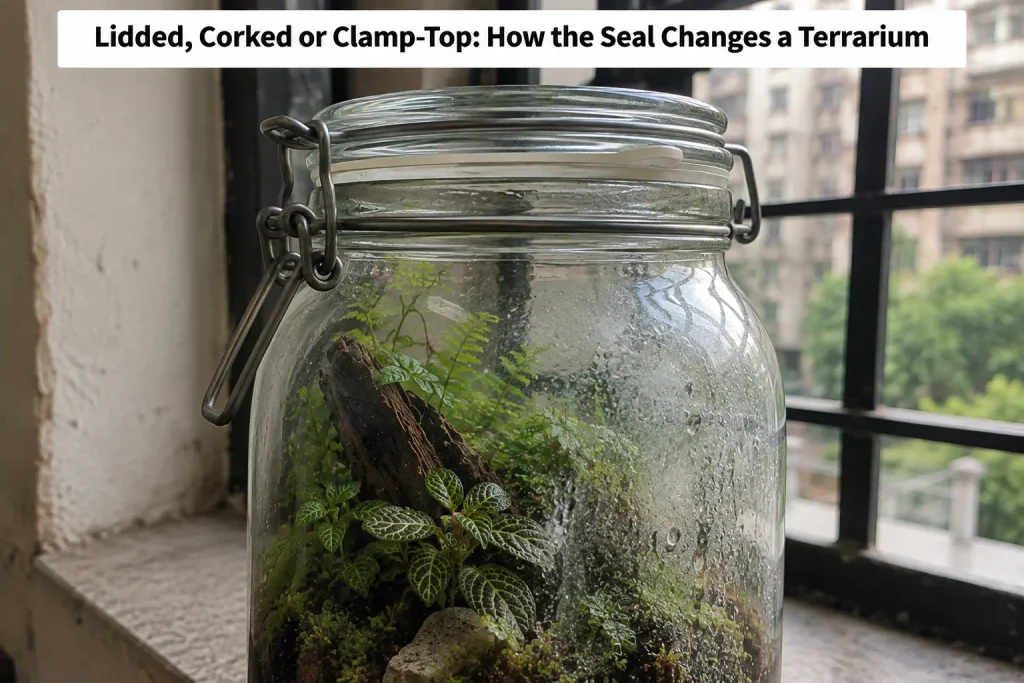
“I care less about whether the lid is called “sealed” and more about whether it keeps the jar’s condensation cycle stable. A clamp-top gives me a tighter starting point, but I still judge it from the glass rather than assuming tighter is automatically better. One detail I keep in mind with cork is that its seal is not fixed: research on cork closures shows that compression and moisture can materially change how well cork conforms to glass and limits gas transfer, so two corked jars can behave differently even when they look equally well plugged.”
The seal types, and what each one does
Clamp-top jars, with a rubber or silicone gasket. The tightest of the common options, effectively no vapor loss, and the lid can be lifted for maintenance without tools. The gasket is a consumable: an old perished one seals badly and will not tell you.
Screw-top jars with a lined lid. Very good, cheap, common, and the lining matters. A bare metal lid over a humid jar is a rusting lid.
Cork stoppers. Traditional, imperfect, and slowly permeable, which means a corked build loses water gradually. That is not always a fault. For a build that runs slightly too wet, a slow leak is a feature, and it is a common reason people prefer cork.
A glass or acrylic sheet laid on top. Effectively a lid, with a small gap around the edge depending on the fit. Highly adjustable, which makes it excellent during the break-in period because you can slide it to open a gap of any size.
Cling film or a plastic sheet with a band. Works, looks temporary, and is genuinely useful as a diagnostic: adjust the covering and see how the build responds before committing to something permanent.
A loose decorative lid that rests. Somewhere between closed and open, and the honest description is that it is neither. It will not run a full cycle and it will not dry like an open build.
The mistake to avoid: making it truly airtight on purpose
Do not seal a terrarium with silicone, glue or tape.
Three reasons, and the third is the one that matters.
You will need to get in. A dead leaf, a mold spot, a plant that outgrows the jar. All of them require access, and a permanently sealed jar has to be broken open.
Adjustment is the main tool during the break-in period. A new build is nearly always too wet at the start and the standard correction is running it partly open, which is the whole method described on the break-in schedule. A permanently sealed jar has removed your only lever.
And a small amount of exchange is not the problem people imagine it is. Builds with resting sheets of glass on top run for years.
How to tell whether your seal is working
The glass is the instrument, and it is the only one you need.
A working closed build shows a condensation pattern that changes through the day and returns. Fogging in the cool morning, clearing as the day warms, partial cover the rest of the time. That is a running water cycle.
No condensation at all, ever, means water is leaving. Either the cover is too loose or the build is dry. The full read is on no condensation in a terrarium.
Total, permanent fogging that never clears means too much water in the system, which the seal is faithfully keeping in. That is on too much condensation and it is where a slightly leakier cover, or a period with the lid ajar, is the correction.
So the seal is not something to optimize in the abstract. It is matched to how wet the build runs.
Matching the seal to the build
Runs too wet? A less complete seal helps: a resting sheet instead of a clamp, a cork instead of a gasket, or a deliberate gap.
Runs dry? Tighten it: check the gasket, check the lid seats properly, or swap a resting sheet for a screw top.
Just right? Leave it. The condensation pattern is telling you the seal and the water content are matched, and that is the state the whole hobby is aiming at.
And if the build is open by design, none of this applies, because there is no cycle to maintain and the water leaves as fast as the room takes it. That difference is the subject of open versus closed terrariums.
Practical points about lids
Check a gasket before you commit. Perished rubber is the most common invisible failure.
Metal lids in a humid environment corrode. Lined lids, plastic lids and glass sheets do not.
A lid that has to be balanced will eventually be knocked off, usually by whoever dusts the shelf.
And an acrylic sheet scratches. Glass does not, and glass is easier to keep clear.
FAQ
Does a closed terrarium have to be airtight? No. The bar is a cover tight enough that water vapor stays in the container rather than leaving into the room, which is much lower than airtight and which almost any reasonable lid clears. The seal is for water only. It is not there to keep air out, since the plants and the substrate life exchange gases inside the jar continuously.
Can I silicone or tape the lid shut? Do not. You will need to get in for a dead leaf, a mold spot or a plant that outgrows the jar, and a permanently sealed jar has to be broken open. Adjusting the cover is also your main lever during the break-in period, when a new build is nearly always too wet. Builds with a sheet of glass resting on top run for years.
Is a cork a poor seal? Cork is slowly permeable, so a corked build loses water gradually, and that is not always a fault. For a build that runs slightly too wet, a slow leak is a feature, which is a common reason people prefer it.
How do I know whether my seal is working? The glass is the instrument and it is the only one you need. A working closed build fogs in the cool morning, clears as the day warms, and carries partial cover the rest of the time. No condensation at all, ever, means water is leaving, so the cover is too loose or the build is dry. Total fogging that never clears means too much water in the system, which the seal is faithfully keeping in.
Is a metal lid a problem? A bare metal lid over a humid jar is a rusting lid. Lined lids, plastic lids and glass sheets do not corrode. Prefer glass over acrylic for a resting cover, since acrylic scratches and glass is easier to keep clear.
What this page does not publish
No product names or brands, and no claim about which jar brands seal well. That is a question about specific products and we have tested none.
No air-exchange rate, no vapor-loss figure and no “how airtight is airtight enough” number, because none is published for a sealed planted container and the condensation pattern answers the question better than a figure would.