
Terrarium Fertilizer: Does a Sealed Jar Need It?

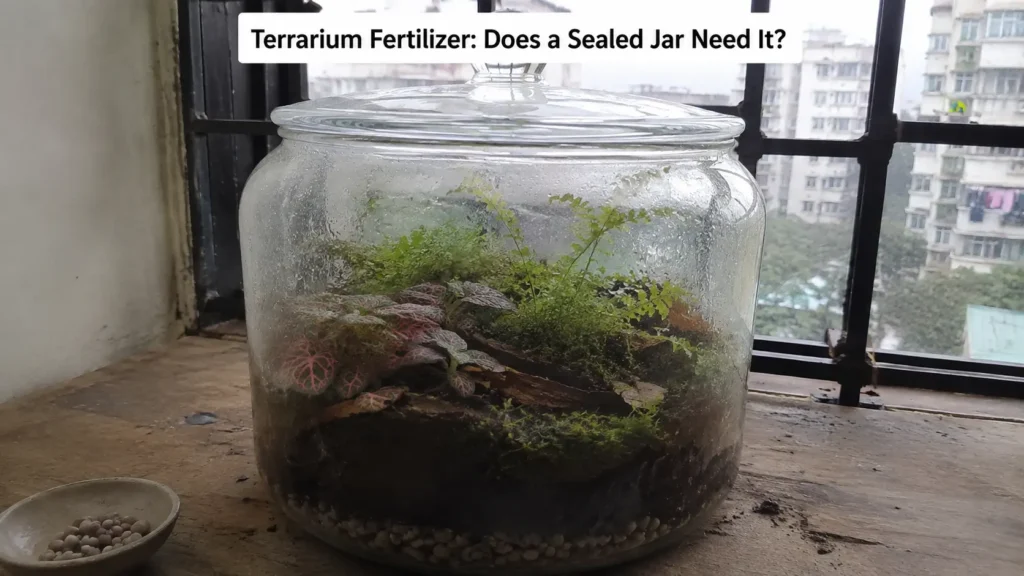
Almost certainly not. A sealed terrarium recycles its own nutrients: leaves fall, break down, and return most of what they took, which is exactly why a balanced closed build can run for years with nothing added. Mississippi State University Extension says it flatly in its closed-system terrarium guide, publication P3253: “There is no need to add fertilizer to a closed system” (read 2026-08-26). And there is a second reason to be careful that most pages skip. A sealed jar has no drainage. Excess fertilizer salts cannot be rinsed back out, so a feeding mistake stays in the substrate until you rebuild.
The part that makes this different: a closed jar cannot be flushed
In a pot, a fertilizer mistake is recoverable. The standard fix is leaching, and it depends entirely on water leaving through the bottom. Colorado State University’s PlantTalk guidance on leaching salts from potting mixes describes the method as filling the pot to the top with water a couple of times and letting the mix drain well between rinses (read 2026-08-26). University of Maryland Extension, in its page on excess fertilizer and salt damage updated March 7, 2023, notes that high soluble salt levels can come from “a single excess application or repeated applications”, and lists the damage as marginal leaf browning or scorch, wilting, marginal yellowing and stunting.
Now take the drainage hole away. A closed terrarium has no runoff, no evaporation to the room, and no way for you to send water through the substrate and out. Whatever you add stays in the loop with the water that carries it. That is the whole reason this article is cautious where a houseplant article can be relaxed: in a pot, the worst case is a bad month; in a sealed jar, the usual rescue is emptying it and starting again with fresh substrate. If you have already reached that point, the post-mortem checklist is a better use of the next hour than another additive.
So the real question is not “how much do I feed it” but “why do I think it needs feeding at all”.
Start with the diagnosis, because feeding the wrong cause is the mistake
Three symptoms send people looking for terrarium fertilizer, and in a sealed container all three have a more likely explanation than a nutrient shortage.
| What you are seeing | Most likely cause in a sealed jar | Check this first | What feeding would actually do |
|---|---|---|---|
| Pale, stretched growth with long gaps between leaves | Too little light | Where the jar sits and how bright that spot is | Push more weak growth, plus salts you cannot rinse out |
| Growth has slowed or stopped | Often normal, since slow growth is the goal here | Whether the plants are already crowding the glass | Speed up crowding you then have to prune |
| Yellowing leaves | Usually water, sometimes light, sometimes ordinary aging | The condensation on the glass at the same time | Nothing useful, and it muddies the diagnosis |
The light case is worth naming precisely, because it is the one people misread as hunger. University of Maine Cooperative Extension Bulletin #5059, by Dr. Alicyn Smart and Nick Goltz, describes etiolation as “plants with insufficient chlorophyll, elongated, spindly stems and pale leaves due to being grown in low-light conditions” (read 2026-08-26). Pale, leggy and stretched is the low-light signature. Iowa State University Extension and Outreach recommends placing a terrarium in medium to bright indirect light, suggesting an east or north window, and warning against direct sun because heat builds up fast behind glass (Aaron Steil, last reviewed January 2024, read 2026-08-26).
Yellowing is the other frequent trigger, and it is the least specific symptom in the jar. Pair it with the glass before you do anything, which is what the guide to yellow leaves in a terrarium walks through. Heavy unclearing condensation with yellowing points at water, not nutrients.
Why feeding a light problem makes it worse
Light is the limiting factor in most stalled terrariums, and nutrients do not substitute for it. A plant that cannot photosynthesize enough is not short of raw material; it is short of the energy to use it. Add fertilizer and you get the growth response the plant can afford, which is more thin, pale, stretched tissue, in a container where soft crowded growth pressed against wet glass is the starting condition for rot and mold.
There is a second-order problem too. Organic feeds are organic matter, and organic matter in a sealed, still, humid container is food for exactly the fuzz people panic about. If you already have growth on the substrate, work out what it is with the visual mold identification guide before you add anything that could feed it further.
And moving the jar is free and reversible. Fertilizing is neither. If you are unsure which one your build needs, the order is not a close call.
The genuine exceptions, stated honestly
An open terrarium behaves like a pot. No lid means water evaporates away, you water it on a schedule, and normal houseplant feeding logic broadly applies, including the ability to leach the substrate if you overdo it. If you are not certain which type you have, the open versus closed comparison sets out the difference; almost everything cautious on this page is about the sealed kind.
A very old, heavily planted build where the litter has always been removed. If every fallen leaf has been tidied out for years, the loop has been leaking nutrients the whole time. That is the one closed-jar case where a deficiency argument is reasonable. Worth knowing before you act on it: Mississippi State’s guide puts a terrarium’s typical display life at no more than one or two years before the plants outgrow the container, so an old build’s real constraint is usually space rather than food.
Mounted or epiphytic plants that were never in soil. Air plants and mounted ferns are fed differently by nature, since they take nutrients from what washes over them. In an open display that is routine. Inside a sealed jar the same warning applies as everywhere else on this page: what you spray still has nowhere to go.
A brand new build is not an exception. A jar in its first months is settling, not starving. What that period looks like is covered in how long a terrarium takes to stabilize.
If you feed anyway, here is what the published guidance actually assumes
Iowa State’s terrarium page starts by saying “Fertilizer should be avoided because it will encourage growth and earlier crowding of the plants”. For plants showing real signs of low fertility, it then suggests a balanced all-purpose fertilizer with low numbers, such as 10-10-10 or 4-4-4, mixed at quarter strength.
Read that as a ceiling, not a recipe, and note what it is measured against: quarter strength means a quarter of the rate on your bottle, and the rate on your bottle was written for a pot that drains. Nobody publishing a fraction knows the volume of your jar, the amount of substrate in it, or how much water is already cycling through it. I have not found a university source that publishes a feeding schedule specific to sealed containers, and I am not going to invent one here. If you go ahead, the honest version is: far less than the label says, once, and then watch for weeks rather than repeating.
Treat the product as a garden chemical, because it is one. Follow the label’s own directions for mixing, handling and storage, use gloves if the label calls for them, mix it away from food preparation surfaces (terrariums often live on kitchen shelves), and store it closed and out of reach of children and pets. If a child or a pet swallows any, that is a call to make immediately rather than a thing to watch: in the US, ASPCA Animal Poison Control and the Pet Poison Helpline both take calls about animals and both charge a consultation fee, and your vet or your local poison center is the right route for a person.
The safe, free option: leave the leaf litter
The cheapest nutrient input in a closed terrarium is the one already inside it. A fallen leaf that decays in place returns its material to the substrate, and a working cleanup crew of springtails and isopods speeds that up. Tidying every scrap of litter out of a jar keeps it looking neat and slowly exports the nutrients the loop was built to recycle.
One distinction matters. Litter is not the same as diseased tissue. A leaf that is browning and drying on the substrate is fuel for the system, while a soft, dark, actively spreading lesion is an infection that should come out promptly, as the guide to terrarium leaf rot explains. Leave the litter, remove the rot.
FAQ
Does a closed terrarium ever need fertilizer?
Rarely. Mississippi State University Extension’s closed-system guide states there is no need to add fertilizer to a closed system, because the sealed container recycles nutrients as plant material breaks down. The main honest exception is an old, heavily planted build that has had every fallen leaf removed for years.
What happens if I over-fertilize a terrarium?
Excess fertilizer salts stay in the substrate, because a sealed jar has no drainage and cannot be leached the way a pot can. University of Maryland Extension lists salt injury as marginal leaf browning or scorch, wilting, marginal yellowing and stunting, and in a closed container the usual remedy is a rebuild with fresh substrate rather than a rinse.
My terrarium plants are pale and leggy. Is that a nutrient deficiency?
Usually not. Pale, elongated, spindly growth is the classic low-light picture that University of Maine Cooperative Extension describes as etiolation. Move the jar to brighter indirect light and give it several weeks before considering anything else, since relocating is free and reversible while feeding is not.
Can I use worm castings or another organic feed instead?
Organic material is still material you cannot take back out, and in a sealed, humid, still container it is also food for mold and fungus gnats. If you use anything at all, use very little, and check any existing growth on the substrate first.
Do open terrariums need fertilizer?
An open terrarium behaves much more like an ordinary potted plant: it dries out, gets watered on a schedule, and can be flushed if you overdo the feeding. Normal houseplant guidance is a much better fit there than the sealed-jar caution on this page.