
Terrarium Maintenance: Weekly, Monthly and Yearly Tasks

A closed terrarium gets sold as the plant that looks after itself. That is mostly true, and this page is about the “mostly”.
Terrarium maintenance for a sealed jar comes down to three habits: look at it every week, act on what you see (dead leaves out, the condensation read, growth checked against the glass), and expect a few bigger jobs each year, such as cutting back, replacing a plant or topping up the substrate. Watering is the rarest job on the list, not the most frequent, and fertilizing is not on it at all.
Why a sealed jar needs so little
Water leaves the substrate and the leaves as vapor, condenses on the cooler glass, runs down and goes back into the soil. That loop is the whole design. Mississippi State University Extension’s publication How to Design a Closed-System Terrarium (P3253, by James DelPrince and Gary Bachman, read September 11, 2026) says that once a closed system reaches equilibrium it “can withstand long periods without additional watering, from weeks to years.”
Iowa State University Extension’s terrarium guide (Aaron Steil, last reviewed January 2024, read September 11, 2026) gives a rough figure: water “will only be needed for many closed terrariums every 3 to 6 months,” and it says frequency varies. The same page makes the point that shapes everything else here: “No plant can be a permanent addition to a terrarium as they will eventually outgrow the space.”
So a sealed jar looks after water. It does not look after growth or dead material, and it does not look after itself when something goes wrong. Maintenance covers those gaps.
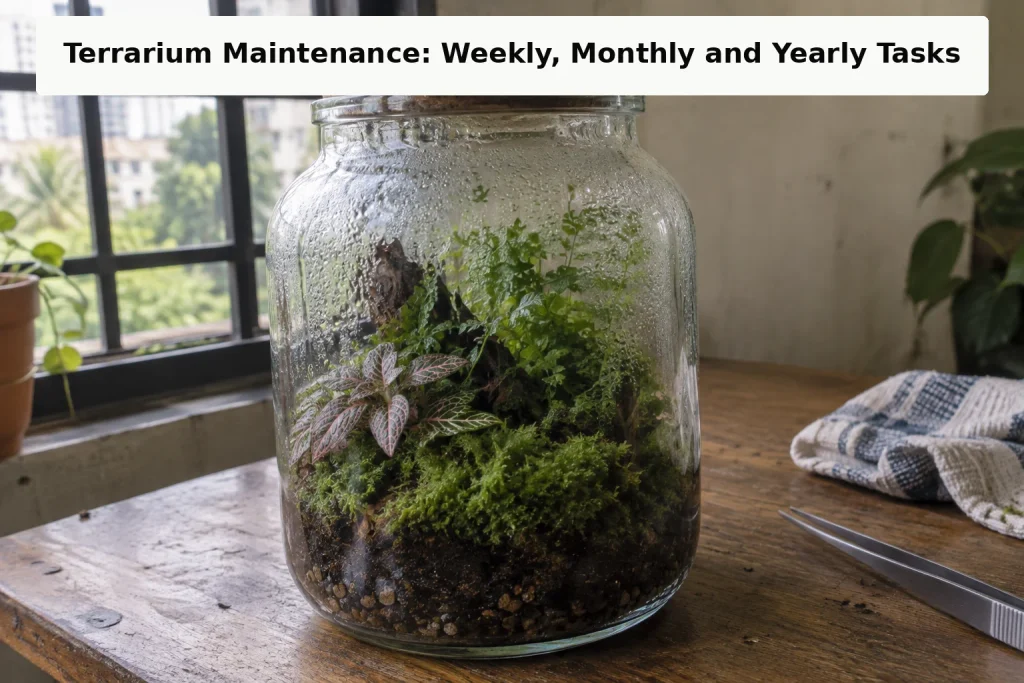
“In my own terrariums, maintenance has become much less about having a schedule and much more about noticing small changes before they become problems. I give my closed builds a quick look regularly, especially for dead leaves, growth pressing against wet glass, unusual condensation, and anything starting to decay. I used to think watering would be the main maintenance job, but in a settled jar it is often one of the rarest. Most of my actual work is simply removing dying material, occasionally trimming plants, and otherwise leaving a stable system alone. The biggest lesson for me has been that knowing when not to interfere is part of terrarium maintenance too.”
Weekly: the two-minute look
Most terrarium maintenance is observation. The weekly job is to look properly, not to do anything by default.
Read the condensation. A working closed jar fogs when the glass is cool, clears as it warms, and carries partial cover the rest of the time. Fog that never clears, or water running down the glass all day, means too much water in the system. The full reading guide is on too much condensation in a terrarium.
Find dead or yellowing leaves and take them out. The Royal Horticultural Society’s terrarium advice (read September 11, 2026) is direct about it: “look out for any dead leaves or other plant debris and remove promptly, to avoid mould.” A dead leaf in a sealed jar is not a cosmetic problem. It is food.
Look for anything white, fuzzy or web-like on the substrate, wood or dead leaves. Some of it is harmless and some of it is the start of a real problem, and telling them apart is covered on terrarium mold identification.
Note what is touching the glass. Leaves pressed against wet glass stay wet, and a leaf that stays wet is the one that rots first.
If you open it, smell it. Earthy is normal. Sour or rotten is a signal, and it is more useful than anything you can see.
Monthly: small corrections
Clean the glass when it needs it. Soil splash and film cut the light the plants run on. Iowa State’s guide notes that soil stuck to the glass “can be rinsed off by lightly running water down the glass,” and the RHS suggests misting so the water runs down the inside and cleans it on the way. Anything more involved, including reaching the inside of a narrow jar, is on cleaning terrarium glass without wrecking the build.
Trim what has reached the glass or the lid. Mississippi State’s publication puts it plainly: “You may need to prune a few leaves or stems if they touch the sides or lid of the container.” A monthly light trim is much easier on a jar than a yearly hard one. Cutting back a genuinely overgrown jar has its own guide on this site.
Turn the jar if the plants are leaning. Plants grow toward the brighter side, and a jar that never moves grows lopsided.
Check the lid. The RHS advises avoiding “metal screw-tops, which can rust.” If you already have one, look at the underside for rust and at the liner or gasket for cracking.
Yearly: the bigger jobs, when the jar asks
None of these belongs on a fixed date. Each has a trigger.
A proper cut-back when light trims no longer keep plants off the glass.
Replacing one plant when it has died or outgrown the space. Iowa State’s warning that no plant is permanent means this is normal, not a failure. The method for doing it without tearing the build apart is covered separately on this site.
Topping up the substrate when it has sunk or roots are showing at the surface. What that fixes and what it does not is on topping up tired terrarium substrate.
Adding water only when the jar has stopped showing condensation and the substrate looks dry. How to judge that is on how often to water a closed terrarium.
No fertilizer. Iowa State says “fertilizer should be avoided because it will encourage growth and earlier crowding of the plants,” and Mississippi State says “there is no need to add fertilizer to a closed system.” Feeding a sealed jar speeds up the one problem you are already managing.
Terrarium maintenance by signal, not by calendar
The calendar headings above are a starting point. The glass is the real schedule.
| What you see | What it usually means | What to do |
|---|---|---|
| Fog that clears through the day | Water cycle running | Nothing |
| Fog that never clears, water running down | Too much water in the system | Vent with the lid off, then reassess |
| No condensation for weeks | Water leaving, or a dry build | Check the lid first, then the substrate |
| Dead or yellow leaf | Normal turnover, or the start of rot | Remove it now |
| White fuzz on debris or wood | Possible mold | Identify it before acting |
| Leaves pressed to the glass | Plant outgrowing its space | Trim back |
| Sour or rotten smell | Decay somewhere in the build | Find the source before resealing |
| Substrate sunk, roots exposed | Settling or breakdown | Top up with the same mix |
The hot, humid room: what changes
Most terrarium care advice assumes a temperate, often heated or air-conditioned room. In a room that is humid for most of the year, a few things behave differently, and none of them needs a number to understand.
Venting is slower. Taking the lid off works because the room air is drier than the air in the jar, so moisture moves out. Mississippi State suggests opening the lid “for about an hour” when condensation builds up. When the room air is itself close to saturated, the difference is small and the same hour does much less. Expect to vent for longer or more often. Watch the glass rather than the clock.
Dead material matters more. Warm, damp, still air suits mold, and a sealed jar is exactly that. The weekly look for debris is the habit that pays for itself.
Metal lids get worse faster. A damp room offers no dry season for a metal lid, so check the underside of any metal lid more often than a guide written for a dry climate would suggest.
Air conditioning moves the condensation. Condensation forms where glass is cooler than the air inside the jar. A room that swings between cooled and uncooled will swing the fog pattern with it. Read the pattern against what the room is doing, not against a textbook morning-fog, afternoon-clear rhythm.
What maintenance is not
It is not watering on a schedule. A sealed jar tells you when it is dry.
It is not wiping away every bit of fog. Condensation is the system working.
It is not opening the lid every day for fresh air. Each opening lets water out and resets the balance. Open it for a reason.
It is not feeding. Both extension sources above say no.
What this page does not publish
No watering volume. It depends on the jar, the substrate and how dry it has become, and no source we read gives one for a sealed container.
No fixed intervals beyond what the named sources state, because the jar’s own signals are more reliable than a calendar.
No product names.
FAQ
How often does a closed terrarium need maintenance? A quick look every week, small corrections about once a month, and bigger jobs such as a cut-back, replacing a plant or topping up the substrate when the jar shows it needs them, which is usually no more than a few times a year. Iowa State University Extension puts watering for many closed terrariums at every 3 to 6 months and says it varies.
Do I need to open a closed terrarium regularly? No. Open it for a reason: to remove debris, to vent condensation that will not clear, or to trim. Mississippi State University Extension suggests about an hour with the lid off when condensation builds up. In an already humid room, venting takes longer.
Should I fertilize a closed terrarium? No. Iowa State University Extension says fertilizer should be avoided because it encourages growth and earlier crowding, and Mississippi State University Extension says there is no need to add it to a closed system.
What is the most important maintenance habit? Removing dead leaves promptly. The RHS gives the reason directly: to avoid mold. In a sealed jar, dead plant material feeds the mold you are trying to prevent.
The short version
Look weekly, correct monthly, and let the jar tell you when the yearly jobs are due. Keep dead material out, keep plants off the glass, keep fertilizer away, and read the condensation before touching the water.