
Should You Ever Open a Closed Terrarium? The Four Times You Should

Readers ask this as a permission question, as though the lid were a rule they might be breaking. It is not a rule. It is a variable, and opening it does something specific that is worth understanding before you do it.
What the lid is actually doing
A closed terrarium works because water cannot leave. It evaporates from the substrate and the leaves, condenses on the glass, runs back down, and does it again. That loop is the entire mechanism, and it is why a sealed build can go months without attention while a pot on the same windowsill needs weekly water.
Opening the lid breaks the loop for as long as it is open. Water vapor leaves as ordinary room air exchanges with jar air, and the system loses some of its water permanently.
So the honest framing is: opening the lid is not forbidden, it is a withdrawal. Sometimes the withdrawal is exactly what you want.
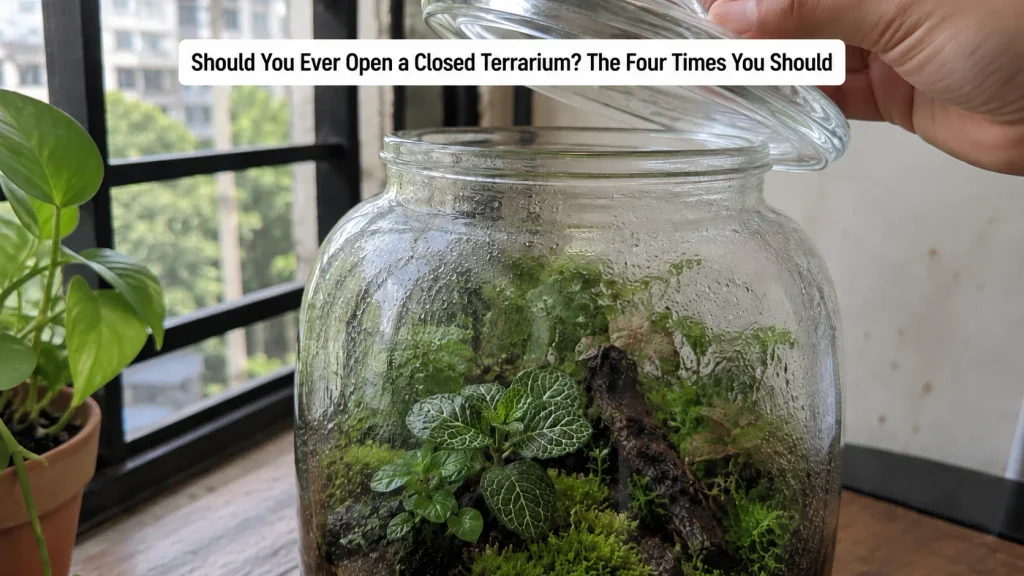
“I only open a closed terrarium when I am trying to change something specific, such as excess moisture, a problem plant, or maintenance. In my build, lifting the lid is a controlled intervention, not routine airing. One thing I watch for afterward is deceptive humidity: a partly open jar can still feel very humid even though its condensation-return cycle has been broken and water is steadily escaping, so leaving it cracked for too long can dry the substrate before the terrarium actually looks dry.”
The four times to open it
1. During the break-in period, deliberately
A newly built terrarium is almost always too wet, because you watered it in and nothing has settled. The standard remedy is to run it open or partly open at first and close it as the balance arrives. That is a scheduled process rather than a reaction, and it is set out on the break-in schedule.
2. When there is genuinely too much water in the system
If the glass is fogged so completely that you cannot see in at any time of day, and it never clears, the build is holding more water than it can cycle. Opening the lid is the correct and often the only remedy, because there is no drainage hole and nothing else removes water.
Read too much condensation first, because the threshold for “too much” is not what most people assume and a partly fogged jar in the morning is normal.
3. When something is wrong and you need to intervene
Mold, rot, a dead plant, a pest outbreak, a smell. You cannot fix any of these through glass. Open it, deal with the problem, close it. The intervention is the reason, not the airing.
If it is a smell, the smell is information rather than something to ventilate away, and the causes are on why a terrarium smells bad. Opening the lid to remove a smell without finding the cause is treating the alarm rather than the fire.
4. For maintenance you cannot do through the opening
Pruning, cleaning glass, replacing a plant. Practical necessity.
The one time not to open it
Because you read that terrariums need airing.
This circulates constantly and it is the houseplant instinct arriving in the wrong container. A closed terrarium is not short of air. The plants and the microbial life in the substrate exchange gases with the jar’s own atmosphere continuously, and a sealed build that is otherwise balanced is not suffocating.
If the build is healthy, opening it on a schedule takes water out of a system that had the right amount and gives nothing back. Then, weeks later, the jar is dry and the reader is looking for a re-watering interval that nobody publishes.
Ventilation is a fix for a specific fault, not a routine.
What actually happens when you open it
Worth knowing, because it explains why the effect is not instant.
Water leaves as vapor with the air exchange, and the rate depends on how humid your room is. In a dry, air-conditioned room a jar loses water quickly with the lid off. In an already-humid room it may lose very little, which is the same climate inversion that runs through this site’s build advice: instructions written for temperate northern rooms do not transfer to a room that is already at high ambient humidity.
The temperature equalizes, which matters if the jar has been in sun.
And the mold picture can change in both directions. Airflow can slow a surface mold. It can also dry a surface layer while the substrate below stays saturated, which addresses the visible symptom and not the cause. What that distinction looks like is on mold and condensation.
How to do it, if you are doing it
Open partly first. A lid cracked or lifted at one edge is a smaller withdrawal than a lid removed, and you can escalate.
Time it by looking, not by the clock. We publish no duration, because no source publishes one and it depends on your room’s humidity, your temperature and how far out of balance the build is. The instrument is the glass: watch the condensation pattern and close it when the pattern looks like a working jar again rather than a fogged one.
Close it before it dries out. Overshooting is the failure here, and it is harder to correct than being slightly too wet, because adding water back into a sealed build is a delicate operation with no drainage to catch a mistake.
Do it once and observe for several days. Changing two things at once in a slow system teaches you nothing.
The honest summary
Open it for a reason. Close it when the reason is gone. There is no schedule, there is no airing requirement, and a healthy sealed build is doing what it was built to do.
And if you find yourself opening it repeatedly to control the same problem, the problem is in the build rather than in the lid: too much water, too much light, the wrong substrate, or a plant that does not belong in a sealed container. The lid is the last thing to adjust, not the first.
FAQ
Is opening a closed terrarium bad for it? It is not forbidden and it is not a rule you are breaking. It is a withdrawal. While the lid is off, jar air exchanges with room air and the system loses some of its water permanently, so the question is whether you have a reason worth that cost.
Do closed terrariums need airing on a schedule? No. A sealed build is not short of air, because the plants and the microbial life in the substrate exchange gases with the jar’s own atmosphere continuously. Opening a healthy jar on a schedule takes water out of a system that had the right amount and gives nothing back. Ventilation is a fix for a specific fault, not a routine.
How long should I leave the lid off? We publish no duration, because no source publishes one and it depends on your room’s humidity, your temperature and how far out of balance the build is. The instrument is the glass: watch the condensation pattern and close it when the pattern looks like a working jar again rather than a fogged one.
Will opening it clear up mold? It can go either way. Airflow can slow a surface mold, and it can also dry a surface layer while the substrate below stays saturated, which addresses the visible symptom and not the cause.
I keep opening it to control the same problem. What am I doing wrong? The problem is in the build rather than in the lid: too much water, too much light, the wrong substrate, or a plant that does not belong in a sealed container. The lid is the last thing to adjust, not the first.
What this page does not publish
No duration for how long to leave it open, because none is published and the glass is a better instrument than any number.
No airing schedule, because a healthy sealed terrarium does not need one.