
Open Terrarium Watering vs Closed: What Changes

If your terrarium has no lid, almost none of the sealed-jar advice you have read applies to it, and the single most consequential difference is this: in a closed terrarium the container is doing the watering, and in an open one you are. That sounds obvious and it is not, because the advice that circulates for open terrariums is mostly houseplant advice, and an open terrarium is not a houseplant either. It is a plant in a glass container with no drainage hole, which is a third thing with its own failure mode.
This page is about watering specifically. The build decision, which container suits which plants, is a separate question.
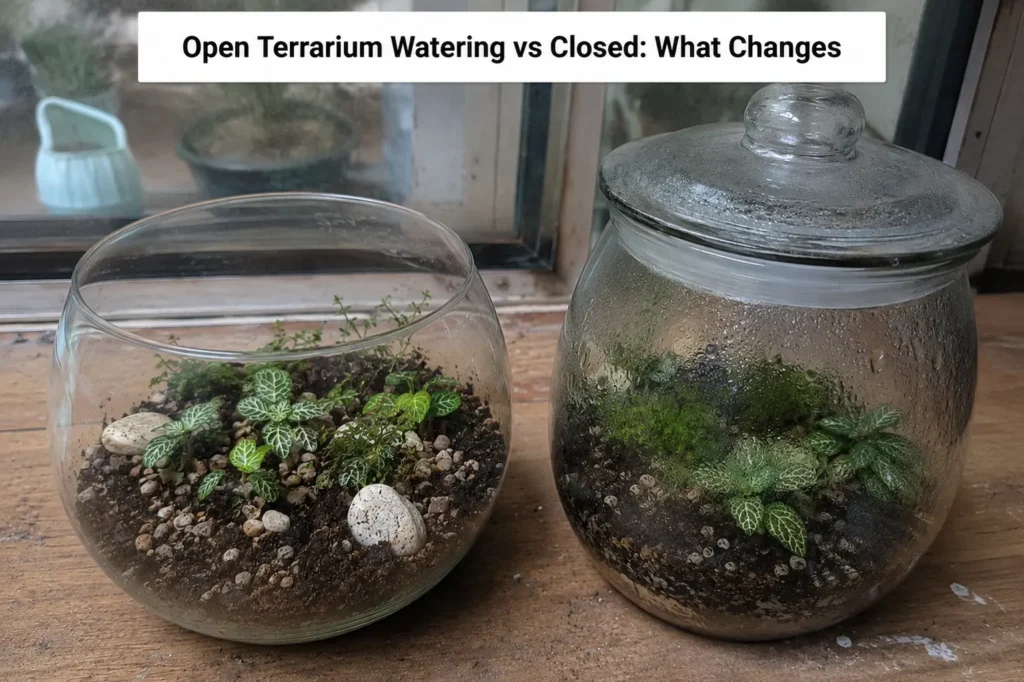
“I treat open and closed terrariums as two different watering systems, even when the containers look similar. In my own builds, like the open and closed pair shown here, the difference is easy to see: the open terrarium steadily loses moisture to the room, while the closed one keeps recycling it through condensation. I therefore water an open build by checking the substrate and drainage layer, but with a closed build I mostly let the glass tell me whether any water is needed at all.”
The one structural fact that decides everything
A closed terrarium runs a water cycle. Moisture evaporates, condenses on the glass, and returns to the substrate. Almost nothing leaves. That is why a sealed jar can go months without attention, and why the useful instrument for a sealed jar is the condensation on its glass rather than a calendar.
An open terrarium has no cycle. Moisture evaporates and goes into the room. You are the return leg. That makes an open terrarium’s watering behavior far closer to a potted plant’s than to a sealed jar’s, and it means the sealed-jar reading you may have learned, watch the fog, do nothing, is actively wrong here: an open terrarium that shows no condensation is behaving exactly as it should.
But the resemblance to a potted plant stops at the bottom of the container, and this is the part that catches people who transfer houseplant habits across. A pot has a drainage hole. Water you overcommit runs out of it. A glass bowl, an apothecary jar, a fishbowl, a wide dish, a bottle with the cork left off: none of them have one. So an open terrarium combines the drying behavior of a houseplant with the no-exit plumbing of a sealed jar, which is the worst pairing on offer and the reason so many of them die of root rot despite being visibly dry on top.
Why the standard houseplant fix cannot be run here
There is a well documented remedy for a potted plant that has been overwatered or over-fertilized: leach it. Fill the pot with water, let it drain fully, and repeat, so that excess water and dissolved salts leave through the bottom. University extension guidance on potting mixes describes exactly that method, and it works.
Every step of it depends on water leaving through the bottom of the container. In an open terrarium there is no bottom to leave through. The same is true of the sealed jar, which is why this site keeps returning to the point: the container, not the lid, is what makes terrarium advice different from houseplant advice. The lid decides how fast water leaves upward. The missing drainage hole decides that nothing leaves downward, ever, in either type.
Two practical consequences follow, and they are the reason this page exists.
Water added to an open terrarium accumulates at the bottom until it evaporates back up. A drainage layer of gravel or LECA under the substrate gives that water somewhere to sit away from roots, which is genuinely useful, but a drainage layer is a reservoir and not a drain. It buys margin. It does not remove water from the container.
Dissolved minerals and fertilizer salts accumulate permanently. In a pot they leave with the runoff. Here they stay, concentrate as water evaporates, and build up over months. This is a slow failure that presents as browning leaf margins and stunted growth long after the watering that caused it, and it is the main argument for using rainwater, distilled or filtered water if your tap water is hard, and for being extremely conservative with feeding.
How to actually water an open terrarium
Check by weight or by finger, not by schedule. Push a finger into the substrate up to the first knuckle. If it comes out with substrate clinging damp to it, wait. If the top layer is dry but it is damp below, usually wait. Dry at that depth, water. For a small container you can also learn its weight: lift it when freshly watered and lift it again a week later, and the difference becomes obvious quickly. Neither method needs equipment and both beat any interval a page can give you.
Look at the drainage layer before every watering. You can see it through the glass. If there is free water standing in it, the container has water regardless of how the surface looks, and adding more is the mistake this whole page is about.
Add less than you think, and add it slowly. A spray bottle for moss and small tropicals, a narrow-spouted bottle or a syringe for anything else, aimed at the substrate rather than over the plants. The target is damp substrate with no water visible in the drainage layer. Because you cannot pour off a mistake, the correct technique is small amounts checked as you go rather than one confident pour.
Water the substrate, not the leaves. Water sitting in the crown of a plant, in an enclosed glass container with limited airflow, is where rot begins. Mist to raise humidity if the plants want humidity; do not mist as a substitute for watering, because misting wets leaves and barely reaches roots.
Adjust for what the container actually is. A wide open dish with a large surface area dries fast and may need water weekly. A tall narrow vase with a small opening barely vents at all, behaves half like a closed system, and can go far longer. Two containers described by the same word can differ by an order of magnitude in how often they need you, which is another reason no published frequency is worth much.
Adjust for the plants. Succulents and cacti in an open container want the substrate to dry out completely between waterings and will rot if it does not. Ferns, moss and tropical foliage want it consistently damp and will crisp if it dries. If your open terrarium contains both, the watering problem is a planting problem and no schedule will fix it.
Adjust for the room. Ambient humidity changes how fast an open container gives up its water, and it changes it by a lot. A dish that needs water every five days in a dry heated room may go three weeks in a humid one, and the seasonal swing in a monsoon climate moves the answer twice a year. The climate section of our humid-build guide covers why local conditions override tutorial numbers, and that applies to open containers as much as to sealed ones.
Reading the signals, side by side
The useful contrast is not “how much water” but “what am I looking at to decide.”
| Closed terrarium | Open terrarium | |
|---|---|---|
| What tells you it needs water | No condensation anywhere on the glass across a full week, plus pale substrate and a dry drainage layer | Substrate dry at finger depth, container noticeably lighter |
| What condensation on the glass means | The cycle is running; usually leave it alone | Poor airflow or a container too enclosed for what is in it |
| Normal frequency | Possibly never; long gaps are correct | Days to weeks, set by container shape, plants and room |
| Sign of too much water | Streaming glass that never clears, water in the drainage layer | Water in the drainage layer, soft yellowing lower leaves, a sour smell |
| How to correct too much | Open the lid until it dries back | Leave uncovered somewhere airy, blot standing water, wait |
| Can you flush a mistake out? | No | No |
The last row is the one to keep. It is the same answer for both, and it is the answer that separates every terrarium from every potted plant.
Two mistakes that come from mixing the two sets of advice
Sealing an open build because the plants looked dry. Putting a lid or plastic wrap on a container that was planted with dry-loving plants, or with a substrate mix that was never intended to hold moisture, converts a manageable drying problem into an unmanageable wet one within days. If a build keeps drying out too fast, the fixes are a narrower opening, a different container, or different plants, and not a lid on a build that was not designed for one.
Treating a closed jar like an open one and watering it monthly. This is the more common direction and it is the more destructive. A sealed jar being watered on an open-container schedule has nowhere to put any of it.
If you have one of each on the same shelf, it is worth writing the type on the underside of the container, because from a meter away they look like the same object and they want opposite things.