
Terrarium Problems: Reading the Glass, Soil and Smell

Almost every troubleshooting guide for terrariums is a list of named problems. Mold. Overwatering. Yellowing leaves. Poor air circulation. Each one gets a cause and a fix, and the list is usually accurate.
It is also close to useless for the person who most needs it, because a list organized by the name of the problem only helps someone who already knows the name. The reader searching for what is wrong with their terrarium is standing in front of a jar with three pieces of evidence and no vocabulary: what the glass looks like, what the substrate looks like, and what it smells like when the lid comes off.
So this guide runs the other way. Start from what you can observe, narrow to what it can be, and end with a name you can act on.
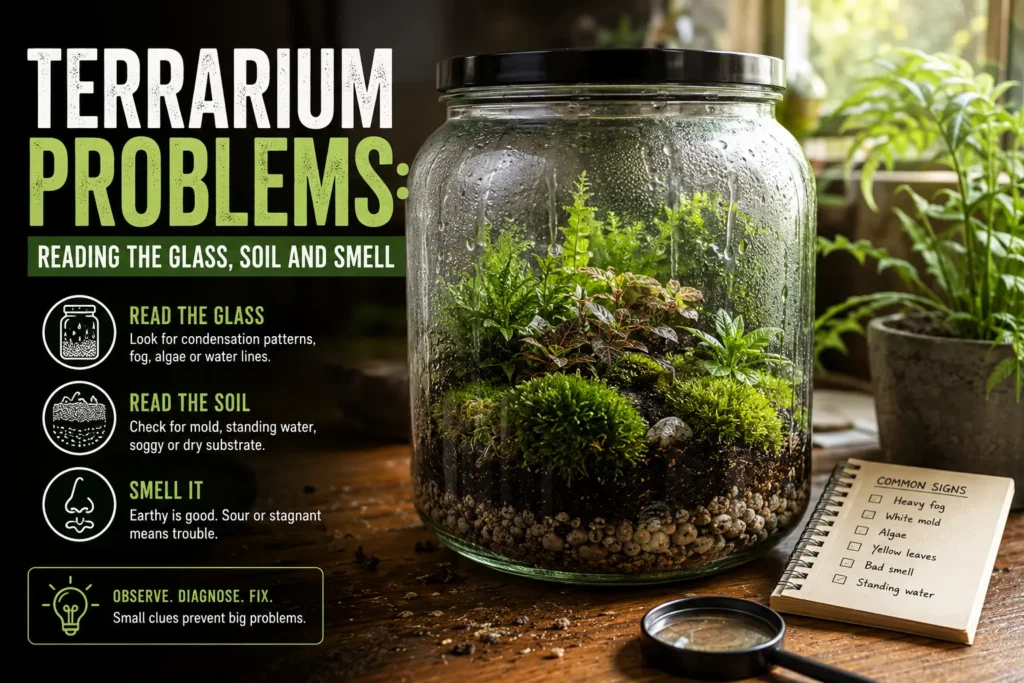
Start with what you can actually see
Before opening anything, do three things in order.
Look at the glass from the side, in daylight if possible, and note the pattern rather than just the presence of fog. Whether it is even or patchy, whether it clears through the day, whether the film is on the inside or the outside.
Look at the substrate and the drainage layer through the glass. In most containers the layers are visible from the side, which means you can see standing water without disturbing anything.
Then open the lid and smell it. Do this last, because opening changes the state of the system, and once the jar has vented you cannot re-read the condensation for a while. Smell is the single most informative observation available and the one nearly every guide leaves out.
Look at the plants after all three. Plant symptoms are the slowest indicator, they arrive after the underlying condition has been running for a while, and they are the most ambiguous: yellowing leaves have half a dozen possible causes and narrow nothing down on their own.
Door one: reading the glass
Heavy fog, all day, running droplets, weeks after building. The system is holding more water than it can cycle. In a young build this may just be an unfinished break-in. Past that, it usually points at one of three build decisions: too much water at planting, an undersized or absent drainage layer, or a substrate holding more moisture than it should.
No condensation at all. Two very different causes with a simple test between them. Either the seal is not sealing, in which case moisture is escaping continuously, or the build is genuinely dry. Check the lid first, since it is the easier of the two to confirm, then look at whether the substrate is dark and damp or pale and pulling away from the glass.
Fog that clears by midday and returns overnight. This is the healthy pattern. It is what a balanced build looks like and it needs nothing.
A cloudy film that does not wipe clean and is not condensation. Mineral deposits from hard water are the usual cause, left behind when droplets evaporate against the glass. Cosmetic, not a health problem, and not urgent.
Green film on the inside of the glass. Algae, which needs light and moisture and has both. It is unsightly rather than dangerous. Heavy algae generally indicates the build is getting more light than it needs, which is worth knowing for its own sake.
Streaking or a persistent water line inside the container. Usually where condensation runs consistently down one face. Cosmetic on its own, but worth noting where the water is collecting.
Door two: reading the substrate
White or gray fuzz on the substrate surface or on wood. Very common in the first weeks of a new build, often recedes on its own as residual sugars are consumed and the system settles. It becomes a real problem when it spreads onto living leaves, when it is dark or slimy rather than fine and white, or when it comes with a bad smell. The mold and condensation guide covers the distinction in detail.
Visible standing water in the drainage layer. A shallow amount sitting in the gravel or LECA is normal and is exactly what the layer exists for. Water rising up into the substrate above it is not. That is a build with more water in it than the layers can hold, and it is the condition most likely to end a terrarium, because saturated substrate cuts oxygen off from roots.
Dark, sodden patches in an otherwise evenly damp substrate. Localized waterlogging, frequently under a piece of hardscape or in a low point of the container. Worth lifting and looking if there is a smell to go with it.
Substrate pale, shrunken, pulling away from the glass. Too dry. Uncommon in a properly sealed build and usually appears alongside an absence of condensation, which points back at the seal.
Fine white specks that move. Springtails, and they are helpful. They eat decaying material and surface growth, and their presence in a healthy build is a good sign rather than an infestation.
Door three: reading the smell
This is the fastest diagnostic available and it takes one second.
Earthy, like forest floor after rain. Correct. This is what a healthy sealed build smells like, and it is a strong signal even when the glass looks slightly off.
Sour, stagnant, like a drain. This is the serious one. That smell means anaerobic decomposition: material breaking down without oxygen, which happens in waterlogged substrate. It is the smell of a build that is actively failing rather than one that looks untidy, and it warrants acting rather than waiting.
Sweet and fermented. Plant material breaking down, usually more of it than the system can process. Look for something substantial that has died and is decomposing where you have not spotted it.
Nothing at all. Not a bad sign in itself, particularly in a young build or a sparse one. Read it alongside the glass rather than on its own.
Reading the plants last, not first
Plant symptoms are what most people notice first and what should be interpreted last, because they are downstream of everything above.
Yellowing leaves are consistent with too much water, too little light, or a plant that is simply shedding older growth while establishing. On their own they narrow nothing.
Brown, crisp edges inside a sealed jar are counterintuitive and usually mean heat or direct sun rather than dryness, since a sealed container is rarely short of moisture. A jar in an afternoon sun position cooks.
Black or soft spots spreading leaf to leaf point at rot, and rot points back at moisture and airflow, which is the glass and the substrate again.
Wilting despite obviously damp substrate is a signal worth taking seriously. In an open pot, a wilting plant usually wants water. Inside a sealed jar with wet substrate, wilting more often means roots are failing in saturated conditions, and adding water makes it worse. This is one of the places where houseplant instincts actively mislead.
Leggy, stretched growth reaching in one direction is a light problem, and the direction points at where the light is coming from.
What is urgent and what can wait
Not everything on the list carries the same weight, and most guides treat them as though they do.
Act now: a sour or drain-like smell, water rising into the substrate from the drainage layer, or growth spreading across living leaves. These are progressive. They get worse on their own.
Watch and address soon: heavy fog that has persisted for weeks, dark sodden patches, spots spreading between leaves, a plant wilting in wet substrate.
Cosmetic, fix when convenient: algae on the glass, mineral film, streaking, a single yellowing older leaf, moss that is not spreading as fast as expected.
The most common failure in terrarium keeping is not neglect. It is intervening hard on something cosmetic and disturbing a build that was settling perfectly well.
Every symptom points back to a build step
This is the pattern worth internalizing, because it turns troubleshooting into prevention.
| What you see | The build decision behind it | Where it is covered |
|---|---|---|
| Persistent heavy fog | Too much water at planting | First watering |
| Water rising into the substrate | Drainage layer too small or absent | Drainage layer |
| Substrate staying sodden | Mix holds too much water | Substrate |
| Growth in week one | Starting spore load, unprepared materials | Sterilizing |
| Fuzz on wood specifically | Wood choice and preparation | Hardscape |
| Never settling into a rhythm | Break-in cut short, or the climate | Break-in schedule |
Almost nothing goes wrong in a closed terrarium at random. It goes wrong because of a decision made during the build, and the useful move after fixing a symptom is to find the decision behind it so the next build does not repeat it. The build guide covers the sequence those decisions sit in.
The site’s account of a first terrarium dying in two weeks is the same pattern in narrative form, and most of the mistakes in it are on the table above.
What not to do while diagnosing
Do not change several things at once. If you vent, remove a plant, wipe the glass and add water in the same session, you have learned nothing about which of them mattered.
Do not use the finger test. Pressing a finger into the substrate to check moisture comes from open-pot houseplant care. Inside a sealed jar the substrate is supposed to be damp, so a damp reading tells you nothing, and the visible evidence through the glass is better information anyway.
Do not water because a plant is wilting, at least not before checking whether the substrate is already wet. In a sealed container, wilting in wet substrate usually means the opposite of thirst.
Do not leave the lid off indefinitely as a general fix. Venting is a targeted correction for excess moisture. A closed terrarium left open stops being one, and the plants selected for it were selected for high humidity.
Do not tear down a build in week two. The first weeks look alarming in almost every new terrarium. Fuzz appears, leaves drop, the glass streams. Most of it resolves as the system settles, and the stabilization timeline sets out what the normal progression actually looks like.
FAQ
How do I tell mold from mycelium without a microscope?
Practically, you often cannot, and for most builds it does not change the response. What matters is behavior: fine white growth on wood or substrate that stays put and recedes is ordinary. Growth that spreads onto living leaves, or that is dark or slimy, is not, and the response is the same either way.
My terrarium smells bad. Is it dead?
Not necessarily, but a sour or drain-like smell means anaerobic conditions in the substrate and it is the one symptom worth acting on immediately. It comes from too much water sitting where there is no oxygen, so the drainage layer and the amount of water in the build are the places to look.
Should I open it while I figure out what is wrong?
Open it once, briefly, to smell it. Then close it. Leaving it open changes the conditions you are trying to diagnose and starts drying a system built to hold moisture.
Can I just start over?
Sometimes that is the right call, particularly when substrate is saturated and sour throughout. It is rarely the right call in the first month, when what looks like failure is usually a build finding its balance.