
Moss Overgrowing Terrarium: How to Rein It In

Moss overgrowing terrarium space usually comes down to too much light, too much standing moisture, or too much nutrient sitting in the substrate for what is naturally a slow, shade-loving plant. The practical fix is not a rebuild. Trim the mat back with clean scissors, cut misting frequency, move the jar out of brighter light, and stop letting decaying leaf litter feed the patch. Left unchecked, a thick moss mat can shade out smaller plants, trap enough moisture underneath itself to invite mold, and eventually brown out from its own base. Three adjustments, not a teardown, bring it back into proportion.
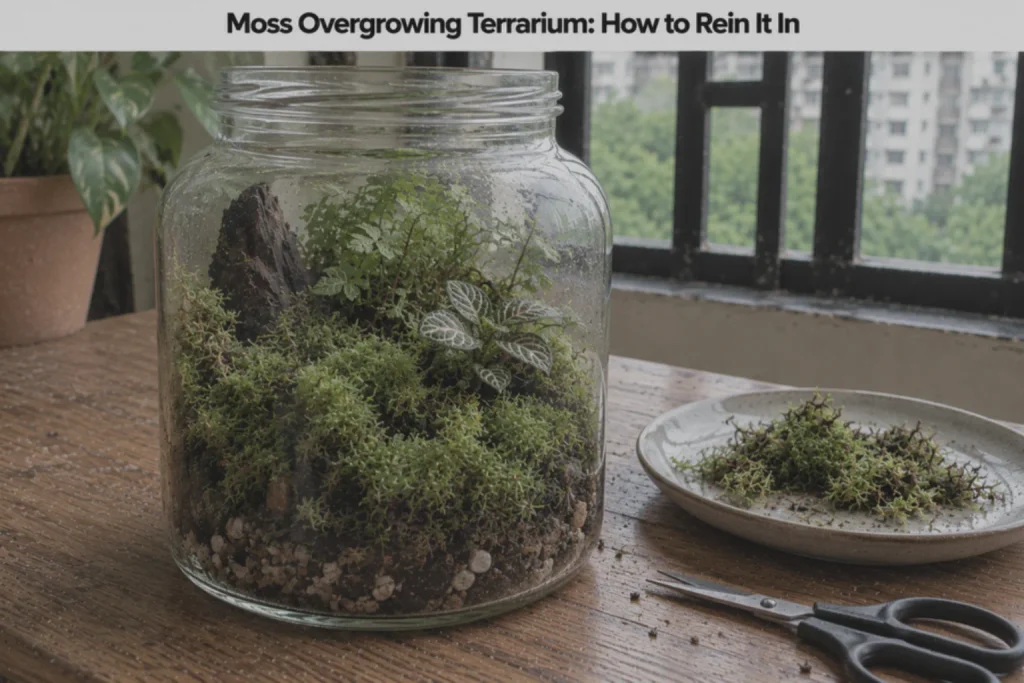
“In my own jars, I’ve found that overgrown moss is usually a sign that the terrarium is doing too well in one direction rather than failing outright. When it starts creeping into smaller plants or building up into a thick mat, I trim only the top layer, remove every clipping, and then look at what is feeding that growth instead of just cutting harder. For me, the useful checks are light, how wet the moss stays, and whether decaying material underneath is adding more nutrients than the patch needs. The biggest thing I try to avoid is stripping it back to bare substrate, because a light thinning keeps the moss healthy while restoring space and airflow around the rest of the build.”
Moss Overgrowing Terrarium Setups: The Biology Behind It
Moss is a bryophyte: it has no true roots and no internal vascular tissue to move water, so it absorbs both moisture and nutrients directly across its leaf surface instead. Michigan Technological University’s Bryophyte Ecology reference, an academic guide to moss and liverwort biology read September 18, 2026, describes this whole-surface absorption as one of the defining traits separating bryophytes from later vascular plants, along with rhizoids that anchor the plant to a surface rather than feed it the way roots do.
In the open, that trait is a liability. Moss dries out fast without regular rain or fog, and taller plants shade it out or crowd it for space. Inside a sealed jar, the same trait becomes an advantage with almost nothing holding it back. Humidity stays high and steady, condensation cycles moisture back onto the moss on a near-daily rhythm, and there is no wind or dry spell to reset growth. A patch that would take a season to fill in outdoors can noticeably thicken in a closed terrarium in a fraction of that time. Once conditions favor it, moss also spreads by fragmentation, meaning a torn-off piece can root wherever it lands, not just by the visible mat creeping outward at its edges.
Moss, Algae or Liverwort? Confirm What’s Actually Spreading
Before trimming anything, confirm what is actually growing, because moss, liverworts and algae get lumped together and treated the same way when they call for different responses.
True moss has small, distinct leaves arranged around a visible stem, and it holds its shape when it dries out, curling rather than dissolving into a film. A liverwort growing under the same conditions often shows up differently: a flat, ribbon-like or scalloped green mat pressed directly against the substrate or glass, sometimes with a bubbly or textured surface, without the leafy stem structure moss has. The two are related but distinct groups within the bryophytes. Per the same Bryophyte Ecology reference, liverworts can form either a leafy body or a flattened thallus of tissue several cells thick, while true moss leaves are always a single cell layer thick, arranged around a stem. That structural difference is also why liverwort tends to spread as a flat sheet rather than a raised, cushiony mat.
Algae, by contrast, is not a plant at all. It shows up as a green film or slick coating on glass, wood or wet substrate rather than as a structured mat, and it wipes or scrapes off rather than trimming like a plant would. If what’s actually spreading is a green film on the glass rather than a leafy mat, treat it as an algae problem and not a moss overgrowth problem, since the fix for one does not address the other.
How to Trim Overgrown Moss Without Killing It
Once the growth is confirmed as moss, thinning it back is straightforward and low risk when done a little at a time.
- Use clean, sharp scissors or curved micro-snips rather than pulling by hand. Moss tears rather than cuts cleanly when pulled, and a torn-out clump takes substrate and neighboring rhizoids with it.
- Take a thin layer off the top rather than shaving a section down to bare substrate. Moss regenerates from what is left behind, and a full clear-cut removes the base it needs to regrow from.
- Work in small sections and pause between them. It is easier to take more off on a second pass than to fix a mat that has been over-thinned.
- Mist lightly after trimming, not heavily. A light mist settles cut edges and loose debris without adding the extra moisture that helped cause the overgrowth in the first place.
- Remove the clippings instead of leaving them in the jar. Cut moss fragments left sitting on the substrate are exactly the kind of organic debris mold uses as a food source, so lift them out with tweezers rather than tucking them under the remaining mat.
Moss does not need frequent haircuts the way a fast-growing vascular plant might. Checking every few weeks and trimming only what has genuinely crossed into another plant’s space, or grown thick enough to trap standing moisture underneath itself, is enough for most closed setups.
Fix the Three Conditions Feeding the Overgrowth
Trimming buys time, but the mat comes back the same way unless one of the three conditions driving it actually changes.
Light. Moss is a shade specialist, not just a plant that tolerates low light, and it out-competes almost everything else when light stays dim and even. Oregon State University’s Extension Service, in guidance on managing moss growth read September 18, 2026, makes a point that transfers directly to a jar even though the guidance itself is written for lawns: moss thrives specifically where shade suppresses competing plants, and once more light reaches an area, other plants can compete with it again. Inside a terrarium that does not mean total darkness, since moss still needs some light to photosynthesize, but nudging the jar toward a brighter, indirect spot for a few weeks tips the balance back toward the vascular plants moss has been outgrowing.
Moisture. A jar that gets misted heavily or opened rarely gives moss exactly the saturated, unbroken humidity it thrives on. Cutting back the misting schedule, and briefly opening the lid for airflow where the build allows it, removes some of the constant water access that made growth so fast in the first place.
Substrate nutrients. Moss growing directly over a rich, organic-heavy substrate has more to draw on than moss growing over a leaner mix. If the terrarium substrate mix underneath is packed with decomposing leaf litter or an overly rich topsoil layer, that steady nutrient release feeds the moss as much as it feeds anything else in the jar. The same pattern shows up where moss has crept from the substrate onto hardscape: moss climbing over wood and stone hardscape that is still breaking down has an additional food source in the decaying wood fiber itself, which is one reason moss overgrowth and softening hardscape often show up together.
When Overgrown Moss Turns Into a Mold Problem
A moss mat grown thick enough to trap moisture underneath itself is no longer just a light and space problem. Dense, matted moss holds water against the substrate and against glass longer than an open surface would, and that trapped dampness with little airflow is the same condition that lets mold establish. If lifting a section of overgrown moss reveals a damp, slightly slimy substrate underneath, or a musty smell that was not there before, treat that as a moisture problem first. The terrarium mold and condensation guide covers reducing trapped humidity without stressing the rest of the setup. Any fuzzy, web-like or unusually colored growth found underneath the moss itself, rather than the moss simply looking dull or matted, is worth checking against a terrarium mold identification guide before assuming it is just overgrowth debris and clearing it away without a closer look.
Keeping It From Coming Back
Prevention comes down to keeping the same three levers deliberately tuned rather than waiting for a problem to reappear. Site the jar somewhere with bright but indirect light rather than a deep, dim corner where moss without competition will simply run, since that setup still suits shade-tolerant plants while favoring moss less than deep shade does. Mist to the point of light condensation rather than standing droplets, and let the jar’s own humidity cycle do most of the work between waterings. Leave a visible gap between the moss and any slower-growing plant near it rather than letting the mat butt right up against it, since a small buffer gives an easy line to trim back to before moss has actually climbed over a neighbor.
None of this requires watching the jar constantly. A short check every couple of weeks, looking specifically at whether the moss has crept past where it started, catches overgrowth early enough that a quick trim is all it ever needs.
FAQ
Does moss ever stop growing on its own inside a terrarium? It slows down rather than stopping outright. Growth rate tracks light, moisture and available nutrients, so once those three settle into balance with the rest of the jar, moss tends to fill in more gradually instead of visibly expanding week to week. It rarely stops needing an occasional trim altogether.
Will trimming moss kill it? Not if only the top layer is removed. Moss regenerates from the base and the rhizoids left behind, so a light trim that leaves structure in place recovers within a few weeks. Shaving a patch down to bare substrate removes the base it needs to regrow from and is much slower to recover, if it recovers at all.
Can overgrown moss actually smother the plants underneath it? Yes, in two ways: by physically covering a smaller plant’s leaves and blocking light to them, and by trapping enough moisture at the base of a plant to encourage rot. Both are reasons to trim moss back from a plant’s base rather than letting the two grow into each other.
Is moss overgrowth a sign my terrarium is unhealthy? Not by itself. Moss overgrowing is more often a sign the jar has settled into strong, stable, high-humidity conditions, since moss thrives precisely in that kind of stability. It becomes a problem only when it starts shading or crowding other plants or trapping moisture against the substrate, which is a maintenance issue rather than a sign the whole setup has failed.
How often should I check terrarium moss for overgrowth? Every two to three weeks is enough for most closed setups. Moss grows slowly enough that daily or even weekly checks are unnecessary; the goal is catching it before it has crossed into another plant’s space or thickened enough to trap moisture underneath itself.