
Replace a Plant in a Terrarium Without Rebuilding It

One plant has died, and everything around it looks fine. The instinct is either to leave the gap or to take the whole jar apart. Usually neither is necessary.
You can almost always replace a plant in a terrarium without rebuilding it: find out why it died, lift it out with its roots and the substrate right around them, fill the hole with fresh mix of the same kind, plant the replacement, and leave the jar open for a while before resealing. The step people skip is the first one, and it is why replacements so often die in the same spot.
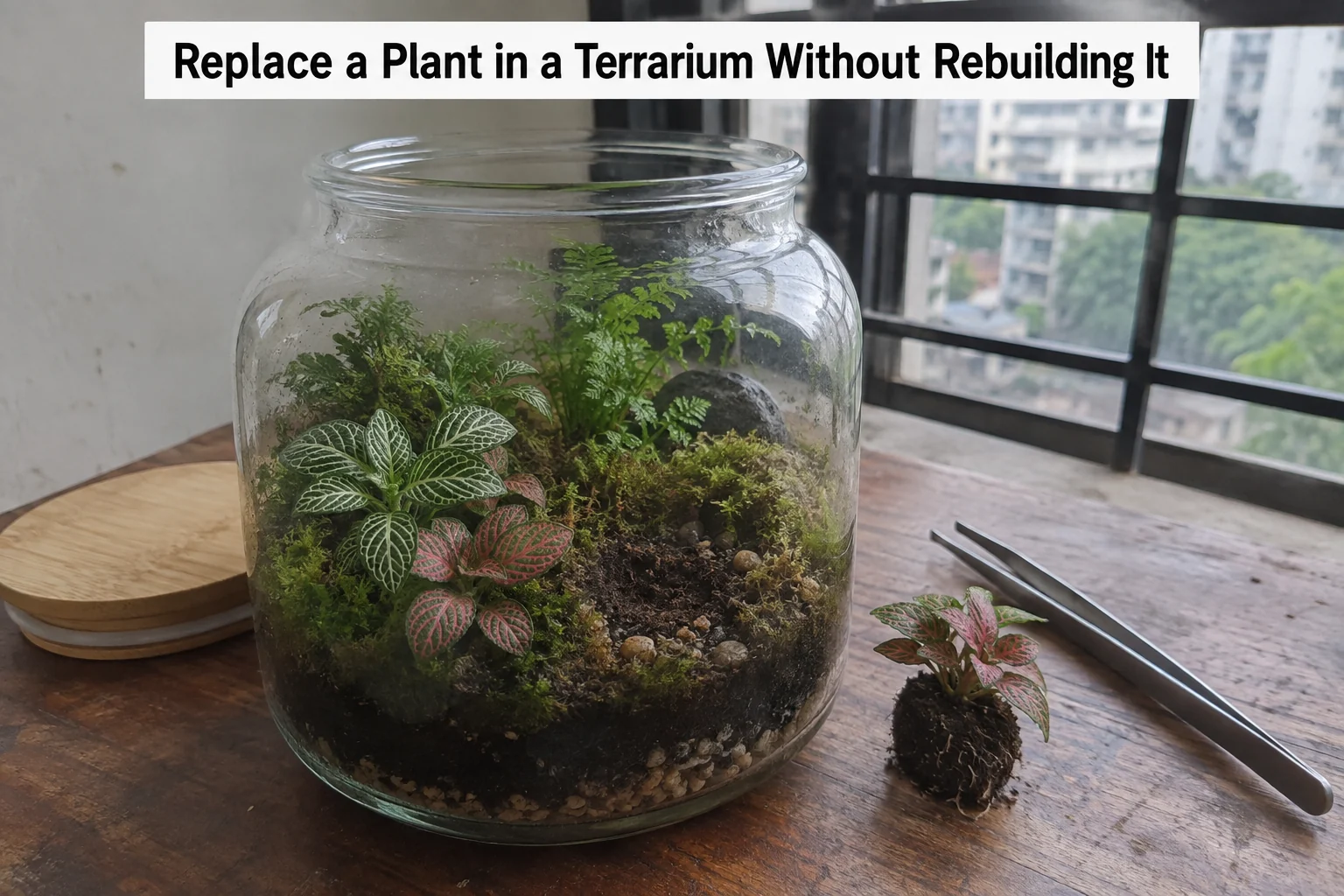
“In my own terrariums, replacing one plant has taught me not to treat every loss like a reason to tear the whole build apart. If everything around the failed plant still looks healthy, I remove that one plant carefully, take out the damaged root zone and any decaying material, refill the gap with the same substrate, and replant without disturbing the rest of the jar. The part I pay most attention to now is why that exact spot failed in the first place. If the soil there is staying wetter, the neighboring plants are shading it, or the replacement is simply another poor fit for sealed humidity, putting in a new plant only repeats the same mistake.”
First: why did it die?
A replacement goes into the same substrate, the same light and the same air. If the cause is still there, the new plant meets it too.
| What you see | Likely cause | Replace now, or fix first? |
|---|---|---|
| Base or roots soft, dark, smelling | Too wet around the roots | Fix the water first |
| Plant pale, stretched, leaning | Not enough light | Move the jar, then replace |
| Plant shaded out by a bigger neighbor | Outgrown by the plant next to it | Prune or remove the neighbor, then replace |
| Plant was a succulent or cactus | Wrong plant for a sealed jar | Replace with a humidity plant |
| Crispy, dry edges | Jar losing water | Check the lid, then replace |
| Several plants declining at once | The whole system, not one plant | Do not replace yet |
Root-level softness is the one to take seriously. Rot spreads through wet substrate, and a new plant dropped into the same spot is a new host. How to read it through the glass is on terrarium root rot.
If more than one plant is failing, stop and work through the post-mortem checklist before buying anything. A single replacement does not fix a system problem.
Wrong-plant deaths are common and easy to fix. The Royal Horticultural Society (read September 11, 2026) says to avoid cacti and succulents in terrariums, because they grow in “bright and sunny, dry, arid conditions,” which it calls “the total opposite to the environment a terrarium creates.”
Taking the dead plant out
Open the jar and give yourself room. Move any loose hardscape or decorations away from the plant so you are not working around them.
Loosen the substrate around the base before you pull. Use a chopstick or a long thin tool to work in a circle around the stem. Pulling a dead plant straight up tears the roots, leaves pieces behind and drags neighboring roots with them.
Lift the root ball with the substrate that clings to it. If the roots were rotting, take the soft, dark, sour-smelling substrate right around them too. That material carries the problem.
Get the fragments out. Every dead leaf and root piece is food for mold in a sealed jar. The RHS advises removing dead leaves and debris “promptly, to avoid mould.”
Be careful with neighbors’ roots. In an established jar, roots cross. If you hit a firm, pale, healthy root that is not the dead plant’s, work around it rather than through it.
Filling the gap
Use the same substrate mix the jar was built with, or as close as you can get. A pocket of different material becomes a spot where water collects or drains differently from the rest of the jar.
Fill loosely, then firm gently. You want the new plant held upright, not sitting in packed soil.
If you are mixing fresh substrate, the reasons to treat it before it goes into a sealed jar, and the safe ways to do it, are on sterilizing terrarium substrate and the jar.
Choosing the replacement
Pick something smaller and slower than the plant that died. Iowa State University Extension (Aaron Steil, last reviewed January 2024, read September 11, 2026) points out that “no plant can be a permanent addition to a terrarium as they will eventually outgrow the space.” A slow grower buys you time.
Pick a plant that likes humidity and lower light. The RHS recommends “naturally miniature and small-sized species of ferns” and plants “that thrive in low light levels and high humidity.” A shortlist of what survives in a sealed jar is on the best plants for a closed terrarium.
Check the grown size, not the size in the shop. The label, or a botanical garden’s plant profile, gives the mature size. Nursery plants are sold young.
If a cat, dog or small child can reach the jar, check the plant before you buy it. The ASPCA’s toxic and non-toxic plant list (read September 11, 2026) lets you look plants up by name for cats, dogs and horses. The ASPCA also notes that eating any plant material may cause vomiting and stomach upset in dogs and cats. If an animal has already eaten part of a plant, call your veterinarian, the ASPCA Animal Poison Control Center at (888) 426-4435 (the ASPCA says a consultation fee may apply) or the Pet Poison Helpline at (855) 764-7661 (it charges a per-incident fee). This site does not assess symptoms.
Preparing the new plant
Inspect it before it goes in. Look under the leaves and at the stem base for pests, webbing or soft spots. Whatever comes in on a nursery plant stays in the sealed jar with it.
Shake off loose nursery mix. Nursery potting mix is usually different from a terrarium mix, and a clump of it becomes the kind of mismatched pocket described above.
Trim anything damaged. A bruised leaf from the trip home is dead material by next week.
Planting it
Make the hole first, with a chopstick or your finger, so you lower the plant in rather than pushing it.
Set it at the same depth it grew at in the pot. Burying the stem deeper invites rot at the base.
Firm the substrate around it gently and check it stands on its own.
Water only if the substrate is dry, and only the new root zone. Disturbed substrate and a fresh plant do not need a flooded jar. How to judge whether the jar needs water at all is covered elsewhere on this site. The default in a sealed jar is less.
Clean the glass before closing. Soil splash cuts light. Iowa State’s guide notes soil on the glass “can be rinsed off by lightly running water down the glass.”
After: vent, then watch
Leave the lid off for a while. Working inside the jar leaves wet surfaces, torn roots and cut tissue, and they need to dry. In an already humid room this takes longer, because the room air cannot take up much more moisture.
Expect a leaf or two to yellow in the first weeks as the plant adjusts. Remove them as they go.
Watch the replacement’s base. Softening there early means the cause you identified in step one is still active.
When it is not a one-plant job
The second plant dies in the same spot. The cause is in the substrate or the position, not the plant.
The rot has spread beyond one root zone. Swapping plants will not keep up.
Everything is declining together. That is the whole jar, and reviving a dying terrarium sets out what can and cannot be saved.
A replacement is a repair, not a reset. It works when the jar is sound and one plant has failed.
What this page does not publish
No watering volume for the new plant. It depends on the jar and the substrate, and no source we read gives one.
No named plants as “safe for pets.” The ASPCA list is the reference, checked plant by plant.
No product names.
FAQ
Can I replace a plant in a closed terrarium without starting over? Usually, yes. Loosen the substrate around the dead plant, lift it out with its roots and the substrate right around them, fill the gap with the same mix, and plant the replacement at its original depth. Rebuild only when the cause affects the whole jar.
Why did my replacement plant die in the same spot? Usually because the original cause is still there: wet substrate at the roots, too little light, or a neighbor shading it out. Find the cause before you replant.
What should I replace a dead terrarium plant with? Something smaller and slower-growing that suits high humidity and lower light. The RHS recommends small, naturally miniature ferns and advises against cacti and succulents. Check the mature size, not the shop size.
Should I water after replacing a plant? Only if the substrate is dry, and only around the new plant. Then leave the lid off for a while so the disturbed surfaces dry before you close it.
The short version
Find the cause, remove the dead plant with its roots, fill with matching substrate, plant something smaller that suits a humid jar, and let it air before sealing. If it dies again in the same place, the problem is in the jar, not the plant.