
Best Moss for Terrarium: Types, Care, and Sourcing

The best moss for terrarium use is not one species, it is the right growth habit for the job. Flat, sheet-forming moss (commonly Hypnum species) covers open ground like a carpet. Clumping moss (cushion moss, mood moss) builds mounds and rolling texture. Java moss trails and tolerates the wettest, most humid closed builds. For a first terrarium, sheet moss is the most forgiving starting point, since it spreads evenly and tolerates a range of light without collapsing into a soggy mat.
Most guides list species and stop there. What usually gets skipped is where the moss came from, whether it is actually moss and not a liverwort or algae mat, and how a hot, humid climate changes the calculation. That is the gap this piece fills.
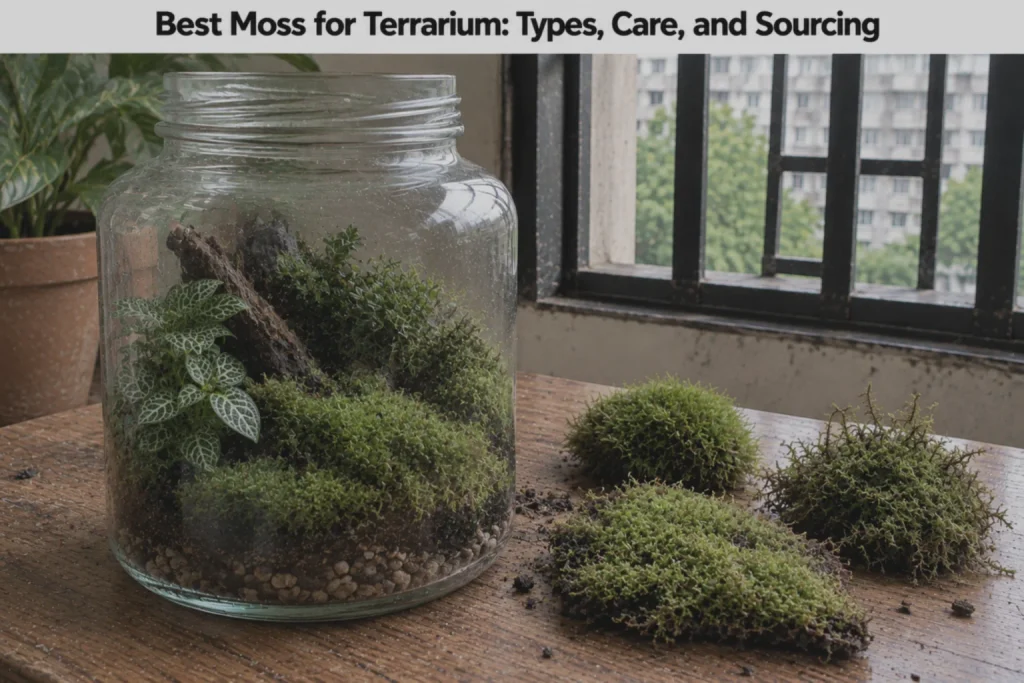
“In my own terrariums, I choose moss more by growth habit than by the name on the label. I use flatter sheet-forming moss where I want the substrate to disappear into a natural carpet, and clumping moss where I want a little height or texture instead of covering every inch of the floor. I am also much more cautious about moss collected locally, because in a warm, humid climate it is easy to find but can bring insects, fungal growth, or species that simply do not settle well indoors. The quickest health check I use is the texture and color: brown and crisp usually pushes me toward moisture or light problems, while black and slimy makes me suspect the build is staying too wet, so I avoid treating every unhappy patch with more misting.“
Two growth habits, and why the difference matters more than the species name
Terrarium moss falls into two structural categories, and knowing which one you are looking at tells you more than the common name does.
Acrocarpous moss grows upright in clumps or cushions. Growth is slow, tufted, and mound-shaped, good for suggesting a small hill, a cliff face, or a patch of texture against flatter ground cover. Cushion moss and mood moss both fall here.
Pleurocarpous moss grows sideways in flat, creeping mats, sometimes called sheet moss. It spreads laterally rather than upward, which is what makes it work as a continuous carpet over substrate. Hypnum-type sheet moss and fern moss both fall here.
A build usually wants both: sheet moss for the flat ground, a clump or two of cushion or mood moss where the layout calls for height or a focal point.
Best moss for terrarium builds, by type
Sheet moss (Hypnum species) for ground cover
Sheet moss is the default answer to “best moss for terrarium” ground cover because it forms a dense, even mat quickly and tolerates a range of light. It prefers low to moderate indirect light and consistently moist substrate underneath, not standing water. It roots into whatever it sits on rather than growing rhizomes deep into soil, which is why pressing it firmly against damp substrate at build time matters more than burying it.
Cushion moss and mood moss for accents
Cushion moss (Leucobryum) forms dense, pale-green, dome-shaped clumps that read as pillows or small boulders. Mood moss (Dicranum species) grows in taller, denser tufts that suggest windswept ground or a miniature cliff edge. Both like medium light and appreciate humidity but, unlike sheet moss, tolerate short dry spells without dying outright, which makes them a slightly more patient choice for a build that will not get daily attention.
Fern moss (Thuidium species) for a lush, shaded carpet
Fern moss forms a soft, feathery mat with small frond-like branches, and it thrives in high humidity and lower light than sheet moss tolerates. It is a common choice in closed, densely planted builds where the canopy above blocks most direct light from reaching the floor.
Java moss for the wettest, most humid closed builds
Java moss is more often sold for aquariums but adapts well to consistently high-humidity terrariums, growing as soft trailing mats that attach to wood, rock, or substrate rather than sitting flat. It is one of the more forgiving options for beginners specifically because it tolerates being too wet, a condition that kills sheet moss faster than almost anything else.
Moss is not a liverwort, and it is not algae
It is worth being explicit here because the three get lumped together constantly and the fixes are not the same. According to Moss in the Landscape from University of Maryland Extension (read 2026-09-18), moss belongs to the bryophytes and has no true vascular system: it does not move water and nutrients through leaf veins or true roots the way a fern or a pothos does, and it anchors itself with root-like structures called rhizoids instead. Liverworts share that same lack of a vascular system but are flatter, often ribbon- or lobe-shaped, and lack moss’s upright, leafy structure. Algae is neither: it is a single-celled or filamentous growth, usually appearing as a green film or slick coating on glass or wet substrate rather than as a distinct plant form. If what showed up in a build looks like a smear rather than a plant, it is almost certainly algae, not an unwanted moss species, and it calls for a different response.
Where terrarium moss actually comes from
Most moss sold for terrariums is either nursery-propagated sheet moss (harvested from managed farms rather than wild sites) or wild-collected from forests, roadside ditches, or garden beds and sold through hobbyist marketplaces. Nursery stock is generally the safer choice: it arrives cleaner, with fewer hitchhiker pests, and does not draw down a wild patch that may take years to recover. In South and Southeast Asian climates specifically, a humid, warm environment supports plenty of local moss growth on shaded walls, pot bases, and garden stone, which means wild-collected moss is genuinely easy to find nearby. That convenience comes with a tradeoff: wild moss carries more unknowns, including insects, mold spores already established in its structure, and species that were never adapted to indoor jar conditions in the first place. If collecting locally, take small amounts from common, abundant patches rather than stripping one spot bare, and treat what is collected as a project that needs preparation before it goes anywhere near a build, not a shortcut around one.
Preparing moss before it goes into the terrarium
Whether moss arrives from a nursery or a garden wall, the same preparation applies before it touches a build:
- Inspect it closely for insects, egg clusters, or fungal growth under magnification if possible. Wild-collected moss needs this step more than nursery stock, but neither should skip it.
- Rinse gently in plain water to remove loose soil, debris, and any surface-crawling pests, without scrubbing hard enough to break apart the moss structure.
- Quarantine briefly in a separate open container for a few days before adding it to a sealed build, watching for anything emerging that was not visible at first inspection.
- Press it into place on damp substrate rather than burying the base, since most terrarium moss anchors with rhizoids at the surface rather than rooting down into soil.
Keeping it green: light, moisture, and substrate
Moss struggles for the same handful of reasons across almost every species. Substrate that is compacted or nutrient-rich works against moss rather than for it. Embracing Moss from University of Vermont Extension (read 2026-09-18) notes that mosses generally favor shade to partial shade, consistent moisture, and lean, often acidic ground, which is part of why a rich potting-mix substrate under moss tends to favor mold and algae over moss growth instead. A lean, well-draining substrate suits it far better than garden soil ever will.
Light matters more than most beginners expect, and more moss dies from too little indirect light than from too much. Direct, hot sun scorches moss quickly in a closed glass container, since the glass concentrates heat, but deep shade eventually starves it. Bright, indirect light, the kind that reaches a desk near a window rather than a windowsill in direct sun, suits most terrarium moss species.
Moisture needs to stay consistent, not saturated. Moss absorbs water across its whole surface rather than through roots, so misting or splashing it directly does more good than watering the substrate alone. In a closed terrarium built with the right substrate and drainage, ambient humidity from the enclosed water cycle usually keeps moss adequately moist between waterings.
Placing moss with the plants around it
Moss reads best as a supporting layer, not the main event, laid where taller plants leave gaps or where bare substrate would otherwise show. In a closed terrarium with broadleaf tropical plants, sheet moss along the visible ground and a clump of cushion moss near a piece of hardscape usually reads as more finished than moss covering every inch of the floor. Leave a little bare substrate near the glass edge if the build includes a cleanup crew, since springtails and isopods need exposed ground to move across as easily as they move under moss.
Troubleshooting: when moss turns brown, black, or fuzzy
Brown, crisping moss usually means too little moisture or too much direct light, not disease. It often recovers with a light misting and a move a few inches back from a bright window. Black, slimy patches point the other direction, standing water or stagnant, overly wet substrate underneath, and the fix is drainage and airflow, not more misting. White or gray fuzz growing on or near the moss is a different problem entirely and is worth checking against a proper mold identification reference before assuming it is a moss issue, since mold and unhappy moss can look similar to an untrained eye at a glance. Persistent fogging or dripping condensation around moss-heavy areas is also worth reading through a guide on managing too much condensation, since a build that is running consistently too wet will eventually take the moss down with everything else in it.
FAQ
What is the best moss for a beginner terrarium? Sheet moss (Hypnum species) is generally the most forgiving starting point. It spreads evenly, tolerates a range of indirect light, and gives clear, visible feedback (browning or blackening) when conditions are wrong, which makes problems easier to catch early.
Can I use moss collected from outside instead of buying it? Yes, with preparation. Rinse it, inspect it for pests and fungal growth, and quarantine it for a few days before adding it to a sealed build. Take only small amounts from common patches rather than stripping one location, and expect more unknowns than nursery-propagated stock carries.
Why is my terrarium moss turning brown or black? Browning usually points to too little moisture or too much direct light. Black, slimy patches point the other way, standing water or poor airflow underneath. The two problems need opposite fixes, so identifying which one is happening matters before adjusting anything.
Does terrarium moss need direct sunlight? No. Most terrarium moss species prefer bright, indirect light. Direct sun through glass concentrates heat and can scorch moss quickly, while deep shade eventually starves it. Indirect light near a window, not on a sunlit windowsill, suits most species.
How is moss different from a liverwort or algae growing in the same terrarium? Moss forms a structured plant with stem-like and leaf-like parts anchored by rhizoids. Liverworts are flatter and lobe- or ribbon-shaped without that same upright structure. Algae is neither: it typically appears as a green film or slick coating rather than a distinct plant form, and it calls for a different fix than an unwanted moss or liverwort would.