
Leaving a Terrarium Alone for a Month: Do You Need a Plant-Sitter?

A settled closed terrarium is the easiest thing in your house to leave. It is the one container plant that genuinely does not need a sitter, and that is not a marketing claim about the format, it is a consequence of how it works: the water cannot leave, so there is nothing to top up.
The risks while you are away are not water. They are light, heat, and the state the build was in when you walked out the door. Everything below is about those three.
The one question that decides everything
Is this build settled, or is it new?
A settled build, meaning one that has been sealed and stable for weeks with a predictable condensation pattern and no active problems, can be left for a month with almost nothing done to it.
A build still in its break-in period is a different animal. It is being managed: opened, closed, watched, adjusted. Leaving one unattended for a month means it will do whatever it was going to do without anyone to catch it, and the most common outcome is that a too-wet build stays too wet for a month. What that period involves is on the break-in schedule.
If you are leaving soon and the build is new, the honest advice is not to build it yet. Build when you get back.
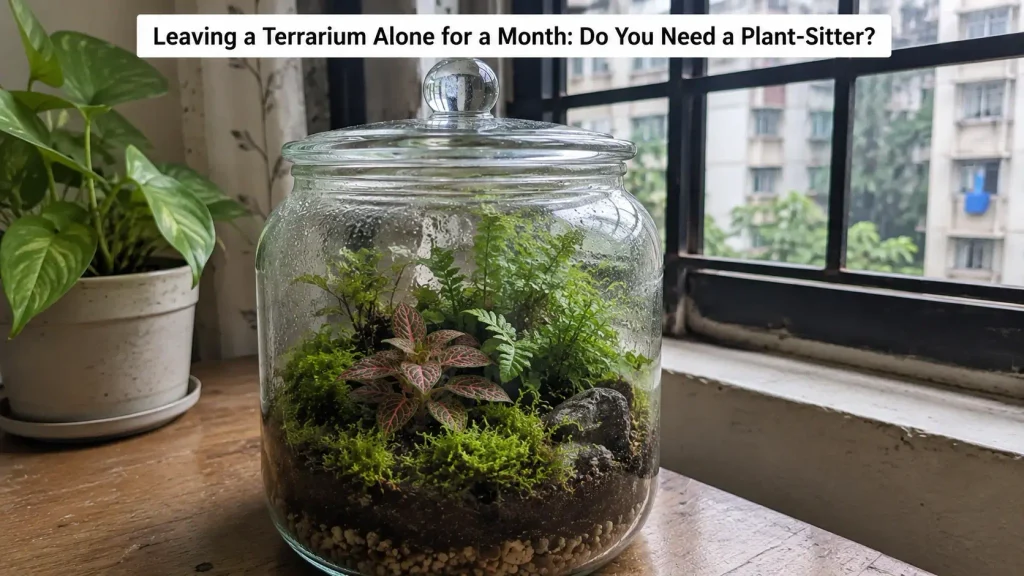
“I would be comfortable leaving a settled closed terrarium for a month without anyone watering or opening it. Before I go, I check that the condensation pattern is stable, remove dying material, and make sure the jar cannot catch direct sun. One extra precaution I use is moving it to its travel-safe position a few days early rather than on departure day, so I can confirm that the new spot does not suddenly change the condensation cycle before I leave it unattended.”
What actually goes wrong while you are away
Light, and the sun that moves
This is the real risk and almost nobody plans for it.
The sun’s angle changes through the year. A spot that is bright indirect light in one month is direct afternoon sun a few weeks later, and a jar in direct sun is a greenhouse with no vents. The temperature inside rises far above the room, and cooked plants are the single most common holiday failure.
You are not there to move it, and there is no self-correction.
So the check is: where will the sun be while I am gone, not where is it now. If there is any doubt, move the jar further from the window before you leave. A month in slightly too little light costs you almost nothing. A week in direct sun can end the build.
Heat, and the building going quiet
An empty home behaves differently. Air conditioning off, heating off or on a holiday setting, blinds closed or open, and nobody opening a door.
In a hot climate, the room a jar sits in can get considerably hotter with the cooling off, and heat inside a sealed container is heat with nowhere to go. This is the same climate reality that runs through building in an already-humid room: advice written for a temperate northern home does not transfer to a room that sits warm and humid all year.
Blinds or a curtain drawn is the cheapest protection available and it costs nothing.
An open terrarium, which is the actual problem case
Everything above assumes a lid. An open terrarium has no water cycle, it dries at the rate of the room, and a month is a long time. That is a genuine sitter case, or a case for moving it somewhere shaded and cool, and the difference between the two formats is on watering an open terrarium versus a closed one.
The five-minute checklist before you go
- Check the condensation pattern is normal. If the glass is completely fogged all day, the build is holding too much water and a month unattended will not improve it. The threshold for normal is on too much condensation.
- Remove anything dead or dying. A dead leaf in a sealed jar for a month is a mold source with a month to work.
- Deal with any mold or pest problem now. Do not leave an active problem to run unattended. There is nothing here that a month of absence improves.
- Move it out of any risk of direct sun, accounting for where the sun will be, not where it is.
- Leave the lid on. Sealed is the safe state.
And do not water it “to be safe” on the way out the door. That is the one intervention that reliably makes things worse: a sealed jar has no drainage, so extra water added before a month of no supervision has a month to sit at the bottom.
What you will come back to
A settled jar will look much as it did. Some growth, possibly some die-back of older leaves, possibly a little more condensation than usual if the room warmed up.
Do not intervene immediately. Look at it for a couple of days first. A jar that has been undisturbed for a month is at whatever equilibrium it found, and the temptation to correct several things at once on the first evening back is how a healthy build gets destabilized.
If something has gone wrong, the two most likely candidates are heat damage, which shows as scorched or collapsed foliage on the light side, and a mold outbreak, which shows as it always does.
Longer than a month
The reasoning does not change. A sealed terrarium’s limit is not a duration, it is whether the conditions it is left in are survivable, and light and heat are the conditions.
A build left in stable, cool, indirect light with no active problems can be left a very long time. The same build in a west-facing window in summer may not last two weeks.
FAQ
Does a closed terrarium need a plant-sitter? A settled one does not. It has been sealed and stable for weeks, the water cannot leave, and there is nothing to top up. An open terrarium is the real exception: it has no water cycle, it dries at the rate of the room, and a month is a long time, so that one is a genuine sitter case or a case for moving it somewhere shaded and cool.
Should I water it before I leave, just to be safe? No. That is the one intervention that reliably makes things worse. A sealed jar has no drainage, so extra water added on the way out the door has the whole trip to sit at the bottom with nobody there to notice.
I built it last week and I am leaving soon. What do I do? A build in its break-in period is being managed: opened, closed, watched, adjusted. Left alone, it does whatever it was going to do, and the usual outcome is that a too-wet build stays too wet the entire time. If the trip is close, the honest advice is not to build it yet. Build when you get back.
Where should the jar sit while I am away? Somewhere it cannot catch direct sun, judged by where the sun will be rather than where it is today, because the angle moves through the year and a jar in direct sun is a greenhouse with no vents. Move it further from the window if there is any doubt, and draw a blind or curtain. A month in slightly too little light costs almost nothing.
How long can a sealed terrarium be left in total? The limit is not a duration, it is whether the conditions it is left in are survivable. A build in stable, cool, indirect light with no active problems can be left a very long time. The same build in a west-facing window in summer may not last two weeks.
What this page does not publish
No maximum duration in weeks or months, because none is published and the honest answer is conditional rather than numeric.
No temperature figures, because we have measured nothing and no source publishes a sealed-container ceiling.
No product recommendations. Nothing needs to be bought to leave a terrarium alone.