
Types of Terrarium Moss: Sheet vs Cushion vs Mood

The three types of terrarium moss you will actually find for sale are sheet moss, cushion moss, and mood moss. Sheet moss (usually a Hypnum species) grows flat and spreads to carpet a surface. Cushion moss (Leucobryum glaucum) forms tight, rounded pale green mounds that hold their shape. Mood moss (Dicranum scoparium) grows in looser, wavy clumps somewhere between the other two. Picking the right one comes down to whether you need flat coverage, sculptural mounds, or texture around hardscape, and how much humidity your build can actually hold.
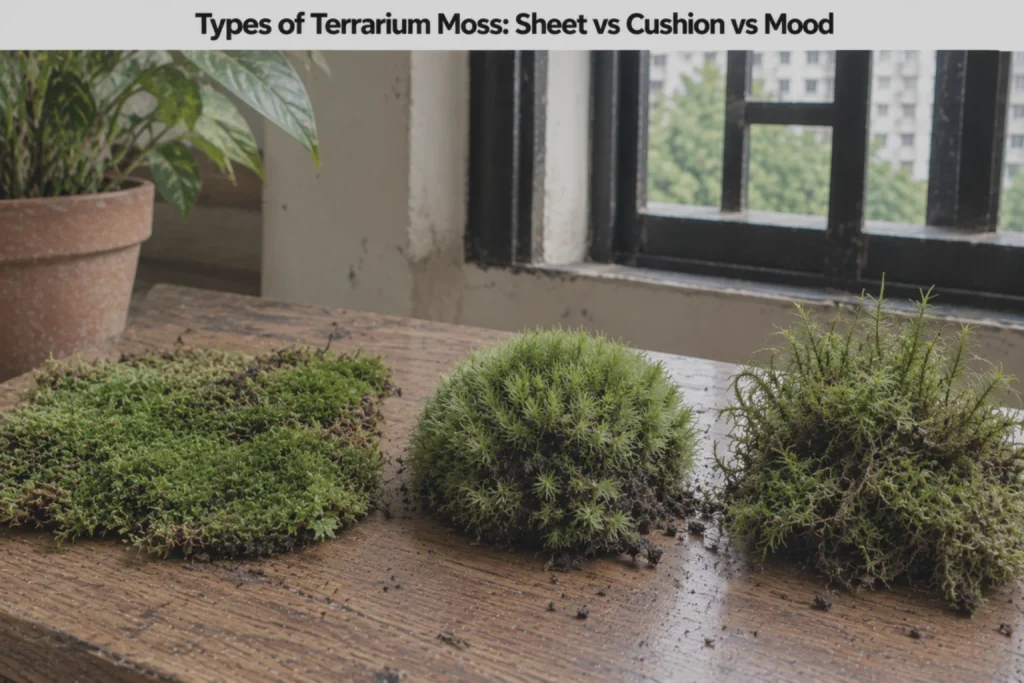
“In my own terrariums, I’ve found that choosing moss by shape and growth habit is much more useful than buying whatever is simply labeled “terrarium moss.” I use sheet moss when I want the ground to disappear into a continuous green carpet, cushion moss when I want a rounded mound that adds height, and mood moss when I want a looser, more natural-looking texture around wood or stone. The practical difference I watch most closely is moisture: sheet moss is happiest in a consistently humid closed build, while the clumping types give me a little more flexibility if the setup is not constantly saturated. The biggest mistake I avoid now is treating all moss as interchangeable, because once I match the moss to the role I actually need it to play, the whole build looks more natural and is much easier to keep stable.”
The three types of terrarium moss you’ll actually find for sale
Nurseries and terrarium suppliers sell a handful of moss species repeatedly, not because they are the only mosses that exist, but because they tolerate handling, shipping, and life in a glass container better than most of the several thousand moss species do. Three names come up again and again.
Sheet moss (Hypnum species)
Sheet moss grows in a pleurocarpous pattern, meaning it branches sideways along a creeping stem rather than growing upright in a single clump. That growth habit is exactly why it works so well as ground cover: it naturally forms a continuous mat rather than isolated tufts. In a terrarium, sheet moss is usually the layer that goes down first, over the substrate, to hide the soil line and give the whole build a finished, woodland-floor look. It tolerates the higher, steadier humidity of a closed terrarium well, which is also where it is most commonly used.
Cushion moss (Leucobryum glaucum)
Cushion moss, also sold as pillow moss or bun moss, grows acrocarpously: upright, in dense, rounded mounds rather than a spreading mat. The individual mounds hold their shape well enough that some growers shape or divide them into smaller domes for a more sculpted look. Compared to sheet moss, cushion moss has a reputation among growers for coping better in an open terrarium or a less consistently humid setup, though it still needs regular moisture and will brown at the tips if it dries out for too long. Its pale, almost silvery green color also reads differently in a build than the deeper green of sheet or mood moss, which is part of why growers reach for it as a focal-point feature rather than a background carpet.
Mood moss (Dicranum scoparium)
Mood moss sits between the other two in growth habit: it clumps rather than spreads, like cushion moss, but the clumps are looser and the leaves have a windswept, wavy look rather than cushion moss’s tight, rounded mounds. It is often confused with cushion moss for exactly that reason, and the two are sold under overlapping names by some suppliers, so checking the scientific name (Dicranum scoparium versus Leucobryum glaucum) is the only reliable way to know which one you are actually getting. Mood moss is typically tucked around rocks, wood, or the base of plants rather than used as a full carpet, since its texture is the point, not flat coverage.
Moss vs liverworts and algae: why the distinction matters
Not everything sold or found as “moss” is actually moss, and getting this wrong changes how you should care for it. According to the University of Wisconsin-Madison Division of Extension’s forestry and wildlife program (read 2026-09-23), true mosses have distinct stems and leaves, while liverworts such as Marchantia polymorpha have no stems or leaves at all: they grow as a flattened, branching thallus only a few cells thick. A flat, ribbon-like green patch in a terrarium that has no visible leaf structure under close inspection is more likely a liverwort than a true moss, and liverworts tend to tolerate wetter, more stagnant conditions than the mosses covered above. Algae is a separate problem again: a slimy or fuzzy green film on glass or substrate, not a plant with any structure at all, and it usually signals too much light or too much standing moisture rather than being something you deliberately introduced. Treating an algae bloom or a liverwort colony as if it were your sheet or cushion moss dying back leads to the wrong fix, so the identification step matters before you change anything about the setup, as covered in more detail when identifying terrarium mold versus these other green growths.
Which type of terrarium moss fits an open vs. a closed build
Closed terrariums hold humidity near saturation almost permanently, which is exactly the condition sheet moss handles best: it stays lush without extra intervention once the enclosure has stabilized. Open terrariums lose moisture to the room air constantly, which is where cushion moss’s better tolerance for drier stretches becomes the practical difference between a moss that survives and one that browns within a few weeks. Mood moss sits in between and does reasonably in either, provided misting is consistent. If you are still deciding on the overall plant and moisture setup before adding moss, the plant list in the guide to closed terrarium plants and the sequence in a first terrarium build, step by step are both worth reading before you commit to a moss type, since the moss should match the enclosure you are actually building, not the other way around.
How terrarium moss actually gets its moisture, and why that changes care
Moss care advice sometimes talks about “watering the roots,” which is not quite right. Moss has no true root system. Per the University of Maryland Extension’s Home and Garden Information Center (read 2026-09-23), moss anchors itself with root-like structures called rhizoids, and it absorbs and moves water and nutrients cell to cell by osmosis rather than pulling water up through a root and stem system the way a vascular plant does. The same source notes moss thrives in consistently moist, semi-shady conditions. That is why misting the moss surface directly, rather than only watering the substrate underneath and assuming it will wick up, matters more for moss than it does for most terrarium plants, and why moss laid directly onto a substrate built to hold and release moisture evenly, like the mix described in choosing a terrarium substrate, establishes faster than moss placed on a substrate that dries unevenly or compacts.
Sourcing terrarium moss without guesswork
Terrarium moss comes from three places: a specialist terrarium or nursery supplier, a general garden center’s live-plant section, or collected outdoors. Buying from a supplier that sells moss specifically for terrariums is the most predictable route, since the species is usually labeled correctly and the moss has typically been kept in conditions closer to what a terrarium needs than moss sitting in a garden center’s outdoor display. Collecting moss outdoors is possible in many places, but it comes with a real caveat: moss on public or protected land is often subject to collection rules, and permission from the landowner or land manager is the responsible starting point regardless of local regulation specifics, since rules vary by location and land type and this article cannot state a universal figure for where you live. Whatever the source, quarantine new moss briefly and check it closely for pests or a mixed-in liverwort or algae patch before adding it to an established terrarium, since it is far easier to reject or clean a small clump on the way in than to remove a problem after it has spread across an established build.
Spotting moss problems early
Healthy sheet, cushion, and mood moss stays a consistent color for its species and holds its structure: sheet moss stays flat and connected, cushion moss stays rounded and dense, mood moss stays clumped with visible individual stems. A moss patch turning uniformly pale, gray, or crumbly and pulling away from the substrate is usually drying out rather than dying from disease. A moss patch developing a slimy sheen, a sudden fuzzy overlay, or a smell is more often a mold or algae problem growing on or around it than a problem with the moss itself, and that distinction is worth checking against a proper mold identification pass before assuming the moss has to be replaced. In most cases the moss survives once the actual cause, usually excess standing water or stagnant air, is corrected.
FAQ
Are mood moss and cushion moss the same thing? No, though they are commonly confused and sometimes mislabeled by sellers. Cushion moss (Leucobryum glaucum) forms tighter, more uniform rounded mounds. Mood moss (Dicranum scoparium) grows in looser, wavier clumps. Checking the scientific name on a listing is the reliable way to tell them apart before buying.
Can I mix different types of terrarium moss in one build? Yes. Many terrarium builds combine sheet moss as a base carpet with cushion or mood moss added as accent mounds around hardscape or plant bases, since the growth habits complement each other visually and the humidity needs are close enough in a closed terrarium to coexist.
Does terrarium moss need direct sunlight? No. Moss generally does better in indirect or filtered light than in direct sun, which can dry it out quickly, especially inside a glass enclosure that also concentrates light and heat.
Is sphagnum moss the same as sheet, cushion, or mood moss? No. Sphagnum moss is a different genus, typically sold dried or fresh for its water-holding capacity, and it is usually mixed into the substrate rather than displayed on the surface as ground cover the way sheet, cushion, and mood moss are.
Is it safe to collect moss outdoors for a terrarium? It can be, but check who owns or manages the land first, since collection rules differ by location and land type. Buying moss from a terrarium or nursery supplier avoids that question entirely and usually comes with a more reliable species label.