
Begonia Terrarium Guide: Which Begonias Rot, Which Thrive

A begonia terrarium works, but only with the right begonia. Small, humidity-loving species such as Begonia thelmae and Begonia prismatocarpa grow happily in a closed jar. The begonias sold as bedding or gift plants, like wax, tuberous and cane types, usually rot or outgrow the glass. The rule that decides it: begonias want humid air, not wet stems. Keep the substrate airy, keep water off the stem base, and never bury the stem or rhizome. Do that and rot becomes the exception.
That is the whole answer in one paragraph. The rest of this page explains why begonias fail differently from ferns and fittonia, which groups belong in which kind of container, and how to tell stem rot from leaf melt when all you can see is the view through the glass.
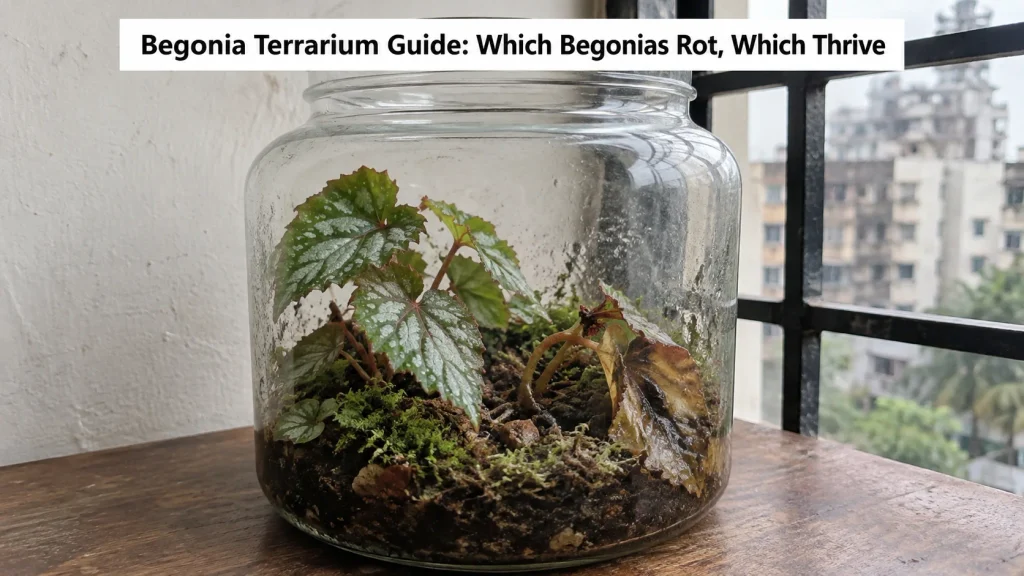
“In my own terrariums, I’ve found that begonias are much less forgiving than moss, fittonia, or small ferns because the air can be humid while the stem base still needs to stay relatively dry. I’m much more comfortable using naturally small species in a closed jar, while larger rex, cane, wax, or tuberous types make more sense in bigger or better-ventilated setups. The part I watch first is the soil line: if the stem starts looking dark, glassy, or soft, I treat that as a moisture problem immediately rather than waiting for the leaves to collapse. The biggest lesson for me is that with begonias, humid air is useful, but wet stems are dangerous, so I plant them high, keep the crown exposed, and water away from the base.”
Will a begonia rot in a terrarium?
It can, and the reason is specific. The disease that most often kills potted begonias at the soil line is stem rot caused by Pythium ultimum, a fungus-like organism that lives in growing media. The Pacific Northwest Pest Management Handbooks entry on begonia stem rot (read September 23, 2026, page last revised March 2026) says excess moisture and cooler media temperatures favor it, and describes stems near ground level turning dark and water-soaked before they collapse.
Read that list of conditions again with a closed jar in mind. Wet substrate, still air, water sitting against the stems: a badly built terrarium supplies all three. The same handbook’s cultural advice is to improve air circulation, avoid wetting the leaves when watering, and sterilize media before reuse. Two of those three are things a sealed jar makes harder by design.
So the honest answer to “will it rot?” is: a begonia rots when the substrate stays wet around its stems, not because the air is humid. The humidity is the part it likes.
Humid air is not wet feet
This is where begonias differ from the usual terrarium starters. Ferns, moss and fittonia tolerate a substrate that stays evenly moist. Many begonias do not. Their stems are fleshy and hold water, and in rhizomatous types the thick stem creeps along the surface of the soil rather than below it.
That shapes three practical rules:
- Plant at the same depth, never deeper. A rhizome or stem base pushed under the substrate stays wet for good.
- Water the substrate, not the plant. Spraying the foliage looks helpful and puts water exactly where rot starts.
- Let the jar breathe when it fogs heavily. Constant heavy condensation means water is dripping back onto leaves and stems all day.
If you already know how a closed jar recycles water, the takeaway is simple: begonias sit at the dry end of what a closed terrarium can hold. Build for them, not for the moss.
Not all begonias: how each group behaves in a begonia terrarium
Begonia is one of the largest genera of flowering plants, and what a nursery calls “a begonia” could be any of several very different growth types. Here is how the common groups compare for glass.
| Begonia group | Typical examples | Closed jar? | Main problem under glass |
|---|---|---|---|
| Miniature terrarium species | B. thelmae, B. prismatocarpa, small collector species | Yes, the natural fit | Can spread fast and need thinning |
| Rhizomatous (incl. most rex) | Iron cross, eyelash, rex hybrids | Only large containers, or open | Size, and rot where the rhizome touches wet media |
| Cane-stemmed | Angel wing types | No | Grows tall and woody, hits the lid |
| Wax and tuberous (flowering) | Bedding and gift begonias | No | Bred for pots and gardens; spent flowers and wet crowns rot |
The table is sorted by what matters for your decision: how well the plant’s size and habit match a container, not how pretty it looks on the nursery bench.
Begonias that suit a closed jar
The begonias that actually belong in closed terrariums are mostly small species from humid tropical forests, sold by vivarium and specialist growers rather than general garden centers.
Begonia thelmae is a low, creeping plant with small bronze-green leaves and red undersides. Its stems root where they touch the substrate, so it forms a carpet instead of a mound. Specialist sellers describe it as beginner-friendly and suited to closed or semi-closed setups, with a substrate of sphagnum and perlite rather than dense soil. It is the easiest begonia to fit into a small jar, because it spreads sideways, not up.
Begonia prismatocarpa is a tiny African species with bright yellow flowers, which is unusual for a terrarium plant. It likes very high humidity and more moisture than most begonias. The catch is growth rate: growers note it can need frequent thinning in a small container, so it suits a larger jar or tank better than a small cloche.
Other small species such as Begonia foliosa (a fine, shrubby, fern-like plant) and Begonia listada (dark leaves with a pale central stripe) appear in terrarium plant lists too. B. listada is usually treated as a focal plant, so give it a roomy container rather than a crowded mix.
Terrarium sellers note that their plants are grown in high humidity in terrariums and greenhouses. That works in your favor for a closed jar, but it also means a begonia moved from a jar into open room air may struggle while it adjusts.
Begonias to keep out of a sealed jar
Most begonias sold in a supermarket or a local nursery are the wrong ones for a closed container.
Full-size rhizomatous and rex begonias. NC State Extension’s Plant Toolbox page on rhizomatous begonias (read September 23, 2026) lists a mature height and width of 1 to 1.5 feet, and notes that most rhizomatous types can tolerate 50% humidity. In other words, the common ones do not need a jar and will outgrow a small one. The same page does say some species with unusual foliage perform better in terrariums, which is why the collector miniatures above exist as a separate category.
Wax, tuberous and cane begonias. These are bred for pots, borders and baskets. They grow tall or bushy, and their flowers drop and decay on the substrate, where they feed mold. That puts them with the other plants that should never go in a closed terrarium: fine plants, wrong container.
The NC State page also lists bacterial leaf spot, powdery mildew, blight, stem rot and crown rot among the problems rhizomatous begonias face. Every one of those is easier to get in still, wet air than in an open room.
Setting up a begonia terrarium so the stems stay dry
The build is standard terrarium practice with the dial turned toward drainage.
- Choose the container for the plant’s adult size. A creeping species suits a small jar. A rex type needs a large tank or an open bowl.
- Use a drainage layer and an airy mix. A dense potting soil holds water against the stems. A chunky mix built around bark, sphagnum and perlite drains fast. The reasoning behind that choice is in the guide to terrarium substrate and why soil fails.
- Sanitize everything first. The American Begonia Society’s terrarium guide stresses cleaning all materials and tools before building, which lines up with the handbook’s advice to sterilize media and disinfect tools against Pythium.
- Plant high. Keep the crown and any rhizome resting on or just in the surface, never buried.
- Water lightly at the edges. Start drier than you think and add a little at a time. A begonia jar that looks slightly under-watered is safer than one with standing water in the drainage layer.
- Put it in bright, indirect light. NC State says direct sun should be avoided for rhizomatous types, and direct sun on glass also overheats a closed jar quickly.
After planting, watch the condensation for the first couple of weeks. A light morning fog that clears is fine. Glass that stays streaming all day means too much water, and the lid should come off for a few hours to let some escape.
Reading rot through the glass
Most begonia losses in a jar show one of three patterns, and each one points to a different fix.
| What you see | Likely cause | What to do |
|---|---|---|
| Stem dark and water-soaked at the soil line, plant falls over | Stem rot from wet substrate (Pythium is a common culprit) | Remove the plant and the substrate around it; take cuttings from healthy stems if any remain |
| Brown, mushy patches on leaves, often where drops land | Leaf rot from condensation dripping onto foliage | Remove affected leaves, vent the jar, reduce water |
| White powdery coating on leaf surfaces | Powdery mildew | Remove affected leaves, improve airflow, open the jar more often |
Stem rot is the serious one. The handbook’s advice for infected plants is removal, not treatment, and a plant collapsing at the base rarely recovers in place. For the full diagnosis process, including what the roots look like when you pull the plant, see terrarium root rot and how to diagnose it through the glass.
The good news is that begonias root readily from cuttings. If the top growth is still firm, a clean stem or leaf cutting set into damp sphagnum can replace the plant you lost. Rare begonia propagators describe rooting cuttings in a damp sphagnum and perlite mix, which is the same airy approach the terrarium itself should follow.
Begonias in a hot, humid climate
On a shelf in South or Southeast Asia, the room is already warm and humid for much of the year, especially through the monsoon. That changes the calculation.
A sealed jar in a warm, humid room holds heat and moisture with no easy escape. For a small species like B. thelmae that can still work, but it leaves less margin for overwatering. For larger rhizomatous begonias, which NC State says can handle 50% humidity, an open or partly vented container is often the better choice where the room air is already moist. You get the humidity from the climate and the airflow from the open top.
The practical rule for tropical homes: when the air outside the glass is already humid, lean toward more ventilation, not less. Close the lid only for the small species that genuinely need it.
What a begonia terrarium cannot do
A few trade-offs are worth knowing before you buy.
- Begonias keep growing. Even the small species spread, and faster ones need regular thinning. Pinching stem tips keeps creepers compact, and the guide to pruning terrarium plants covers how to cut back inside a jar without disturbing the rest of the build.
- Terrarium-grade begonias are specialist plants. You will rarely find B. thelmae or B. prismatocarpa in an ordinary nursery. What the nursery has is usually a wax or rex hybrid, which is the wrong plant for a small closed jar.
- Flowers are a cost. Flowering species drop spent blooms onto the substrate. Pick them out before they rot.
- Begonias are less forgiving than fittonia or moss. A jar that a fern shrugs off can kill a begonia at the stem.
FAQ
Can you put a rex begonia in a closed terrarium?
Only in a large container. NC State Extension lists rhizomatous begonias, the group rex begonias belong to, at 1 to 1.5 feet tall and wide, which is too big for most jars. Miniature rex hybrids and small collector species fit better.
What is the best begonia for a small terrarium?
Begonia thelmae is the most practical choice for a small jar because it creeps and roots along the surface instead of growing upward. Begonia prismatocarpa is also small but grows fast enough that it suits larger containers.
Why is my begonia rotting in the terrarium?
Usually because the substrate stays wet around the stem base, or condensation keeps dripping onto the leaves. Begonias like humid air but not wet stems. Plant at the original depth, use an airy mix, water less and vent the jar when the glass stays fogged.
Do begonias need an open or closed terrarium?
Small species such as B. thelmae suit closed or semi-closed containers. Larger rhizomatous and rex begonias are usually better in an open or vented container, especially in a room that is already warm and humid.
Should I mist begonia leaves in a terrarium?
It is better not to. Wet foliage and wet stems are where rot starts, and plant disease guidance for begonias advises avoiding wetting the leaves when watering. Water the substrate at the edges instead.