
Peperomia Terrarium: Does It Survive a Sealed Jar?

Yes, a peperomia terrarium can work, but the “easy houseplant” label does not carry over into a sealed jar on its own. Peperomia is a large genus, and many of its species have fleshy, water-storing leaves. Inside a closed container the usual way they fail is rot at the base of the stem, caused by substrate that never gets a chance to dry. Small trailing types such as Peperomia prostrata (string of turtles) handle a closed jar best. Rippled types such as Peperomia caperata can work too, if you plant them high, keep the mix airy and vent the jar when the fog will not clear.
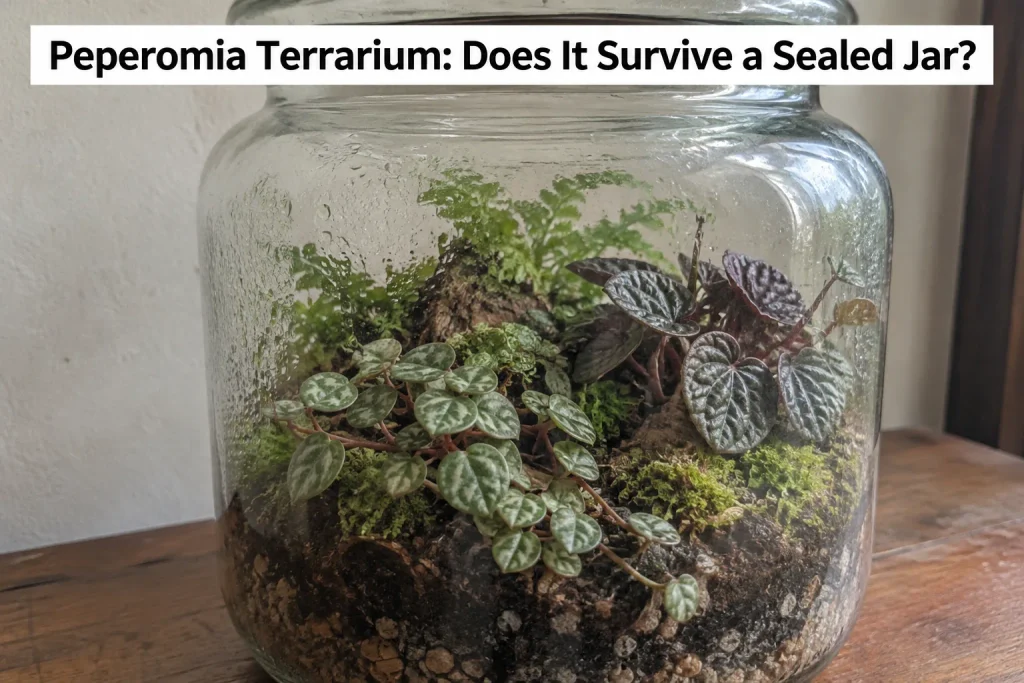
“In my own terrariums, I’ve found that peperomia can work behind glass, but only when I stop treating the whole genus as if every species wants the same thing. Small trailing types like string of turtles are much easier for me to trust in a sealed jar, while thicker or more succulent peperomias make me watch the stem base and substrate moisture much more closely. I now plant them higher in the build, keep moss away from the stem, and avoid the wettest edge against the glass. The biggest lesson for me is that a peperomia usually tells me it is too wet at the base before the leaves make the problem obvious, so I check the stem and the condensation before I even think about adding more water.”
Why “easy” in a pot is not easy in a peperomia terrarium
Peperomia earns its easy reputation in a pot on a windowsill. There, the soil dries out between waterings, the pot drains, and room air carries moisture away from the leaves. Forget to water for a while and a fleshy-leaved peperomia shrugs it off, because it has water stored in its leaves.
A closed terrarium removes every one of those safety valves. There is no drainage hole, the air inside recycles its own moisture, and water that goes into the jar mostly stays there. That is what makes a closed build good for a fern or a fittonia. It is also what goes wrong for a plant that likes its roots to dry out now and then. The drought tolerance that makes peperomia forgiving in a pot does nothing for you in a jar, because drought is not the problem in a jar. Too much water is. What matters is whether the peperomia you bought tolerates constantly damp roots, and that depends on the species.
Not one plant: the care profiles disagree with each other
The clearest way to see this is to compare two species profiles from the same source. The NC State Extension Gardener Plant Toolbox entry for Peperomia caperata (read on 2026-09-23) describes emerald ripple peperomia as wanting “soil that dries between watering.” It says the plant “will not tolerate wet soil” and is “susceptible to root rot,” and it lists the plant as tolerating medium to low relative humidity. None of that describes a sealed jar.
The same toolbox’s Peperomia prostrata profile (also read on 2026-09-23) reads very differently. String of turtles is described as native to the wet tropical areas of Ecuador, preferring “evenly moist soil” and “average to higher humidity levels,” and it names a terrarium outright as one of the places the plant suits. It still warns that overwatering can cause root rot, but the baseline is a damp, humid plant, not a dry-between-waterings one.
The toolbox’s genus-level Peperomia entry puts the group at over 1,000 species, notes that many are succulent and store water in their leaves, and lists root rot plus yellowing or curling leaves as signs of overwatering. Put those entries side by side and the takeaway is plain: “peperomia” on a nursery tag tells you very little about how the plant will cope with a closed lid.
Which peperomia types suit a closed jar
The table below sorts the peperomias most often sold for terrariums by how they cope with a sealed container. The verdicts come from the extension profiles above and from what terrarium builders and vivarium suppliers consistently report. They are not measured thresholds.
| Type | Common examples | What the source material says | Sealed-jar verdict |
|---|---|---|---|
| Small trailing, humidity-tolerant | P. prostrata (string of turtles) | Evenly moist soil, average to higher humidity, terrarium named as a use | Best candidate for a fully closed jar |
| Rippled or crinkled rosette | P. caperata and its cultivars, including ‘Rosso’ | Soil should dry between waterings, will not tolerate wet soil | Workable if planted high in an airy mix and vented when needed |
| Thin-leaved compact cultivars | ‘Piccolo Banda’ | Builders report it rots more easily than thick-leaved types | Risky in a fully sealed jar |
| Thick, waxy, semi-succulent | ‘Hope’ and similar upright types | Stores water in its leaves; builders suggest partial seal or open setups for ‘Hope’ | Better in a vented or open build |
Two patterns show up. First, the smaller and more moisture-tolerant the plant, the better it does behind a lid. Second, leaf thickness cuts both ways. Terrarium makers report that thick, waxy leaves resist damp air on the leaf surface better than thin ones, but the most succulent types are also the ones whose roots least like wet substrate. Leaf thickness protects the leaves, not the roots.
Where to put a peperomia inside the jar
Most peperomia terrarium guides list species and stop there. Where you plant the peperomia inside the jar matters about as much as which one you pick, because a closed jar is not evenly wet.
Water gathers at the lowest point of the substrate, collects under moss carpets, and runs down the glass as condensation, soaking the edges where substrate meets glass. The top of a mound or slope, and anything sitting on hardscape, stays noticeably less saturated. Here is how to use that:
- Plant it high. Set the peperomia on the highest part of a sloped substrate, or tuck it into a pocket on a piece of rot-resistant wood or stone. Keep the lowest, wettest corner for the fern or the moss.
- Keep it off the glass. Condensation keeps the substrate right against the glass wetter than the center. Stems pressed against wet glass are a common place for rot to start.
- Keep moss away from the stem. A moss carpet holds water right at soil level. Leave a small ring of bare, gritty substrate around the stem instead of tucking moss up against it.
- Plant at the same depth it grew in the pot. Burying the stem deeper puts tissue that was never meant to sit in wet media straight into it.
Substrate: airy around the stem
The extension profiles agree on one thing: good drainage. A dense, peaty, soil-heavy mix holds water against the roots for a long time in a jar that cannot drain. If your build uses a general mix, make the patch where the peperomia goes chunkier and more open than the rest. Our guide to why plain soil fails in a terrarium substrate mix explains the components that keep air around roots. For peperomia, lean toward the airy end rather than the moisture-holding end.
Watering and venting a sealed peperomia build
Most watering problems in a peperomia terrarium come from treating the plant like a fern. Water the build for its thirstiest plant and the peperomia sits in water it never needed.
- Water to the substrate, not the plant. If the build needs a top-up, add water away from the peperomia’s stem, along the lower zone of the jar.
- Let condensation tell you, not the calendar. A light mist that clears for part of the day suggests a balanced jar. Glass that stays fogged all day, day after day, means there is more water in the system than it is using. Our guide to reading too much condensation in a terrarium covers what each fog pattern means.
- Vent before you water again. For caperata-type peperomias in particular, the fix for a jar that stays soaked is to crack the lid for a few hours, not to wait it out.
- Do not water because the leaves look dull. Soft, limp or yellowing leaves in a jar that is already wet point to root trouble, not thirst.
Reading rot early: the stem base, not the leaves
Rot in a peperomia usually starts where the stem meets the substrate, and the leaves are often the last to show it. By the time the top of the plant collapses, the base can already be soft. Look through the glass for:
- A darkened, glassy or translucent stem base. Healthy peperomia stems are firm and evenly colored.
- Leaves dropping from the bottom up, especially with a soft, dark attachment point.
- Yellowing or curling leaves in a wet jar, which the NC State genus entry lists as a sign of overwatering.
- A plant that wobbles or leans when the jar is tilted slightly, because the roots below are no longer holding.
If you catch it early, remove the affected plant, cut above any soft tissue and restart from a healthy cutting. Our walkthrough on diagnosing terrarium root rot through the glass covers how to check the rest of the build so the problem does not move to the neighbors.
When a peperomia belongs in an open terrarium instead
Sometimes the honest answer is that this plant does not belong behind a lid. If you have a thick-leaved, semi-succulent peperomia, or a caperata that keeps rotting despite careful placement, an open or partly open container is the better home. Our comparison of open vs closed terrariums walks through what changes when the lid comes off.
Climate matters here too. In much of South and Southeast Asia, including Dhaka where this site is written, the monsoon keeps indoor air damp for months at a time. A sealed jar in a room like that has even less chance of drying out, and a flat without air conditioning adds warmth on top of the humidity. If your room already feels humid, a closed caperata build will need more venting than a guide written for a dry, air-conditioned home suggests, and a lid you crack regularly during the wet season may make more sense.
Trimming and restarting from cuttings
Peperomia is one of the more forgiving plants to reset. The NC State profiles list leaf or stem tip cuttings for P. caperata and leaf cuttings for P. prostrata. That helps in two ways. A trailing peperomia that has spread across the substrate can be cut back and the trimmings rooted for the next jar. And a plant that has rotted at the base often still has healthy tips or leaves worth rooting, which beats throwing out the whole thing. Pull trimmings out of the jar rather than leaving them on the substrate, where soft tissue can decay and feed mold.
What peperomia will not do in a sealed jar
To be fair about the limits: no placement trick turns a plant that wants its soil to dry out into one that likes being permanently damp. A closed jar can be managed around a caperata, but it cannot be made to suit one, which is why caperata-type builds need more attention than a fern or moss jar. Some peperomias, ‘Rosso’ among them, are slow growers, so a gap left for one stays a gap for a while. And nursery labels often skip the species or cultivar, so confirm what you are buying before it goes into a sealed build.
FAQ
Can peperomia live in a closed terrarium?
Some can. Small, humidity-tolerant types such as Peperomia prostrata (string of turtles) suit closed jars, and NC State Extension names terrariums as one of its uses. Types that prefer soil that dries between waterings, such as Peperomia caperata, can live in a closed jar only with careful placement, an airy substrate and regular venting.
Which peperomia is best for a terrarium?
For a fully sealed jar, the small trailing Peperomia prostrata is the safest choice because it prefers evenly moist soil and higher humidity. Rippled P. caperata cultivars such as ‘Rosso’ are popular for their color but are more prone to rot in a jar that never dries.
Why is my peperomia rotting in my terrarium?
Rot in a sealed peperomia build almost always comes from substrate that stays wet around the stem. Common causes are planting it in the lowest part of the jar, packing moss against the stem, a dense soil-heavy mix, or watering the whole build for thirstier plants.
Should I water a peperomia terrarium when the leaves look soft?
Not if the jar is already wet. Peperomia leaves store water, and soft or yellowing leaves in a damp, fogged jar usually point to root problems from too much moisture. Check the stem base and the condensation before adding any water.