
Ferns for Terrariums: Small Species That Stay Small

The best ferns for terrariums are the ones that are small by nature, not the ones that happen to be small in a nursery pot. Heart fern (Hemionitis arifolia) is the most reliable compact choice for a closed jar. Dwarf lemon button fern works if you pull its runners, delta maidenhair suits only large containers, and creeping epiphytes such as dragon scale fern belong on wood or stone. Skip bird’s nest fern, full-size Boston fern and asparagus fern, which is not a fern at all.
That short answer hides the question most people actually bring here: which fern will still fit in six months? A fern’s tag tells you its name. Its growth habit, meaning how it spreads, tells you whether it stays where you planted it. This guide sorts the common terrarium ferns by that habit first, then by how much humidity each one really wants, because not every fern belongs under a lid.
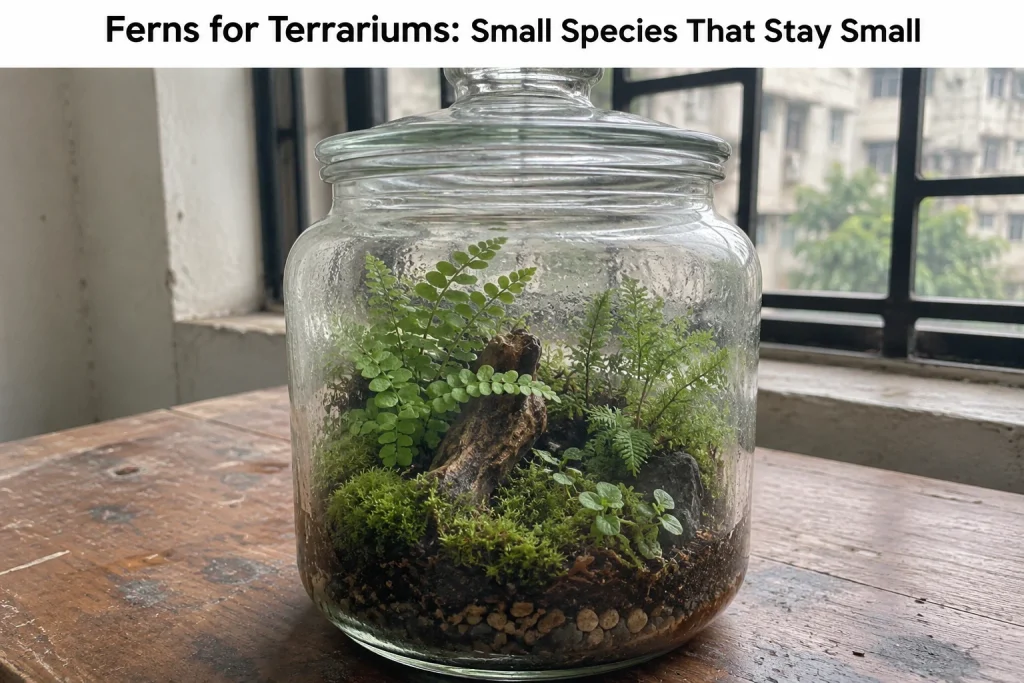
“In my own terrariums, I’ve found that the safest fern is not the smallest one at the nursery, but the one whose growth habit stays predictable once the jar settles. I prefer naturally compact, clumping ferns like heart fern because they stay where I plant them and are much easier to manage than runner-forming or creeping types that quietly spread through the whole build. The thing I watch most is the crown: I keep it right at the substrate surface and never bury it, because in a humid closed jar that is where rot starts fastest. I also treat any fern touching wet glass as an early warning to trim or reposition it, rather than waiting for the frond to brown.”
The Short List: Ferns for Terrariums Compared
Sizes below come from the NC State Extension Gardener Plant Toolbox where it lists them. Where no authoritative size exists for a terrarium form, the table says so instead of guessing.
| Fern | How it spreads | Adult size | Best container | Takeover risk |
|---|---|---|---|---|
| Heart fern (Hemionitis arifolia) | Clump from one crown | 6 to 10 in tall and wide | Closed jar | Low |
| Lemon button fern (Nephrolepis cordifolia dwarf forms such as ‘Duffii’) | Clump plus runners and tubers | Dwarf form; the wild species is far larger | Closed or open, medium jar | High if runners are left |
| Delta maidenhair (Adiantum raddianum) | Clump | 1 to 2 ft high and wide | Large closed jar or carboy | Medium |
| Button fern (Pellaea rotundifolia, now listed as Hemionitis rotundifolia) | Clump that spreads wide | 6 in to 1 ft | Open terrarium | Low, but rots easily when sealed |
| Dragon scale fern (Pyrrosia piloselloides) and Microgramma | Creeping rhizome, epiphytic | Small fronds on a wandering rhizome | Mounted on wood or stone | Medium, climbs hardscape |
| Filmy ferns (Hymenophyllaceae) | Mostly epiphytic, delicate | Small | Sealed, very humid builds only | Low; the fern is the fragile one |
Sort Ferns by How They Spread, Not by the Label
Every fern in a terrarium does one of three things as it grows. It widens from a single crown, it sends runners through the substrate, or it walks a creeping rhizome across whatever it touches. That habit, more than the height on the tag, decides whether a fern shares a jar politely. A fern that grows to a foot but stays in one clump is easier to live with than a shorter fern that pops up in every corner.
Clumping ferns: the safest picks
Heart fern is the standout. The NC State Extension Gardener Plant Toolbox entry for heart fern (read 2026-09-23) lists it at 6 to 10 inches tall and equally wide, calls it “perfect as a container planting or for use in a terrarium,” and describes it as preferring humidity of 60 percent or above with soil that stays evenly moist but never soggy. The same entry gives its native range as India to southern China and western to central Malesia, the same part of the world as Bangladesh, so warm indoor temperatures here suit it.
Delta maidenhair is a good fern in the wrong jar for most people. The same database lists it at 1 to 2 feet high and wide, says it “does well in terrariums,” and warns that its roots should not be allowed to dry out. In a small jar it presses against the glass within a season. In a large container or carboy it is one of the prettiest options you have. Trim it by cutting whole old fronds at the base rather than snipping frond tips.
Runner ferns: the lemon button fern problem
This is the group that answers “which fern took over my jar.” The NC State Extension entry for Nephrolepis cordifolia lists the wild species with fronds up to 3 feet long and a spread of up to 4 feet, reproducing by stolons and tubers, and notes it is considered invasive in Florida and New Zealand. The forms sold for terrariums are dwarf cultivars such as ‘Duffii’ and the lemon button fern.
A dwarf cultivar solves the height problem. It does not solve the runners. A stolon can travel under the substrate and send up a new plant on the far side of the jar, right in the middle of your moss or fittonia. The fix is routine: pull runners as soon as you see them and check for small tubers while you are there, since the tubers are how the plant spreads. Our guide to pruning terrarium plants covers how to cut back inside a narrow opening without disturbing the rest of the build. Dwarf Boston fern cultivars such as ‘Fluffy Ruffles’ belong to the same genus and need the same watchfulness.
Creeping-rhizome ferns: small fronds, long reach
Dragon scale fern, Microgramma species and mini rabbit’s foot ferns grow as epiphytes in the wild. Each has a rhizome that creeps over bark and rock with small fronds along its length. They rarely compete with other plants’ roots, but they will cover wood, stone and eventually the glass itself. Mount them instead of burying them: tuck the rhizome against a piece of wood or into a crack in stone, and keep it on the surface. A creeping rhizome pushed down into wet substrate tends to rot.
The Nursery Trap: Ferns Sold Small That Grow Huge
Garden centers often sell young ferns in tiny pots next to terrarium supplies. Some of those are juveniles of large plants.
Bird’s nest fern (Asplenium nidus) is the classic case. NC State Extension lists it at 3 to 5 feet tall with fronds that can reach 4 to 5 feet long. A small one looks perfect in a jar for a while, and then every new frond comes in bigger than the last.
Full-size Boston fern (Nephrolepis exaltata) is a hanging-basket plant with the same runner habit as its dwarf relatives, only on a larger scale.
Asparagus fern (Asparagus setaceus) is the one that catches the most people. NC State Extension states plainly that asparagus ferns “are not ferns at all” and belong to the asparagus family. The plant flowers, sets berries the extension describes as poisonous if eaten, has sharp spines along its stems, and reaches 2 to 3 feet as a houseplant. A quick check works on any plant with a fern label: true ferns never flower or fruit. They reproduce by spores, which usually show up as small brown dots or lines on the underside of mature fronds.
All three belong on the list of plants that should never go in a closed terrarium, along with the other common mismatches.
Not Every Fern Wants a Lid
Most ferns for terrariums like humidity, which is why they are sold for closed jars. Two exceptions push in opposite directions.
Button fern is the fern that dislikes a sealed jar. It is a cliff brake from New Zealand, and NC State Extension notes that it does not require the high humidity most ferns prefer, needs good drainage and tolerates soil that is occasionally dry. Inside a jar that fogs up every day, its crown sits wet and rots. It does far better in an open terrarium or a shallow bowl. If you are unsure which style suits your plants, the comparison of open vs closed terrariums walks through the trade-offs.
Filmy ferns sit at the other extreme. Britannica describes the Hymenophyllaceae as small, delicate ferns, mostly epiphytes, and their fronds are usually only one cell thick between the veins. With fronds that thin, they lose water fast in ordinary room air. They are a specialist choice for a fully sealed, very humid build, not a first fern.
Climate changes the picture too. In Dhaka and much of South and Southeast Asia, room air during the monsoon months is already humid, so an open terrarium with a heart fern or maidenhair can get by for a good stretch of the year. The dry winter months and air-conditioned rooms pull that moisture out quickly. If your jar lives near an AC unit, treat humidity-loving ferns as closed-jar plants all year.
Planting Ferns in a Terrarium So They Don’t Rot
Fern roots are fine and fibrous. They want a substrate that holds moisture without packing down, not dense garden soil. A few habits prevent most losses:
- Keep the crown at the surface. The crown is where the fronds emerge. Burying it in damp substrate is the fastest way to rot a clumping fern.
- Shake off some nursery soil. It is often heavier than your terrarium mix, and it can carry pests. NC State Extension lists mealybugs and soft scale among the problems seen on delta maidenhair.
- Give bright, indirect light. Glass traps heat, and direct sun on a sealed jar cooks delicate fronds. NC State Extension notes that maidenhair “loses vitality in too much shade or full sun,” which is a good rule for most small ferns.
- Remove old fronds at the base. A brown frond will not green up again. Cutting it out keeps rotting material off the substrate.
- Mount epiphytes, plant terrestrials. Dragon scale fern and Microgramma go on wood or stone. Heart fern, maidenhair and lemon button fern go into the substrate.
Tiny Green Hearts on the Soil: Fern Babies, Not Liverwort or Algae
Months after planting, a closed jar with a mature fern sometimes grows small, flat green shapes on the substrate or on damp wood. Many people assume it is liverwort or algae. Often it is neither: it is the next fern generation.
Mature ferns release spores. When a spore lands somewhere damp, it grows into a separate tiny plant called a prothallus, or gametophyte. The University of British Columbia’s BIOL/APBI 210 lab page on the fern gametophyte (read 2026-09-23) describes it as “very tiny but distinctly heart shaped, with a notch at the apex,” green and photosynthetic, and anchored by rhizoids rather than true roots. The same page notes that “water must still be present for fertilization to take place,” because the sperm swim. A closed terrarium is close to ideal for that, which is why fern babies appear in sealed jars far more often than in open ones.
Here is how to tell the three green surface growths apart:
| What you see | Likely cause | What happens next |
|---|---|---|
| Tiny flat hearts with a notch, scattered singly | Fern prothallus | A small first frond may grow out of it and become a new fern |
| Flat green ribbons that fork and keep spreading, sometimes with small cups on top | Thalloid liverwort, a bryophyte related to mosses, not a fern | Keeps expanding across the substrate |
| Green film or slime on glass or soil with no defined shape | Algae | Spreads with light and moisture |
Liverworts and algae are not fern relatives at all, so the distinction matters for what you do next. Prothalli are harmless. Leave a few if you want free baby ferns, or lift them out with tweezers if they are crowding moss. Any new fern will be the same kind as the parent if only one fern species lives in the jar.
When a Fern Starts Touching the Glass
Fronds pressed against condensation stay wet and tend to brown first. When a fern outgrows its space, you have three options, in order of effort.
- Cut back. Remove the oldest outer fronds at the base. Clumping ferns handle this well.
- Divide. Lift the clump, split the crown into sections with a clean blade, and replant one piece.
- Swap. Take the fern out and put a smaller species in its place. You can replace a plant in a terrarium without rebuilding it if you work carefully around the roots of its neighbors.
The honest trade-off: no fern stays the same size forever in a sealed jar. Choosing a clumping, naturally compact species just turns a yearly rebuild into an occasional trim.
FAQ: Ferns for Terrariums
What is the smallest fern for a terrarium?
Among commonly sold ferns, heart fern is one of the most compact terrestrial choices, listed by NC State Extension at 6 to 10 inches tall and wide. Creeping epiphytes such as dragon scale fern carry smaller fronds, but their rhizomes wander over hardscape, so they need trimming of a different kind.
Do ferns do well in closed terrariums?
Most tropical ferns do, because they like steady moisture and humidity. Heart fern, delta maidenhair and filmy ferns suit closed jars. Button fern is the notable exception: it prefers good drainage and tolerates dry spells, so it rots easily under a lid.
Can I put asparagus fern in a terrarium?
It is not a good idea. Asparagus fern is not a true fern but a member of the asparagus family. It flowers, produces berries NC State Extension describes as poisonous if eaten, has sharp spines and grows to 2 to 3 feet as a houseplant.
Why do new plants keep appearing around my terrarium fern?
There are two common reasons. Lemon button fern and other Nephrolepis ferns spread by runners and tubers, which send up new plants away from the parent. Separately, mature ferns release spores that can grow into tiny heart-shaped prothalli on damp substrate in a closed jar.