
Keep Cat Away From Terrarium: Placement, Lids, Barriers

The reliable way to keep cat away from terrarium jars is to make the jar physically unreachable, not to teach the cat to leave it alone. Put the terrarium in a closed space the cat cannot enter, such as a glass-front cabinet or a room the cat does not use, keep a secure lid on it, and give the cat a better perch somewhere else. Cornell’s Feline Health Center puts it plainly: “The only way to guarantee protection for both your houseplants and your cat is to block access to the plants.” Deterrents and training help at the edges; access is the core.
This guide works through that in order: why cats go for terrariums, where to put the jar, how to close it, what barriers do and do not do, and why the spray bottle is off the table.
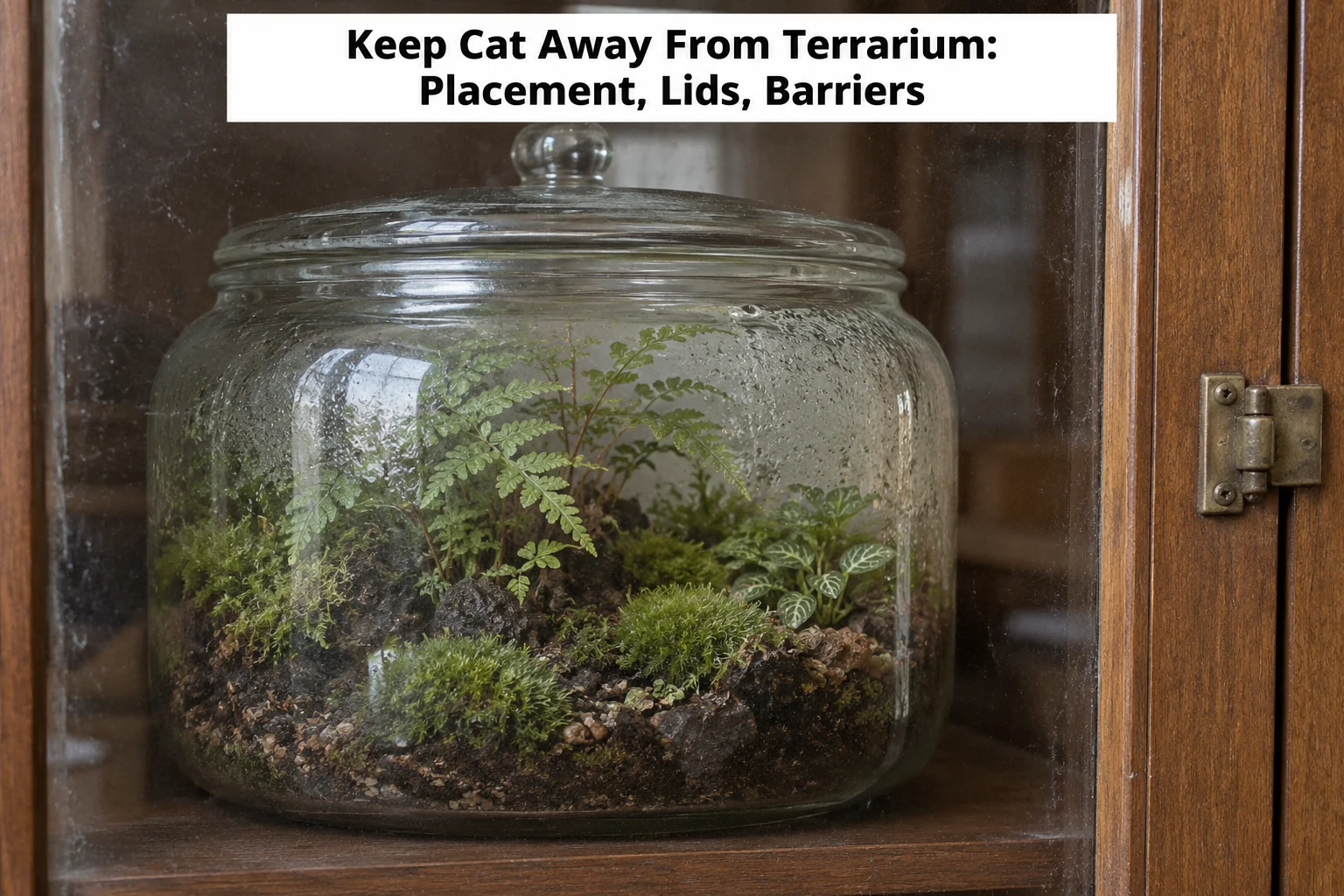
“I would rely on a closed cabinet or an inaccessible room before relying on height alone. A secure lid protects the planting, but it does not stop the whole jar being pushed off a shelf. After moving a terrarium behind glass, I would also recheck the light reaching it so the barrier protects the build without leaving it in a dim corner.”
Why Cats Go for a Terrarium in the First Place
It helps to know what you are competing with. A terrarium on a shelf offers a cat several things at once:
- A raised spot. Shelves, window ledges and tops of units are exactly the places many cats choose to sit and watch a room.
- Movement and texture. Condensation running down glass, a leaf moving in a draft, or moss with an interesting smell all draw attention.
- Something to chew. Cornell notes that cats may chew vegetation naturally, which makes an open jar of greenery an obvious target.
- Warmth. A jar on a sunny sill sits in the same warm spot a cat would choose anyway.
Most of the ways cats damage a terrarium follow from those draws: sitting on a lid, pawing a cork out, knocking the jar off a ledge while jumping past it, or reaching into an open top. The fixes follow from them too.
Placement to Keep Cat Away From Terrarium Shelves
For most cats, “high up” is not out of reach. Placement works when it removes access, not when it adds distance.
Options that remove access
- A closed glass-front cabinet or display case. The jar stays visible and gets light through the glass, but the cat cannot get to it. This is the single most effective placement for a cat household.
- A room the cat does not use. A study, spare room or office with the door kept shut solves the problem entirely, as long as the door really does stay shut.
- Inside a bookcase, not on top of it. A jar pushed well back into a shelf with other books or objects around it has no clear landing space beside it. A jar on the top of a unit has open air around it and is a natural target.
Options that reduce but do not remove risk
- A deep, stable shelf with no landing spot beside it. If a cat cannot land next to the jar, it is harder to knock. Pushing the jar well back from the edge helps.
- Away from jumping routes. A shelf a cat uses as a step to a window or the top of a wardrobe is the wrong shelf.
- Heavy and low-profile containers. A squat, heavy jar is harder to tip than a tall, narrow vase. Our guide to what to build a terrarium in looks at what a container has to do, and stability is one more requirement to add in a cat home.
A note on shelving itself
A tall, lightweight shelving unit can tip if a cat launches off it. If your furniture came with an anti-tip fitting, it is worth using. Fitting one usually means drilling into a wall, so check for hidden wiring and pipes first, and if you are not confident doing that, have a handyperson do it.
Lids: A Closed Jar Is the Cat-Resistant Jar
An open terrarium is an open invitation: paws go in, plants come out, soil ends up on the floor. A closed terrarium removes that whole category of trouble, provided the lid stays on when a cat investigates it.
Not all closures are equal. A cork that sits loosely can be batted out. A lid that simply rests on top can be pushed off. A screw lid or clamp-top needs grip and leverage a cat does not have. Our guide to lidded, corked and clamp-top seals explains how each closure behaves and how it affects moisture inside the jar, which matters because the lid you choose for security also sets how the jar breathes.
Container shape helps too. A bottle or demijohn with a narrow neck is almost impossible for a paw to get into, even if the stopper comes loose. Our guide to carboy and demijohn terrariums covers the trade-offs of building in one; in a cat household, the small opening is a real advantage.
What a lid does not do is stop a jar being knocked over. A sealed jar on a ledge is still a sealed jar that can fall. Lids and placement work together; neither replaces the other.
Barriers and Covers
When a closed cabinet is not an option, a barrier around the jar is the next best thing.
- A cloche or cover over an open planting. If you already have an open terrarium, a larger glass cover or cloche over the whole thing turns it into a closed display, as far as the cat is concerned. Check that the cover sits securely and is heavy enough not to be nudged off.
- Filling the space around the jar. Books, heavy objects or other decorations that leave no gap for a cat to land next to the jar make approaches harder.
- Room-level barriers. A closed door is the most effective barrier there is. Cornell’s point about blocking access applies to rooms as much as shelves.
Cornell’s guidance also lists environmental deterrents, such as double-sided tape and booby traps around houseplants, which work because they are consistent and do not depend on you being there. Other feline veterinary guidance is more cautious. The Feline Veterinary Medical Association’s guidance on addressing undesirable behaviors (FelineVMA, read on 2026-09-27) notes that even when a caregiver “uses a deterrent such as a scat mat,” a cat may keep returning when the reward outweighs the unpleasant experience, and it favors physical barriers and positive reinforcement over aversive methods. The honest reading is that surface deterrents are a supporting measure at most, and physical inaccessibility is the reliable part.
We leave scented repellent sprays out of this guide. If you are considering one, ask your veterinarian which products, if any, are appropriate around your cat and your plants.
Why the Spray Bottle Is Off the Table
Many forum threads about cats and tanks recommend squirting the cat with water whenever it goes near. Feline veterinary sources do not support this.
The Cornell Feline Health Center’s guidance on destructive behavior (Cornell University College of Veterinary Medicine, updated March 2018, read on 2026-09-27) says “cats do not respond well to punishment because they see no link between the punishment and the ‘crime.'” It explains that methods like water spraying teach a cat to avoid the behavior only when you are present. In other words, the cat learns to visit the terrarium when you are out.
The FelineVMA goes further, stating that “Disciplining in the form of verbal or physical punishment (e.g., using squirt bottles) can increase feline protective emotions,” and that it can lead to other unwanted behavior and damage the relationship between cat and owner. For a terrarium, the practical result is the same: punishment does not protect the jar when you are not in the room, and a closed cabinet does.
Give the Cat a Better Place to Be
A cat that has a more attractive spot is less interested in yours. The FelineVMA recommends providing high perches where a cat can watch the room, including warm options such as “a sunny window or a safely heated commercial cat bed,” and rewarding the cat with treats and attention for using them.
For a terrarium owner, that suggests a simple trade:
- Give the window to the cat. If your terrarium and your cat both want the sunny sill, move the jar into a cabinet or back into the room and put a perch or cat tree at the window instead.
- Reward the perch. Treats and attention when the cat uses its own spot build the habit, per the FelineVMA’s positive reinforcement guidance.
- Offer something safe to chew. Cornell lists offering oat grass among the alternatives for cats that chew plants. If you are unsure what suits your cat, your vet can advise.
Putting It Together
| Measure | What it does | How reliable |
|---|---|---|
| Closed cabinet or cat-free room | Removes access entirely | Most reliable |
| Secure lid or narrow neck | Keeps paws out of the plants | Reliable for the contents, not for falls |
| Deep shelf, no landing spot | Makes knocking harder | Reduces risk |
| Surface deterrents | Discourages approach | Supporting only; vet sources differ on use |
| Better perch plus rewards | Gives the cat a reason to be elsewhere | Helpful alongside the above |
| Spray bottle or scolding | Teaches the cat to avoid you | Not recommended by feline vet sources |
If your cat ever does chew or swallow something from a terrarium, contact your veterinarian. In the US, the ASPCA Animal Poison Control Center lists (888) 426-4435 and the Pet Poison Helpline lists (855) 764-7661; Pet Poison Helpline states that an incident fee applies. This guide is about keeping the jar out of reach, and a vet is the right person for anything beyond that.
Frequently Asked Questions
How do I keep my cat away from my terrarium?
Make it physically unreachable. A closed glass-front cabinet or a room the cat cannot enter works best, backed by a secure lid. Cornell’s Feline Health Center says blocking access is the only way to guarantee protection for both houseplants and the cat.
Will a lid stop my cat from knocking my terrarium over?
No. A secure lid keeps paws out of the plants and soil, but a closed jar can still be pushed off a ledge. Placement on a deep, stable surface with no landing spot nearby, or inside a cabinet, is what prevents falls.
Should I use a spray bottle to keep my cat off the terrarium?
Feline veterinary sources advise against it. Cornell notes that cats do not link punishment to the behavior, and the FelineVMA warns that squirt bottles can increase protective emotions and damage the cat-owner relationship.
Do deterrent mats or double-sided tape work?
They can help as a supporting measure. Cornell lists double-sided tape among environmental deterrents, while the FelineVMA notes a cat may keep returning despite a scat mat when the reward is strong. Blocking access is more reliable.
Is a closed terrarium better than an open one if I have a cat?
Yes, for the contents. A closed jar keeps paws out of the plants and soil. A narrow-necked bottle is even harder for a cat to get into. It still needs a safe spot, because a lid does not stop a fall.