
Isopods in Terrarium Jars: Usually a Bad Idea (Here’s Why)

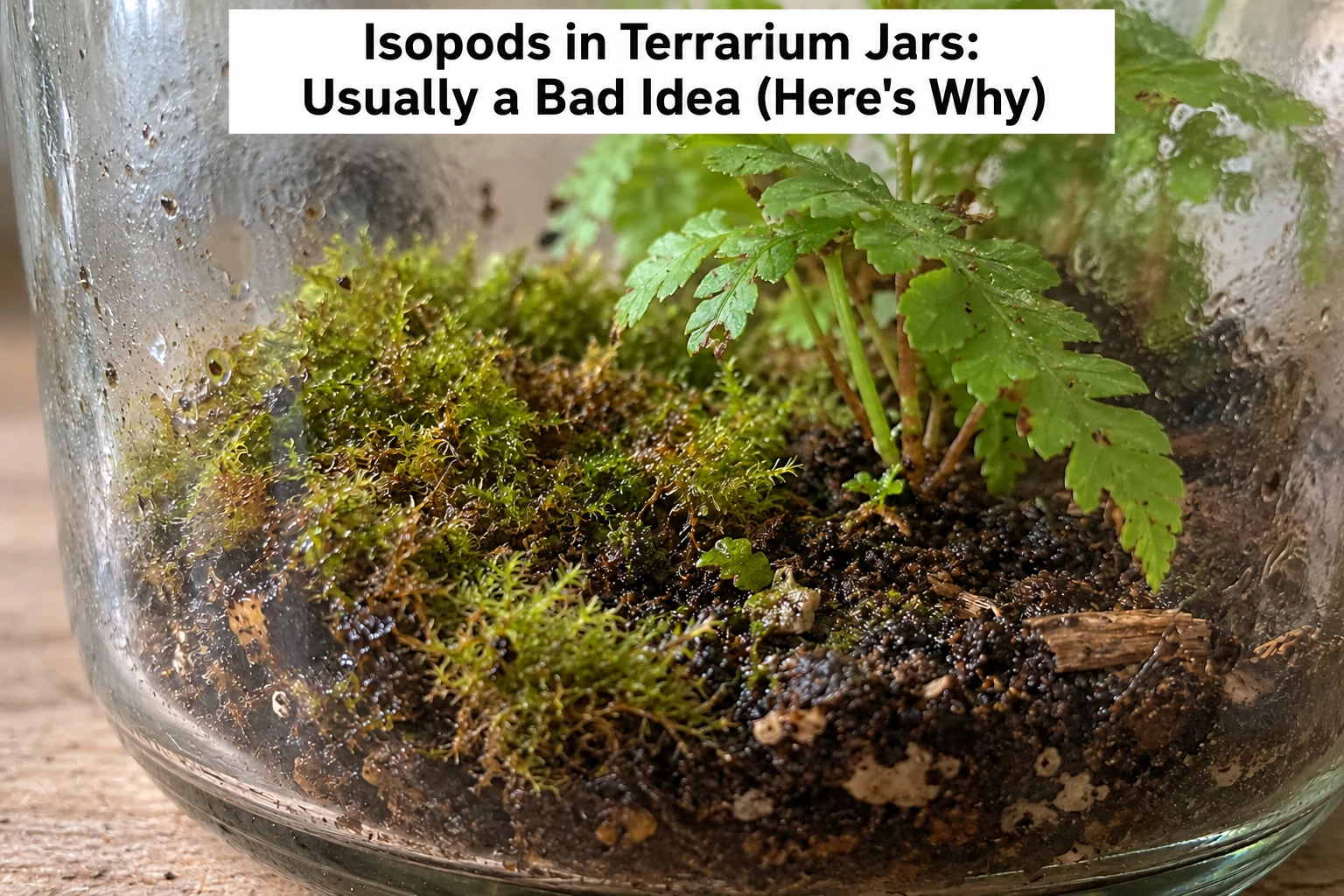
Keeping isopods in terrarium builds works well in a large, leaf-littered enclosure, but in a small closed jar it is usually a bad idea. Isopods eat decaying plant material, and a small jar produces very little of it. Once the decay runs out, the UC Statewide IPM Program notes that these animals “occasionally feed on seedlings, new roots, lower leaves,” which in a jar means your moss and new growth. They also need moisture but can drown in standing water. For most small sealed jars, springtails alone do the cleanup job with far less risk.
That is the short version. The rest of this guide explains what isopods need, why a small sealed jar struggles to provide it, the specific ways things go wrong, and the situations where isopods genuinely do make sense.
“I would not add isopods to a small moss jar simply because a larger bioactive tank uses them. The food supply and space are very different, and tender new growth can become vulnerable when decay is scarce. Before introducing a crew, I think about what will feed it after the initial scraps are gone, not just what needs cleaning today.”
Why Everyone Pairs Isopods With Springtails
Search for “cleanup crew” and almost every result recommends the same duo: springtails and isopods. Most of those results come from shops that sell live cultures, and most of them are writing about bioactive enclosures for reptiles and amphibians. Those are large tanks with deep substrate, thick leaf litter, animal waste and uneaten food. In that setting, isopods have a constant supply of food and a real job to do.
A jar on a bookshelf is a very different place. It has a few plants, some moss, perhaps a piece of wood, and no animal waste at all. The advice was not wrong. It was written for a different kind of container.
What Isopods Actually Are and What They Need
Isopods, the group that includes pillbugs, sowbugs and woodlice, are not insects. The Missouri Department of Conservation’s field guide to land isopods (read on 2026-09-27) describes them as “land-dwelling members of the crustacean order Isopoda.” It explains that they breathe through gills that must stay moist, that they live in “damp, humid places such as under rocks and logs,” and that they “will drown if submerged in water too long.” Their food, according to the same guide, is “decaying plant material, such as rotting wood, and fungi.”
So an isopod needs three things at once:
- Constant moisture, because their gills must stay damp.
- No standing water, because they can drown.
- A steady supply of decaying plant matter and fungi to eat.
A large, well-built enclosure with a thick layer of leaf litter provides all three. A small closed jar often fails on the third, and sometimes on the second.
Problem 1: A Small Jar Runs Out of Food
A healthy closed terrarium produces decay slowly. A leaf yellows here, a moss tip browns there. That is enough to feed a population of springtails, which are tiny. The University of Maryland Extension puts springtails at 1 to 2 millimeters long. Isopods are much larger: the UC Statewide IPM Program’s pillbugs and sowbugs page (read on 2026-09-27) gives adults as about 1/3 to 3/4 inch, and the Missouri guide gives about 1/4 to 1/2 inch. Even the smaller kinds kept in terrariums are many times the size of a springtail.
When decay runs short, isopods look for the next best thing. The UC IPM page is clear that they “feed primarily on decaying plant material” but “occasionally feed on seedlings, new roots, lower leaves, and fruits or vegetables touching the soil.” In a garden bed, that is an occasional nuisance. In a jar, the tender material within reach is exactly what you most want to keep: fresh moss, new fern fronds, the soft roots of a plant that has only just settled in.
The result is often slow, confusing damage. Moss thins in patches. A newly planted cutting fails to root. A fern loses its lowest fronds. It looks like a light or water problem, and people change the wrong thing.
Problem 2: The Population Has Nowhere to Go
In a large bioactive tank, isopod numbers are kept in check partly by the reptile or amphibian that eats some of them, and partly by the keeper, who can remove extras. A closed jar has neither.
The UC IPM page also notes that adults “can live for 2 to 5 years,” and the Missouri guide describes females carrying eggs in “a water-filled brood pouch, the marsupium.” Put a few isopods into a jar with plenty of food at first, and they can breed. When that first flush of food is gone, you may have a larger population than the jar can support, long-lived animals and very little decay. That is when plant damage tends to start.
Removing isopods from a planted jar is also much harder than adding them. They hide under wood, in moss and deep in the substrate. Catching them all usually means taking the build apart.
Problem 3: Water Pools in the Wrong Places
Isopods need damp conditions but, as the Missouri guide warns, can drown if submerged. A small closed jar often has exactly the wrong water pattern: condensation runs down the glass and collects at the base, or a drainage layer fills with water after one heavy watering.
In a large enclosure, isopods can move to a drier or wetter zone. In a small jar, the whole bottom may be too wet at once. If you have seen water sitting in the gravel of a jar, our guide to a flooded, waterlogged terrarium explains how to drain it. Reading the fog on the glass also tells you a lot about how wet the jar really is; see reading condensation in a terrarium.
Problem 4: Moss Is Both Food and Home
Moss-heavy jars are among the most popular closed builds, and they are also among the worst places for isopods. Moss holds moisture, shelters small animals and has soft growing tips. An isopod population in a moss jar is living inside the most tender plant material in the build. Springtails in the same moss mostly graze fungus and decay on the surface, which is why they are the safer match.
Isopods in Terrarium Builds: When They Do Make Sense
This is not an argument that isopods are bad for terrariums in general. They suit some builds well:
- Large enclosures with plenty of floor space and room for a thick layer of leaf litter.
- Builds with lots of decaying material, such as leaf litter topped up regularly and soft wood that is meant to break down.
- Open or ventilated setups where water does not pool at the base.
- Vivariums with animals, where waste and uneaten food provide a real food source.
If you do want isopods in a planted display, the practical rules are:
- Choose the biggest container you can. Our guide to how small is too small for a closed terrarium explains why small volumes are harder to keep stable in general.
- Keep a generous layer of leaf litter on the surface and top it up as it breaks down.
- Keep the substrate damp but never flooded.
- Start with a small number and watch for thinning moss or damaged new growth.
- Have a plan for removing them if damage starts.
The Simpler Choice for Small Jars: Springtails Alone
For most small, sealed jars, springtails do everything a cleanup crew needs to do. The University of Maryland Extension’s springtails fact sheet describes them as feeding mainly on “algae, fungi, pollen, and decaying organic matter,” and states that “springtails do not bite or cause damage.” They are small enough that a jar’s slow trickle of decay can support them, and they graze mold before it spreads.
Many closed jars also run perfectly well with no added animals at all. If you are deciding between a sealed jar and an open container for a particular build, our guide to open vs closed terrariums covers the trade-offs.
Quick Comparison
| Question | Isopods | Springtails |
|---|---|---|
| Food they need | Decaying plant material and fungi, in bulk | Fungi, algae and decay in tiny amounts |
| Risk to plants in a small jar | Can feed on seedlings, new roots and lower leaves | Described by UMD Extension as causing no damage |
| Water risk | Need damp but can drown if submerged | Need damp conditions |
| Easy to remove if things go wrong | No, they hide throughout the build | Rarely needed |
| Best container | Large, leaf-littered enclosures | Almost any closed jar |
Frequently Asked Questions
Do I need isopods in my terrarium?
No. Isopods are useful in large enclosures with lots of leaf litter or animal waste, but most small closed terrariums work fine with springtails alone, or with no added animals at all.
Will isopods eat my terrarium plants?
They mainly eat decaying plant material, but the UC Statewide IPM Program notes they occasionally feed on seedlings, new roots and lower leaves. In a small jar with little decay, moss and new growth are the most likely targets.
Can isopods live in a sealed jar?
They can survive if the jar stays damp and has enough decaying material, but the Missouri Department of Conservation notes they can drown if submerged, and a small jar often lacks enough food. That combination makes a small sealed jar a poor long-term home.
How long do isopods live in a terrarium?
The UC Statewide IPM Program states that adult pillbugs and sowbugs can live for 2 to 5 years. That long lifespan, plus breeding, is why a population in a small jar can outgrow its food supply.
I already added isopods to a small jar. What should I do?
Watch for thinning moss and damaged new growth. Adding more leaf litter gives them something else to eat. If damage continues, the most reliable fix is to take the build apart carefully, remove the isopods, and move them to a larger enclosure.