
Too Many Springtails in Terrarium: Boom, Crash, Fix

Too many springtails in terrarium soil is rarely a problem for the plants. Springtails breed fast when there is plenty of damp decay and fungus to eat, and their numbers fall again once that food runs short. A sudden boom is best read as a message about the jar: it is wetter, or fuller of decaying material, than it needs to be. The fix, when one is needed, is to deal with the moisture and the food supply, not to kill the springtails.
That is the short version. The rest of this guide explains why springtail populations swing so hard in a closed jar, what a boom and a crash each tell you, the rare cases where a large population is worth acting on, and how to bring numbers down gently.
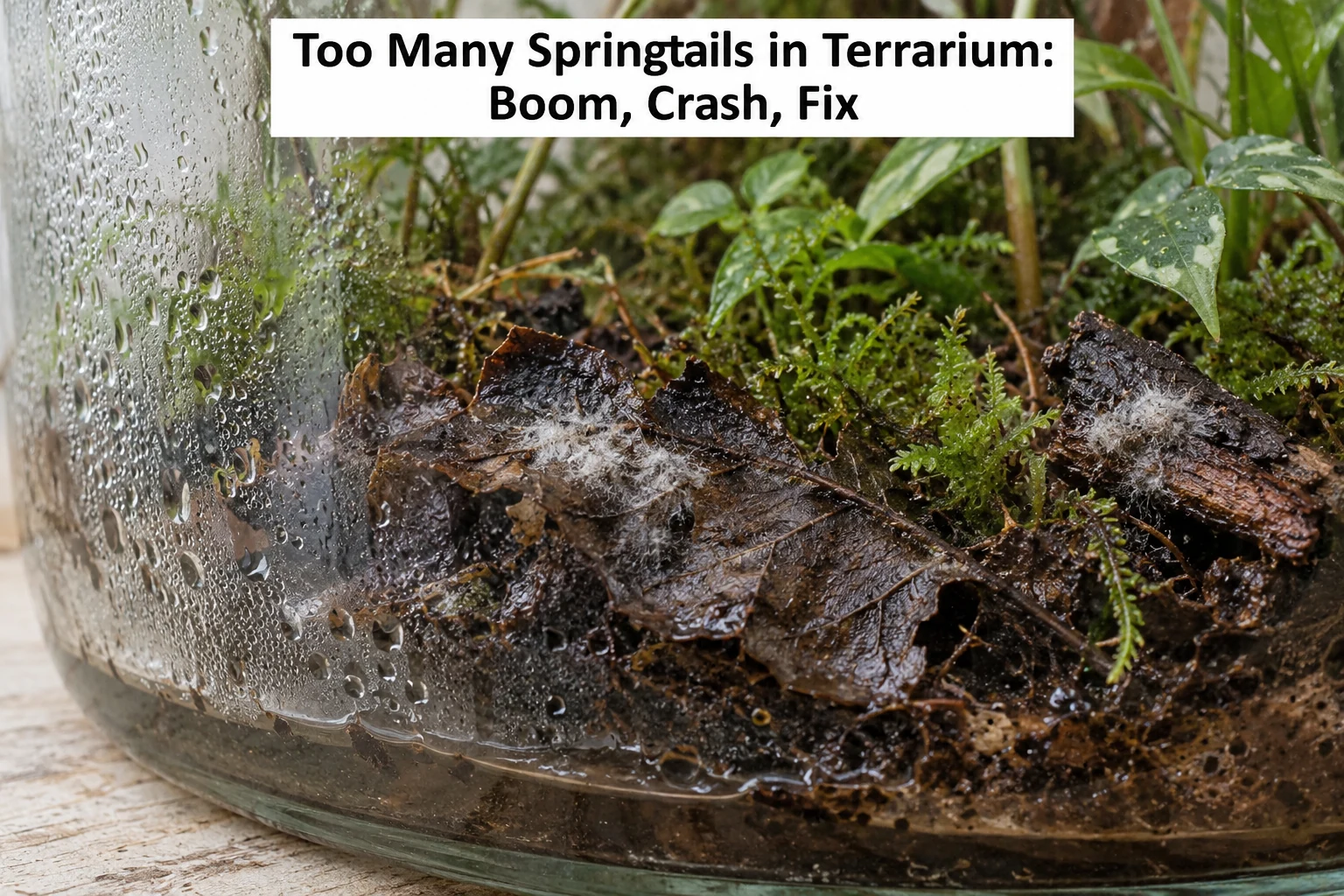
“When springtail numbers rise, I look for the food and moisture behind the change before treating the population itself as a problem. A collapsing leaf or wet patch can support a sudden surge. I would remove obvious rot and reassess excess water without drying the moss out, then watch whether the population settles as the extra food disappears.”
Why Springtail Numbers Explode in a Closed Jar
Springtails are tiny soil animals that live on fungi and rotting plant matter. The University of Maryland Extension’s springtails fact sheet (dated August 4, 2023, read on 2026-09-27) describes them as “very small insects, 1 to 2 millimeters long” that “primarily feed on algae, fungi, pollen, and decaying organic matter.” The same page says “springtails do not bite or cause damage.”
Put those animals in a sealed jar and you have created close to ideal conditions for them:
- Constant moisture. A closed terrarium recycles its own water, so the soil rarely dries.
- A food supply that grows on its own. New wood, fresh moss and new substrate all feed a flush of mold and fungus in the first weeks. Dead leaves and roots add more.
- No predators. In a plant-only jar, nothing is there to eat them.
With food and water on tap and nothing hunting them, the population grows until it hits the one limit left: food. That is why the boom so often arrives some weeks after a build, or after a batch of leaves dies back, or after an overwatering.
How big can a springtail population get naturally? Ohio State University Extension’s Ohioline springtails fact sheet (David J. Shetlar and Jennifer E. Andon, April 20, 2015, read on 2026-09-27) says “Populations can reach numbers that are up to 100,000 individuals per cubic meter of surface soil, or many millions per acre.” A jar full of visible springtails is dense by human standards but not unusual for these animals.
What a Springtail Boom Is Telling You
A boom is a reading, not a verdict. The University of Maryland page notes that indoor springtail infestations “are usually associated with dampness, organic matter, and mold,” and that springtails in a building “generally suggest some kind of moisture problem.” A terrarium is a much smaller room, but the logic transfers directly.
When numbers jump, check three things:
- Is the soil wetter than it should be? Look for standing water in the drainage layer, soil that stays dark and shiny at the glass, or condensation that never clears. Our guide to a flooded, waterlogged terrarium covers how to tell and how to drain it.
- Is there a new source of decay? A plant that has melted, a patch of rotting moss, soft wood breaking down or a pile of dropped leaves can all feed a surge.
- Is there mold the springtails are grazing? A boom often sits right on top of a mold bloom. The springtails are the response, not the cause. Our guide to terrarium mold and condensation explains how the two link together.
If the answer to all three is no and the plants look healthy, the boom is most likely a young population catching up with the food a new build produced. That usually settles by itself.
Why the Crash Follows
Every boom in a sealed jar is followed by a fall. There are two common causes, and they mean very different things.
The food-limited crash (normal)
Once springtails have grazed down the mold and the easy decay, there is less to eat, and fewer young survive. Numbers drop back to a level the jar can support. You will still find springtails if you lift a leaf, but you no longer see them streaming across the glass. This is the healthy pattern, and it is what hobbyists usually mean when they say a population “balances out.”
The drying crash (a warning)
Springtails need moisture to survive. Ohioline notes that springtails “are abundant only in damp, moist or very humid locations,” and the University of Maryland page says they move “seeking moisture when their outside habitat becomes too dry.” In a terrarium, there is nowhere to move to. If the jar dries out, the springtails die.
So a sudden disappearance, especially alongside a lid that has been left open, no condensation for days, or moss turning pale and crisp, points to a jar that has gone too dry. Our guide to no condensation in a terrarium covers whether that is a dry jar or a bad seal.
| What you see | Most likely meaning | What to do |
|---|---|---|
| Boom some weeks after building | New substrate and wood feeding a mold flush | Usually nothing; let it settle |
| Boom after overwatering | Wet soil and fresh decay | Fix the water first |
| Boom on a patch of mold | Springtails grazing the mold | Deal with the cause of the mold |
| Slow decline, a few still visible | Food running short | Normal; nothing needed |
| Sudden disappearance, jar dry | Moisture has dropped too far | Check the seal and water level |
Can You Really Have Too Many Springtails in Terrarium Soil?
For a plant-only terrarium, the honest answer is: rarely, and not in the way most people fear.
Springtails in normal conditions eat fungi and decay, not healthy plants. The University of Maryland Extension states they “do not bite or cause damage.” There is one caveat worth knowing. Ohioline notes that while “Most feed on algae, fungi and decaying vegetable matter,” some species “may feed on the stems and roots of young seedlings, resulting in wilting or even death.” In a terrarium, that means a very large population with little decay left to eat is not a great neighbor for seedlings or freshly sown moss. Established plants are much less exposed.
The other reasons people want fewer springtails are practical rather than harmful:
- They are hard to look at. A glass wall crawling with white specks spoils the view of the build.
- They get out when you open the jar. A few escapees into a dry room are unlikely to survive, since the extension sources above tie springtails to damp places. A damp spot, like a bathroom or a leaky sink cabinet, is a different matter.
- The boom is covering up a problem. This is the real risk. If you treat the springtails as the issue, you can miss the waterlogged soil or rotting plant that caused them.
In a vivarium with animals, such as tiny frogs, keepers on hobby forums describe very dense springtail populations bothering small animals. That is outside the scope of a plant-only terrarium, and anyone keeping animals should follow a husbandry source for that species.
How to Bring the Numbers Down Gently
If the jar has a real moisture or decay problem, fix that first. The population will follow. If the jar is healthy and you simply want fewer visible springtails, these steps work with the animals’ biology rather than against it.
Remove the extra food
Pick out dead leaves, melted plant tissue and obvious patches of rot with long tweezers. Fewer food sources mean fewer young survive. This is the most direct step you can take, and it is good jar hygiene anyway. If one plant keeps rotting, it is usually better to take it out than to keep feeding the population with it.
Let the jar breathe for a short while
If the soil is soggy, opening the lid for part of a day lets some excess moisture escape. Do this in short sessions and watch the moss and leaves closely, because a closed-jar planting can dry out faster than you expect. The goal is damp soil, not dry soil. The extension advice for houseplants runs the same way: Ohioline advises to “avoid over-watering potted house plants and allow the soil to dry between watering,” which in a sealed jar translates to not adding more water while the population is high.
Lift some out
Many hobby guides describe placing a small pinch of fish flakes on the soil, letting springtails gather on it overnight, then lifting it out along with them. This is a way to move them into a separate culture or a new build rather than wasting them. Remove the bait promptly, because uneaten food in a closed jar turns to mold, which feeds the next boom.
Do not spray
Insecticide is the wrong tool. The University of Maryland page says “Insecticide sprays inside the home are not recommended or necessary,” and Ohioline says “Control with pesticides is generally not required if moisture management is followed.” Inside a terrarium, any spray would also land on the plants and soil life you want to keep.
Preventing the Next Boom
You cannot stop springtails from responding to food. You can keep the swings smaller:
- Do not overfeed the jar with decay. A light layer of leaf litter feeds a steady population. A thick mat of it feeds a boom.
- Keep watering conservative. Most closed jars need far less water than new builders give them. Our guide on how often to water a closed terrarium explains how to judge it.
- Clear dying plants early. One melting plant can feed a surge for weeks.
- Expect a boom in a new build. The first weeks after planting are when mold and springtails tend to peak together. A jar that is still settling is not yet a jar with a problem.
Frequently Asked Questions
Is it bad to have too many springtails in a terrarium?
Usually not. Springtails eat fungi and decaying plant matter, and the University of Maryland Extension states they do not bite or cause damage. A large population is best read as a sign that the jar is damp and has plenty of decay, which is worth checking.
Why did my springtails suddenly disappear?
Either they ate through their food and the population shrank to match, which is normal, or the jar dried out. Springtails need moisture to live. If the moss looks crisp and there is no condensation, check the lid and the water level.
Will springtails eat my terrarium plants?
Most springtails feed on algae, fungi and decay. Ohio State University Extension notes that some species may feed on the stems and roots of young seedlings, so seedlings and newly sown moss are the plants most exposed when numbers are high and food is short.
How do I get rid of excess springtails without harming the jar?
Remove dead leaves and rotting material, avoid adding water while numbers are high, and lift some out on a small pinch of bait. Extension sources say pesticides are not needed when moisture is managed.
Can springtails escape from a terrarium into my house?
A few may escape when you open the lid. Extension sources link springtails to damp places, so escapees in a dry room are unlikely to survive for long, while a damp area of the home could support them.