
Liverwort in Terrarium: The Thing That Isn’t Moss

Liverwort in terrarium builds is a bryophyte, not a moss: it grows as a flat, lobed thallus with no true stems or leaves, spreads fastest in wet, shaded, poorly drained spots, and can be either a deliberate groundcover or an uninvited colonizer competing with the moss and plants already in place. Confirm which one you actually have before changing anything about watering, light, or substrate, because the fix for one is often the wrong fix for the other.
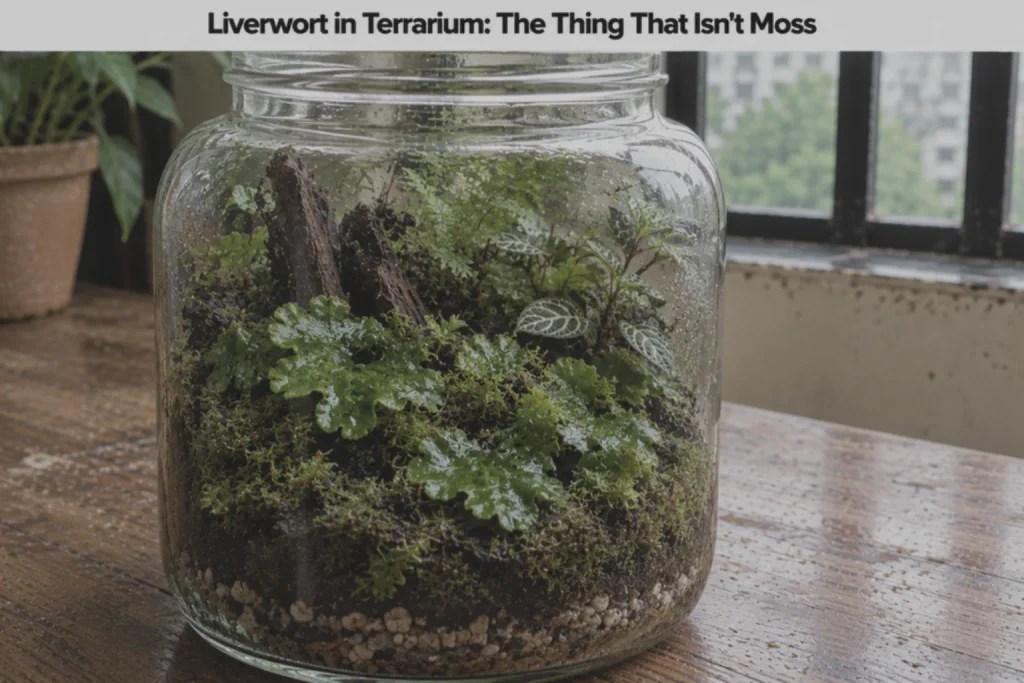
“In my own terrariums, liverwort has taught me not to assume every flat green patch is moss just because it looks similar at first glance. In a humid closed jar, especially in my climate, it can spread quietly across damp substrate and around plant bases before it becomes obvious that it is a different plant altogether. I now look for the flat, lobed, ribbon-like thallus rather than tiny leafy stems, and that identification decides whether I leave it as groundcover or remove it before it starts crowding something I actually want to keep. The useful lesson for me is that liverwort itself is not automatically a problem; the real warning sign is when it starts taking over space or tells me the surface is staying wetter than I intended.“
What liverwort actually is (not moss, not algae)
Mosses, liverworts, and hornworts are all bryophytes: small, non-vascular plants that move water and nutrients cell to cell rather than through the xylem and phloem a flowering plant uses. That shared ancestry is exactly why the three get lumped together and confused for one another. According to Penn State Extension’s guide to liverworts (read 2026-09-18), liverworts lack true roots, stems, and leaves altogether. Thalloid liverworts, the type most likely to show up in a terrarium, grow as a flat, green, lobed, ribbon-like body called a thallus that lies close against a moist surface and anchors itself with hair-like rhizoids that draw up water by capillary action rather than through a root system. Moss, by contrast, has an upright stem with distinct leaves that carry a visible midrib. Algae is neither: it has no body structure at all, just a slimy or fuzzy film, and usually points to too much light or standing moisture rather than a plant you’d want to keep.
How to tell liverwort from moss and from algae
A quick visual check settles most cases. Moss looks like tiny upright stems with individual leaves branching off; under light magnification you can usually see a leaf midrib. Liverwort looks flatter and glossier, like a thin green ribbon or lobed disc pressed against the substrate, with no separate leaf shapes to pick out. Algae has no structure at all, just a green or brown sheen or fuzz, often on glass or standing water rather than on substrate. A healthy liverwort patch stays plump and green and expands outward gradually; if it starts drying, lifting at the edges, or turning dull, the enclosure has gotten drier than it prefers.
At a glance:
- Moss: upright stems with distinct, midribbed leaves; browns and crisps when too dry
- Liverwort: flat, lobed thallus with no stems or leaves; stays plump when hydrated, dulls and lifts when too dry
- Algae: no plant structure at all; a slimy or fuzzy film that signals excess light or standing water
This distinction matters before doing anything else, since treating an algae bloom or a spreading liverwort colony as though it were a struggling moss patch leads to the wrong fix, and mixing the three up is one of the more common misreads covered in terrarium mold identification, where fuzz, slime, and plant growth all get sorted out side by side.
Why liverwort shows up in a closed terrarium
Liverwort does not need to be introduced deliberately to appear. Spores travel on air currents, on hands, on tools, or hitch a ride on moss, wood, or soil brought in from elsewhere, and a closed terrarium is close to ideal habitat once they land. Per Michigan State University Extension’s fact sheet on identifying and managing liverwort (read 2026-09-18), the plant favors cool temperatures, low light, high moisture, and poorly drained substrate, with an optimum growth range of roughly 64 to 72°F, and it spreads fastest wherever a surface stays damp and undisturbed for long stretches. A sealed glass jar with a stable, warm, humid interior, common in a South or Southeast Asian apartment where ambient humidity already runs high for much of the year, checks nearly every box on that list. A build that goes through a humid monsoon stretch without extra ventilation, common for keepers in this climate, often sees a small liverwort patch turn into a visible one within a couple of weeks, simply because the surface never gets a chance to dry between waterings. It is not a sign of a mistake in the build; it is a sign the terrarium is doing exactly what a closed terrarium is supposed to do, holding moisture in.
Is liverwort a problem in your terrarium, or a feature
The honest answer depends on what else is growing there and whether you put it there on purpose. Some keepers introduce liverwort deliberately as a groundcover alternative when moss has been unreliable, since it tends to establish faster and tolerate wetter, more stagnant conditions than most terrarium moss species. If that’s the intent, it pairs reasonably well with the tougher end of the plant list in low-maintenance terrarium plants ranked by neglect, since both tolerate the same steady, high-humidity conditions. The problem case is different: liverwort that arrived uninvited and is spreading over moss, around plant crowns, or across the base of stems that need airflow and space to avoid rot. Left unchecked in a small enclosure, it can outcompete slower-growing moss for the same damp surface and gradually smother the openings a plant’s growth point needs. Whether to leave it or pull it back comes down to whether it is sharing space or taking it over.
What liverwort needs to establish and spread
Liverwort is not picky about substrate the way some terrarium plants are. It roots into almost anything that stays consistently damp, which means the substrate underneath matters less for liverwort itself than for what happens around it. A substrate mix that drains evenly and does not stay waterlogged at the surface, like the layered approach in choosing a terrarium substrate, reduces the standing surface moisture liverwort depends on, without starving the rest of the build of humidity. Low, indirect light is enough for liverwort to keep spreading, so dimming a grow light will not discourage it much on its own; moisture control does more of the work. Because liverwort reproduces both by spores and by small clumps called gemmae that break off and root elsewhere, a single unnoticed patch can turn into several within weeks once conditions favor it.
Managing liverwort in terrarium builds once it’s established
If liverwort is welcome, maintenance is minimal: keep the surface damp, keep light indirect, and let it spread into the ground-cover role it’s suited for. If it’s not welcome, physical removal is the first and most reliable step, and it works best done in full rather than partially. Lift the entire patch with tweezers or a small tool, taking the thallus and as much of the rhizoid layer as possible, since a fragment left clinging to the substrate can regrow into a new patch within days. Reducing surface moisture afterward, by improving drainage or venting the enclosure briefly, makes the spot less hospitable to a second colonization, and drying that one area slightly more than the rest of the build for a few days gives any stray spore less to work with. Liverwort thrives on the same standing moisture that causes cloudy glass and heavy condensation, so a build that keeps fogging up or staying wet at the surface is also a build liverwort will keep coming back to, which is worth ruling out before repeating the removal every few weeks.
Sourcing liverwort for a deliberate build
If the plan is to add liverwort on purpose rather than manage it as an accident, buy from a terrarium or bryophyte supplier rather than collecting it outdoors, since a labeled species arrives closer to terrarium-ready condition and with a known identity. Quarantine any new liverwort briefly and check it for pests, mold, or a mixed-in patch of something else before adding it to an established build, since a contaminated clump is far easier to reject on the way in than to remove later. It attaches to damp wood or stone on contact rather than needing to be planted, which makes it a straightforward addition to hardscape already in place; if the terrarium is still in early planning, the sequencing in a first terrarium build, step by step is worth reading first, since where liverwort or moss goes down usually comes near the end of the build, not the beginning.
FAQ
Is liverwort the same thing as moss? No. Both are bryophytes, but moss has upright stems and leaves with a visible midrib, while liverwort is a flat, lobed thallus with no stems, leaves, or midrib at all. They are related but structurally distinct plants.
Why is liverwort growing in my terrarium even though I never added it? Liverwort spores travel easily on air, tools, hands, or material brought in from elsewhere, and a closed terrarium’s stable warmth and moisture make it easy to establish once a spore lands on a damp surface.
Should I remove liverwort from a terrarium, or leave it? It depends on whether it’s spreading over moss or plant crowns that need space, or simply filling bare damp substrate. If it’s competing with something else you’re trying to grow, remove it; if it’s just covering open ground, it can stay.
Does liverwort need the same light as terrarium moss? Roughly, yes. Liverwort tolerates low, indirect light and does not need or benefit much from stronger light, since moisture and shade drive its spread far more than light intensity does.
How do I get rid of liverwort without disturbing other terrarium plants? Lift it out by hand or with tweezers, taking the whole thallus and rhizoid layer where possible, and reduce standing surface moisture afterward so a fragment left behind is less likely to regrow.