
Terrarium Light Hours Per Day: Why the Advice Disagrees

There is no single right number, because terrarium light hours per day depend on how bright the light is. Under a lamp, extension guidance for indoor plants sits in a narrow band: Illinois Extension says 14 to 16 hours is sufficient and warns against more than 16, and Iowa State University Extension suggests starting at 14 hours and staying between 8 and 16. A bright spot needs fewer hours than a dim one. Every terrarium needs a dark period each day.
If you have read several terrarium guides, you have probably seen different hour counts, often with no explanation of where they came from. This article explains why they disagree, what the published guidance actually says, and how to pick a schedule for your own jar.
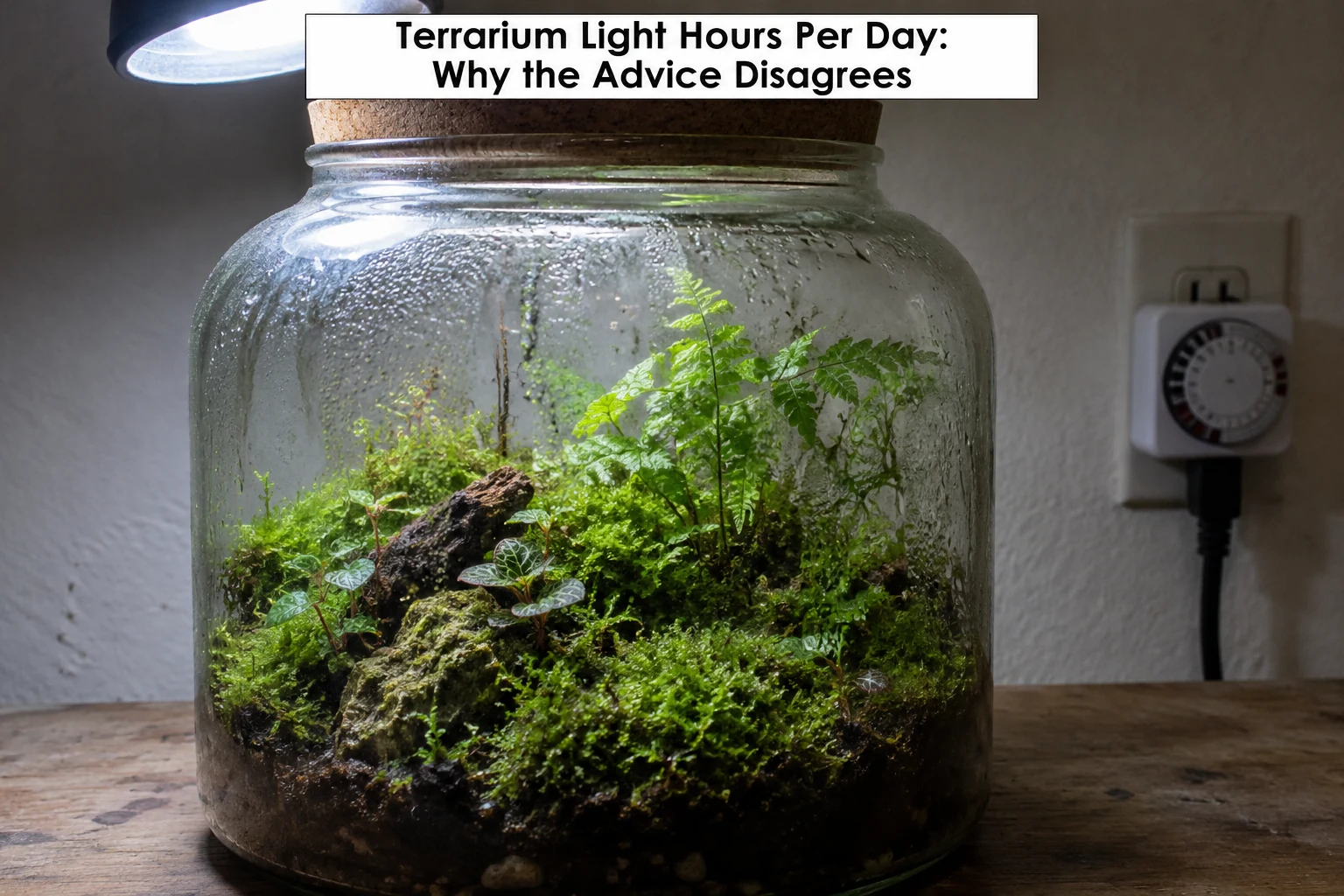
“I treat lighting hours and brightness as one decision. Extending a weak lamp into the night does not make it a good setup, so I look at the light reaching the leaves and keep a regular dark period. After a power cut, I also check the timer clock; a shifted schedule can quietly change the routine even when the lamp still switches on.”
Why terrarium guides give different hour counts
Most of the disagreement comes from guides answering different questions without saying so.
- Daylight or lamp? A jar near a window gets however many hours the window gives it. A jar under a lamp gets whatever the timer says. Advice for one does not transfer cleanly to the other.
- How bright? Ten hours under a strong lamp and ten hours in a dim corner are not the same amount of light. An hour count with no brightness attached is half a measurement.
- Which plants? Moss and small ferns are content with less than a flowering plant. Guides written for vivariums or seedlings often carry numbers meant for more demanding plants.
So when two guides disagree, they may both be reasonable for their own setup. The useful move is to understand what the hours are doing, then apply that to your own jar.
Terrarium light hours per day: what extension guides actually say
University extension services publish general guidance for plants grown indoors under lamps. It is not terrarium-specific, but it is the most careful public advice available, and closed terrariums are, in the end, indoor foliage plants in glass.
Illinois Extension’s houseplant lighting guide (read September 27, 2026) defines duration as “the number of hours of light that falls on a plant in 24 hours.” For plants in low light that are given extra hours of light, it states: “Duration of 14 – 16 hours is sufficient. Do not expose plants to more than 16 hours of light since they need a rest period too.”
Iowa State University Extension’s guide How to Determine How Much Supplemental Light to Provide for Indoor Plants (by Aaron Steil, last reviewed December 2023, read September 27, 2026) suggests leaving lights on for 14 hours a day as a starting point, then adjusting the timer “without going less than 8 hours or more than 16 hours.”
Put together, the published guidance gives you a floor and a ceiling:
| Source | Starting point | Range | Upper limit |
|---|---|---|---|
| Illinois Extension | Not stated | 14 to 16 hours | No more than 16 hours |
| Iowa State University Extension | 14 hours | 8 to 16 hours | 16 hours |
Both are written for plants under artificial light. Neither is a target for a jar on a windowsill, where the day length is set by the sun, not by you.
Hours times brightness: the daily light total
The reason hour counts alone mislead is that plants respond to the total amount of light they receive over a day. Horticulturists call this the Daily Light Integral, or DLI.
Iowa State’s guide gives the calculation: “DLI = PPFD × # hrs × 0.0036,” where PPFD is the brightness of usable light at the leaves. You do not need to run the numbers to use the idea. The formula shows that brightness and hours multiply together:
- Halve the brightness and you need double the hours to reach the same daily total.
- Double the brightness and half the hours give the same total.
University of New Hampshire Extension specialist Jonathan Ebba, in a Q&A published February 2, 2021, puts typical daily totals at “4-6 moles per square meter per day for houseplants” and “6-8 for shade plants.” He also makes the point that settles most hour debates: “failure with growing plants under lamps is more often about light quantity (intensity and duration) than quality (spectrum).”
This is why the 16-hour ceiling matters. If a lamp is too weak, you cannot keep adding hours to make up for it. Past 16 hours the published advice says stop, so the fix for a weak or distant lamp is more brightness at the plants, not a longer day.
Daylight hours are not the same as useful hours
For a terrarium lit by a window, counting from sunrise to sunset overstates how much useful light it gets.
- The spot is only bright for part of the day. Mississippi State University Extension’s terrarium guide recommends “an eastern exposure with morning sun,” which means the jar’s brightest hours come in the morning, and the rest of the day is dimmer.
- Weather changes the total. A run of cloudy or monsoon days gives the same hours with far less light.
- Seasons shift it. Day length and the sun’s angle change through the year. The change is larger the farther you live from the equator, and smaller near the tropics, but the angle of the sun through a window still shifts where the bright patch falls.
A better way to think about a window is “bright hours”: how long the spot is clearly lit. If a jar gets only a short stretch of good light, a lamp can extend that. When you combine the two, keep the total within the 16-hour ceiling so the plants still get a proper dark period.
Why the dark period matters
Illinois Extension is direct about this: plants “need a rest period too.” A lamp left on day and night is not giving the plants anything extra that they can use, and in a closed jar constant light can encourage algae on damp glass. Terrarium algae on the glass explains why light and algae go together.
Iowa State also warns that other light sources can intrude on the dark period: “Ensure other lights in the area (room lights, lamps, street lights, etc.) are not ‘polluting’ the dark period.” That advice is written with flowering plants in mind, but the principle is useful for any jar. If the terrarium sits in a room where the main light is on until late, count those hours.
Setting a schedule that stays the same
Consistency matters as much as the number. Mississippi State’s guide cautions: “Avoid moving it frequently, as changes in light intensity and duration may harm plant health.” The same logic applies to a timer that keeps being changed.
A practical approach, based on the published ranges:
- Start in the middle. Iowa State’s starting point of 14 hours under a lamp is a reasonable default, within Illinois’s 14 to 16.
- Use a plug-in timer. Same on time, same off time, every day.
- Wait before judging. Give the plants a few weeks. A new build also needs time to settle, and early changes can be about the build rather than the light. How long a closed terrarium takes to stabilize covers what is normal in that period.
- Adjust in small steps. If the plants stretch and pale, first move the lamp closer or brighten it. If you change the hours, change them a little at a time and stay between 8 and 16.
- Keep the glass cool. Longer hours under a warm lamp mean more heat in a sealed jar. Touch the glass after the lamp has been on for a while. It should feel close to room temperature.
Reading the plants after a change
The plants tell you whether the schedule suits them.
Signs of too little light overall:
- Stems stretching with long gaps between leaves.
- New leaves smaller and paler than older ones.
- Colorful foliage fading toward plain green.
Signs of too much light or heat:
- Bleached, scorched or crispy patches on the side nearest the light.
- Plants wilting during the lit period.
- Algae spreading quickly on the glass.
Slow growth on its own is not a problem. In a closed terrarium, slow growth is usually the aim. Fitting light checks into your routine is easy if you already follow a weekly, monthly and yearly terrarium maintenance schedule.
Timers, travel and power cuts
A timer keeps the schedule steady when you are not there, which is one reason lamp-lit jars cope well with short trips. Leaving a terrarium alone for a month covers what else to check before you go.
Two small practical points:
- Check the clock after a power cut. Some plug-in timers stop keeping time while the power is off, so the lamp can end up switching on and off at the wrong hours. Where power cuts are common, check the timer’s clock afterward.
- Keep the timer and plug dry. Place them away from the jar, where condensation and watering cannot reach them.
Frequently asked questions
How many hours of light does a terrarium need per day?
Under a lamp, Iowa State University Extension suggests starting at 14 hours and staying between 8 and 16, and Illinois Extension says 14 to 16 hours is sufficient with no more than 16. The right number within that range depends on how bright the light is at the plants.
Can a terrarium light be on 24 hours a day?
No. Illinois Extension warns against more than 16 hours of light because plants need a rest period. Constant light also gives algae more time to grow on damp glass.
Why do terrarium guides give different numbers of hours?
They answer different questions. Some assume a window, some assume a lamp, and many ignore brightness. Plants respond to the total light over a day, which is brightness multiplied by hours, so no hour count is correct without knowing how bright the light is.
Is it better to give more hours or a brighter light?
If the plants are stretching, add brightness first, for example by moving the lamp closer, while keeping the glass cool. Adding hours only helps up to the 16-hour ceiling.
Do window-lit terrariums need a timer?
No. A jar near a window follows the sun. A timer matters when a lamp provides some or all of the light.