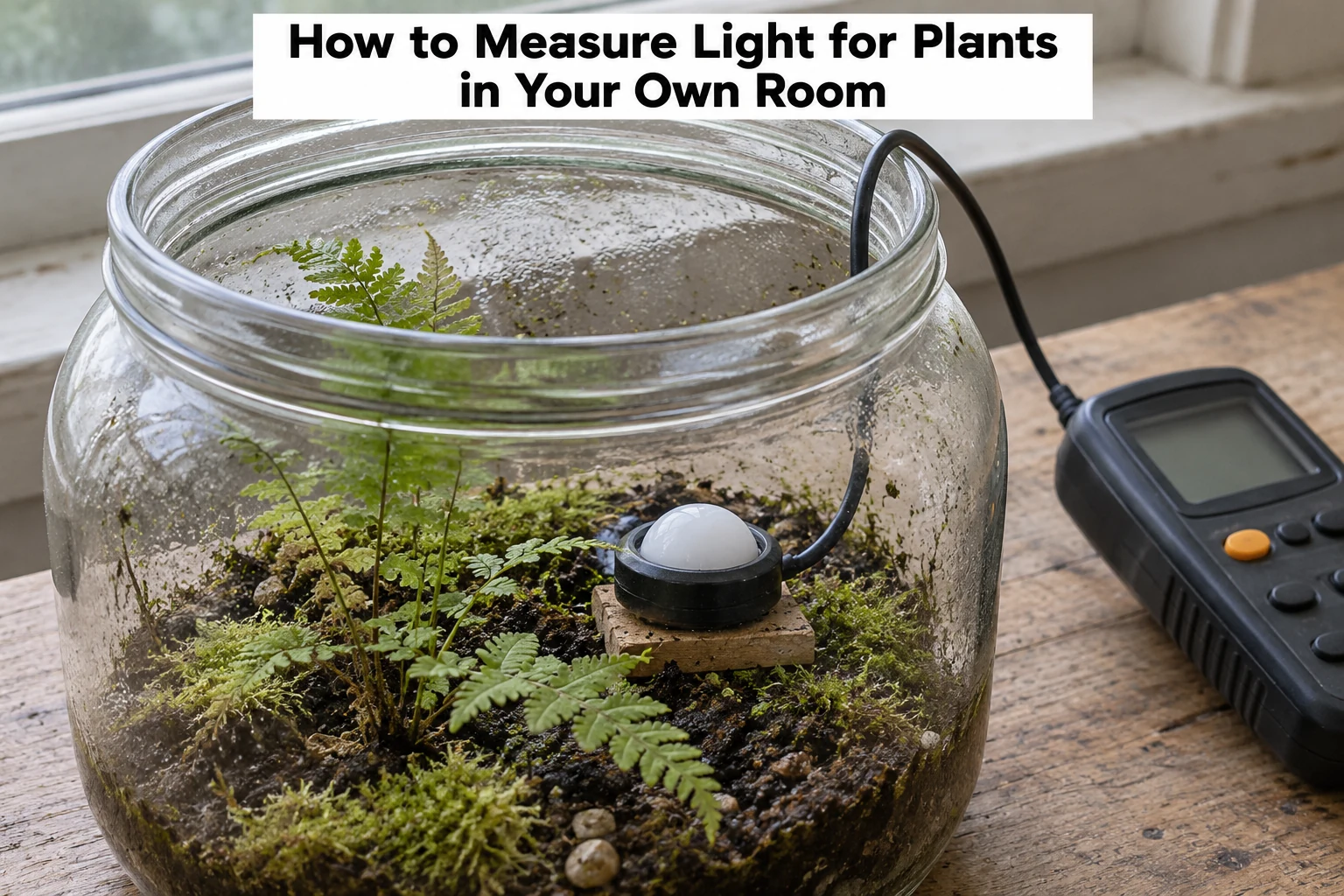
How to Measure Light for Plants in Your Own Room

Here is how to measure light for plants: take a reading with a light meter, or a phone app for rough comparisons, at the height of the leaves around midday, then compare it with a published scale in foot-candles or lux. UF/IFAS Gardening Solutions groups indoor spots from low light (25 to 100 foot-candles) to direct sun (over 1,000). With no meter at all, a shadow test at several times of day still separates direct sun, bright indirect light and dim light.
Guesswork is the usual approach, and it is the reason so many terrariums end up in the wrong spot. This guide covers the three ways to measure, what the numbers mean, where to hold the meter, and what a reading cannot tell you.
“I measure light where the leaves sit, not where the room looks brightest to my eyes. A phone is useful for comparing positions if I keep its orientation consistent, but I would not treat one reading as a complete picture. Morning and afternoon checks can reveal a direct sunbeam that a comfortable midday measurement misses.”
Why your eyes are the wrong tool
A room that looks bright may be dim for a plant. The University of Florida’s UF/IFAS Gardening Solutions page Light for Houseplants (read September 27, 2026) explains the problem: “human eyes are very adaptable.” Your eyes adjust to the room, so a spot a few feet from the window feels nearly as bright as the sill. For a plant, it may not be close.
Illinois Extension’s houseplant lighting guide (read September 27, 2026) shows how quickly light drops with distance. It rates the spot directly in front of an east or west window as high light (300 foot-candles), a few feet away as medium (150), and 3 to 10 feet away as low (75). That is a drop your eyes will barely register. A measurement will.
How to measure light for plants: three methods
1. The shadow test (free, no equipment)
Hold your hand a short distance above the spot where the plant will sit, and look at the shadow on the surface.
- Sharp, dark shadow with clear edges: direct sun is reaching the spot.
- Soft shadow with blurry edges: bright indirect light.
- Faint shadow or barely any: low light.
This gives you categories, not numbers, but it answers the most important question for a closed terrarium: does direct sun ever land here? Repeat it in the morning, around midday and in the afternoon, because a spot can be shaded at one time and in full sun at another.
2. A phone light meter app (cheap, good for comparisons)
Light meter apps turn your phone into a rough meter. University of New Hampshire Extension specialist Jonathan Ebba, in a Q&A published February 2, 2021, explains that these apps “use the light sensor on your phone and convert the reading to PAR based on the lamp type.” Iowa State University Extension also lists a smartphone app as an option alongside a light meter.
Treat the readings with care. UF/IFAS says phone applications “should only be used for approximations.” Where an app is genuinely useful is comparison: measure two spots with the same phone, held the same way, and the higher reading is the brighter spot. That is usually the decision you need to make.
3. A handheld light meter (most reliable)
UF/IFAS calls a hand-held digital light meter “often the best tool for the job,” and says that if it reads in foot-candles or lux and is accurate to one foot-candle, “it will do for your houseplants.” A dedicated meter makes it easier to compare your numbers with published scales.
| Method | What you get | Best for | Weak point |
|---|---|---|---|
| Shadow test | Direct, bright indirect or low | Checking for direct sun | No numbers |
| Phone app | Approximate lux or foot-candles | Comparing spots | Approximations only |
| Handheld meter | Foot-candles or lux | Matching published scales | You need to own one |
Units: foot-candles, lux, PPFD and DLI
The readings come in several units, and published guides do not all use the same one.
- Foot-candles (fc or ftc): the unit most US extension guides use. Illinois Extension defines a foot-candle as “the amount of light that one candle produces, measured one foot away.”
- Lux: the metric equivalent, and the unit many phone apps show. Iowa State University Extension’s guide How to Determine How Much Supplemental Light to Provide for Indoor Plants (by Aaron Steil, last reviewed December 2023, read September 27, 2026) gives the conversion: 1 foot-candle = 10.764 lux. To go from lux to foot-candles, divide by 10.764.
- PPFD: the amount of light plants can actually use, arriving at the leaves each second. Iowa State explains that you can estimate it by multiplying a lux or foot-candle reading by a conversion factor that the lamp’s manufacturer provides.
- DLI (Daily Light Integral): the total usable light over a whole day. Iowa State’s formula is DLI = PPFD × hours × 0.0036.
For placing a terrarium in daylight, foot-candles or lux are enough. PPFD and DLI matter more when you are setting up a lamp and want to check it against published targets.
Where and when to take the reading
How you measure matters as much as what you measure with.
- At leaf height. Iowa State’s instruction is to measure with the meter “placed at foliage level.” For a terrarium, that means where the plants sit inside the jar’s footprint, not at the top of the lid or on the floor beside the table.
- Around midday. UF/IFAS gives its light categories as midday readings, so measure at a similar time if you want to compare.
- More than once. Take readings in the morning, at midday and in the afternoon. Light changes through the day, and a single reading can miss the hours of direct sun.
- Across seasons. The sun’s angle changes during the year, so a spot measured in one season may read differently a few months later.
- With and without the glass. If you want to know what the container itself costs, take one reading in the open and one through the wall of the empty jar. Mississippi State University Extension’s terrarium guide says the container “should not be cloudy or tinted, as this would restrict light and limit plant growth.” If your glass has clouded over time, terrarium glass that won’t wipe clean explains why.
Keep a simple log: date, time, spot, and reading. After a few days you will have a clear picture of your room instead of a guess.
Reading your numbers against published scales
Once you have numbers, compare them with a published scale. Two extension services use slightly different ones.
| Light level | UF/IFAS (midday) | Illinois Extension |
|---|---|---|
| Low | 25 to 100 ftc | 75 ftc |
| Medium | 100 to 500 ftc | 150 ftc |
| High | 500 to 1,000 ftc | 300 ftc |
| Direct sun | Over 1,000 ftc | 1,500 ftc |
The scales do not line up exactly, which is a useful lesson in itself: treat light categories as broad bands, not precise cut-offs.
For a closed terrarium, Mississippi State’s guide asks for “bright, indirect light.” On the UF/IFAS scale, the closest description is its medium band: spots near windows that get no direct sun. Readings that land in the direct sun range tell you to move the jar back, however bright and pleasant the spot looks.
What a reading cannot tell you
A light meter is a better tool than your eyes, but it has limits.
- It does not measure heat. A sealed jar in direct sun can overheat, and a light reading will not show that. Touch the glass after the jar has sat in the spot for a while. If it is noticeably warm, the spot is too sunny. Brown, crispy leaves in a closed terrarium covers what heat damage looks like.
- Published scales come from specific places. The UF/IFAS scale comes from Florida and the Illinois scale from the US Midwest. Window-direction advice written there may not match a home at a different latitude, with a balcony overhang, or facing a wall across a narrow lane. Your own readings beat anyone’s window-direction rule.
- The plants have the final word. A spot that measures well but produces stretched, pale growth needs more light. If a jar has already grown leggy in a dim spot, pruning terrarium plants explains how to cut it back after you move it.
- Numbers do not choose the plant. Measurement tells you what light you have. Matching plants to it is the next step, and the best plants for a closed terrarium are the ones that cope with the moderate light most jars receive.
A three-day measuring routine
- Day 1: do the shadow test at the candidate spots in the morning, at midday and in the afternoon. Rule out any spot where direct sun lands on the jar.
- Day 2: take meter or app readings at leaf height at the remaining spots, at the same three times. Write them down.
- Day 3: repeat the midday reading. Compare with the UF/IFAS bands, pick the brightest spot that never gets direct sun, and check the glass temperature once the jar is in place.
Then leave the jar there. Mississippi State’s guide advises avoiding frequent moves, because changes in light intensity and duration can harm plant health.
Frequently asked questions
What is the easiest way to measure light for plants?
The shadow test. Hold your hand above the spot: a sharp shadow means direct sun, a soft shadow means bright indirect light, and a faint shadow means low light. Check at several times of day.
Are phone light meter apps accurate enough for plants?
For comparing spots, yes. For exact numbers, not really. UF/IFAS Gardening Solutions says phone applications should only be used for approximations. Use the same phone, held the same way, for every reading.
How many lux is bright indirect light?
UF/IFAS places spots near windows with no direct sun in its medium band of 100 to 500 foot-candles at midday. Using Iowa State’s conversion of 10.764 lux per foot-candle, that is roughly 1,076 to 5,382 lux. Scales vary between sources, so treat these as broad bands.
Where should I hold the light meter?
At leaf height, where the plants actually sit. Iowa State University Extension recommends placing the meter at foliage level. For a terrarium, that means inside the jar’s footprint, not above the lid.
When is the best time to measure light for plants?
Around midday gives readings comparable with UF/IFAS’s scale, but also measure in the morning and afternoon to catch any direct sun, and remeasure when the seasons change.