
Terrarium No Natural Light: Windowless Rooms and Offices

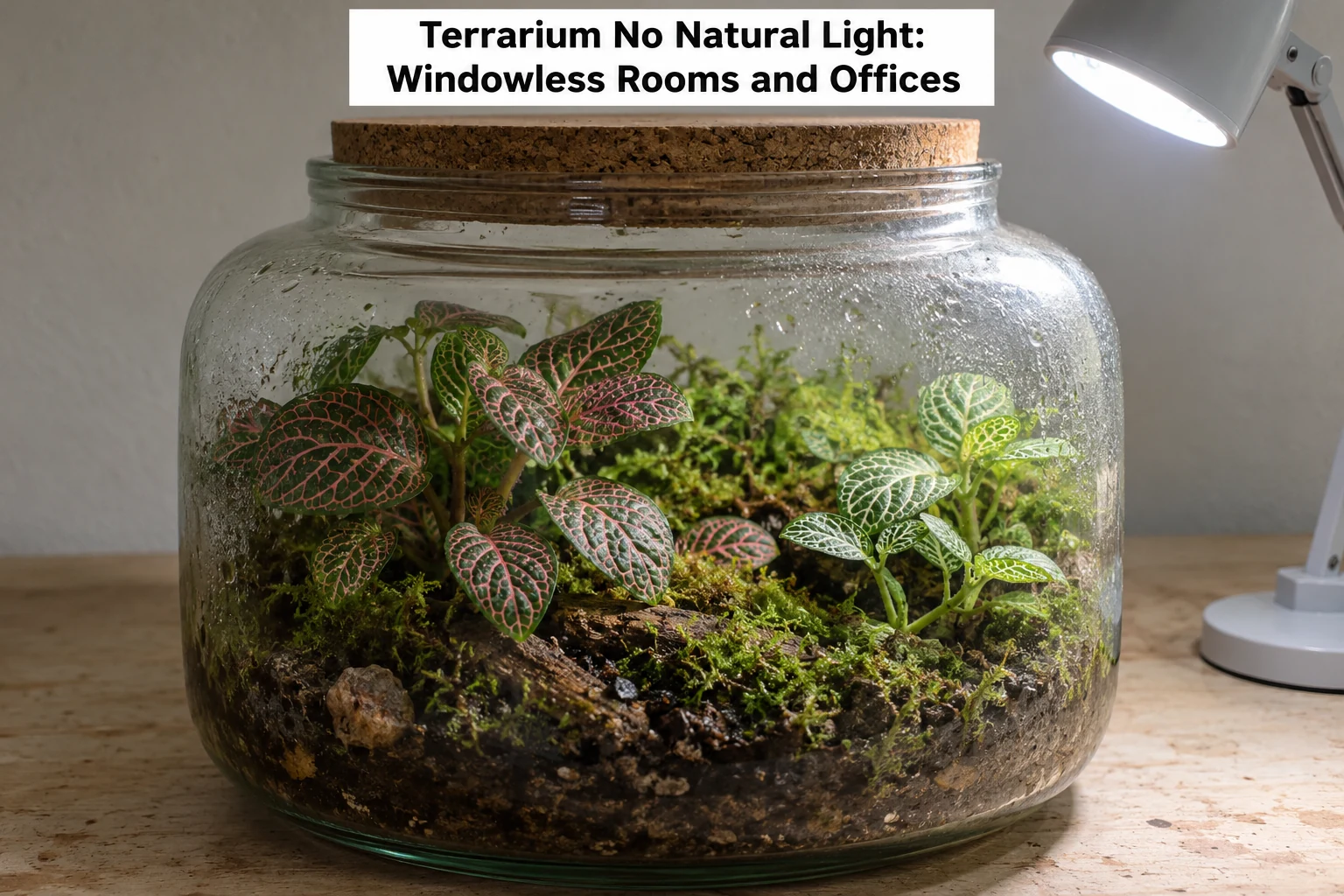
A closed terrarium can live in a room with no window, but only if a lamp takes over the window’s job. Overhead office or room lighting is rarely enough on its own. A terrarium no natural light setup needs three things: a dedicated light close to the jar, a steady on and off schedule with a real dark period, and plants that cope with modest light. Get those right and a windowless desk is workable, not hopeless.
The rest of this guide explains why ceiling lights fall short, what the lamp has to do, which plants suit the setup, and the office-specific problems that most terrarium guides never mention.
“For a windowless spot, I treat the lamp as part of the terrarium setup rather than optional room lighting. The leaves need a dependable light source even when nobody is at the desk. Before trusting an office timer, I would check whether its socket stays powered over weekends and holidays; a reliable schedule means little if the building switches the supply off.”
Can a terrarium survive with no natural light at all?
Not with no light at all. Plants make their food from light. Mississippi State University Extension’s terrarium guide puts it simply: “Air, moisture, and sunlight aid in photosynthesis, which converts light energy into carbohydrates.” A sealed jar recycles water and air, but it cannot make its own light.
The light does not have to come from the sun, though. A plant cannot tell whether its light came through a window or from a lamp. What it responds to is how bright the light is and for how long. So the real question for a windowless room is not “sun or no sun” but “is there enough light at the leaves, for enough hours, every day?”
Why office ceiling lights usually fall short
Most offices feel bright, which is exactly why they mislead. The University of Florida’s UF/IFAS Gardening Solutions page Light for Houseplants (read September 27, 2026) explains that “human eyes are very adaptable,” so we are poor judges of how much light a spot actually gets. The same page notes that fluorescent office lighting often measures “40 ftc or fewer,” meaning 40 foot-candles or less.
For comparison, UF/IFAS classes 25 to 100 foot-candles at midday as a low light area, the kind of spot that gets very little natural light because it is far from windows or heavily shaded. A typical office desk under ceiling lights sits near the bottom of that low band. Some tough, slow plants hang on at that level. Most terrarium plants will slowly stretch and fade.
There are other problems with relying on ceiling lights:
- They are far away. The fittings are designed to light a whole room from the ceiling, not to light a small jar on a desk.
- Their schedule is not yours. Lights may go off early, stay off all weekend, or be controlled by sensors.
- Some never switch off. In some buildings the lights run late into the night, which eats into the dark period plants need.
Terrarium no natural light setups: the three things that matter
1. A light that belongs to the jar
The single biggest improvement is a small lamp dedicated to the terrarium and placed reasonably close to it. You do not need anything specialized. UF/IFAS notes that for grow lights, “lights labeled ‘cool white’ work well,” and that incandescent bulbs “are hot, short-lived, and expensive” to run for the hours plants need. A cool-running white LED or fluorescent desk lamp is a sensible type to look for.
Heat is the point to watch. A closed jar holds heat, so after the lamp has been on for a while, touch the glass nearest to it. It should feel close to room temperature. If it is warm, move the lamp back.
2. A schedule you control
Put the lamp on a plug-in timer so the jar gets the same day every day. Iowa State University Extension’s guide How to Determine How Much Supplemental Light to Provide for Indoor Plants (by Aaron Steil, last reviewed December 2023, read September 27, 2026) suggests 14 hours a day as a starting point and keeping the schedule between 8 and 16 hours. Illinois Extension similarly warns against more than 16 hours, because plants need a rest period.
In a room with no window, the lamp is doing all the work, so the full schedule comes from the timer. Iowa State also warns that room lights, lamps and street lights can end up “polluting” the dark period. If the office lights stay on late, count them when deciding how long your own lamp runs.
3. Plants that cope with modest light
Choose plants that tolerate lower light and humidity, and skip anything that wants full sun. Many forest-floor species are a good match because they grow in filtered light in nature. Low-maintenance terrarium plants, ranked by neglect is a good place to start, since plants that forgive a missed week also tend to forgive a modest lamp.
The office problems nobody plans for
Most terrarium advice assumes a home. An office adds its own complications.
Weekends, holidays and switched-off sockets
A timer only works if its socket has power. In some offices, desk sockets or whole floors are switched off at night or during closures. If that happens, the lamp stays off for days. A closed terrarium can ride out a short dark spell, but a long office closure deserves a plan. Leaving a terrarium alone for a month covers how sealed jars cope with long gaps and what to check before you go.
Air conditioning and cold glass
Air conditioning blowing directly onto a jar can cool one side of the glass and change where condensation forms. If the fog pattern suddenly shifts after the jar moves near a vent, airflow is a likely reason, not only a sealing fault. Reading the fog in a terrarium with too much condensation explains what different patterns mean. The simple fix is a spot out of the direct airflow.
People moving it
Cleaners and colleagues move things. Mississippi State’s guide advises: “Avoid moving it frequently, as changes in light intensity and duration may harm plant health.” Choose a spot where the jar and lamp can stay put, and let people know it is meant to stay there.
Workplace rules on plug-in devices
Many workplaces have rules about personal electrical items, timers and extension leads. Check before plugging anything in. That is not only about permission. Building managers often know which sockets lose power overnight, which is exactly what you need to know.
Open or closed for a windowless room?
Air-conditioned rooms tend to have dry air. A closed terrarium keeps its own humidity inside the glass, which makes it the more forgiving choice for a desk you are not at every day. An open terrarium dries out faster and needs more attention. Open vs closed terrarium compares the two in detail.
Windowless rooms at home
The same rules apply to interior rooms at home, such as a windowless bathroom, a small store room, or an inner room in an apartment.
- Interior rooms: a desk lamp on a timer is usually all you need, plus the heat check.
- Bathrooms: the humidity suits terrarium plants, but a lamp in a bathroom puts electricity near water. Use only a plug-in fixture that its manufacturer rates for that kind of location, keep it well away from water and splashes, and never run cords across wet areas. Adding a socket or fixed light in a bathroom is work for a licensed electrician, not a weekend project.
A quick setup checklist
| Check | What good looks like |
|---|---|
| Light source | A dedicated cool-running white lamp near the jar, not just ceiling lights |
| Schedule | A plug-in timer, same hours every day, within the 8 to 16 hour range |
| Dark period | The room is dark, or at least dim, for part of every day |
| Heat | Glass near the lamp stays close to room temperature |
| Airflow | The jar is out of direct air conditioning drafts |
| Plants | Low-light, humidity-loving species, nothing that needs full sun |
| Power | The socket stays live overnight and at weekends, or you have a plan for closures |
How to tell the setup is working
Give it a few weeks, then look for:
- Healthy signs: compact growth, good leaf color, and new leaves about the same size as older ones.
- Too little light: stems stretching toward the lamp, smaller and paler new leaves, colors fading to plain green.
- Too much light or heat: bleached or crispy patches on the side nearest the lamp, or algae spreading quickly on the glass.
Adjust one thing at a time. If the plants are stretching, bring the lamp a little closer before extending the hours, and recheck the glass temperature after any change.
Frequently asked questions
Can a terrarium survive in a room with no windows?
Yes, if a lamp supplies the light. Plants need light to make food, but the light does not have to be sunlight. A dedicated lamp on a timer, with a daily dark period, can do the job.
Are office ceiling lights enough for a terrarium?
Usually not on their own. UF/IFAS Gardening Solutions notes that fluorescent office lighting often measures 40 foot-candles or fewer, which falls in its low light range. A small lamp near the jar makes a much bigger difference.
How long should the lamp be on in a windowless room?
Iowa State University Extension suggests starting at 14 hours a day and staying between 8 and 16 hours. Illinois Extension warns against more than 16 hours, because plants need a rest period.
What happens to an office terrarium over a long holiday?
If the lamp’s socket loses power, the jar sits in the dark until someone returns. A closed terrarium can handle a short dark spell, but for a long closure it is worth checking whether the socket stays live, or taking the jar home.
Should an office terrarium be open or closed?
Closed is usually easier. Air-conditioned rooms often have dry air, and a closed terrarium keeps its humidity inside the glass, so it needs far less attention than an open one.