
Terrarium Plants: What Goes in Which Jar (Full Directory)

Short answer: the best terrarium plants are small, slow-growing plants that match the container. A closed (sealed) terrarium needs humidity-loving foliage plants such as fittonia, small peperomias, pilea, miniature ferns, selaginella and mosses. An open terrarium suits succulents and cacti, which rot in the wet air of a sealed jar. Pick the container type first, then the plant’s eventual size, then light.
Most lists of terrarium plants read like a nursery catalogue: twenty pretty photos, no warning about which ones will fill the jar by next season. This page is the other kind. It sorts plants by the container they belong in, the job they do in the layout, and the specific way each one tends to go wrong behind glass.
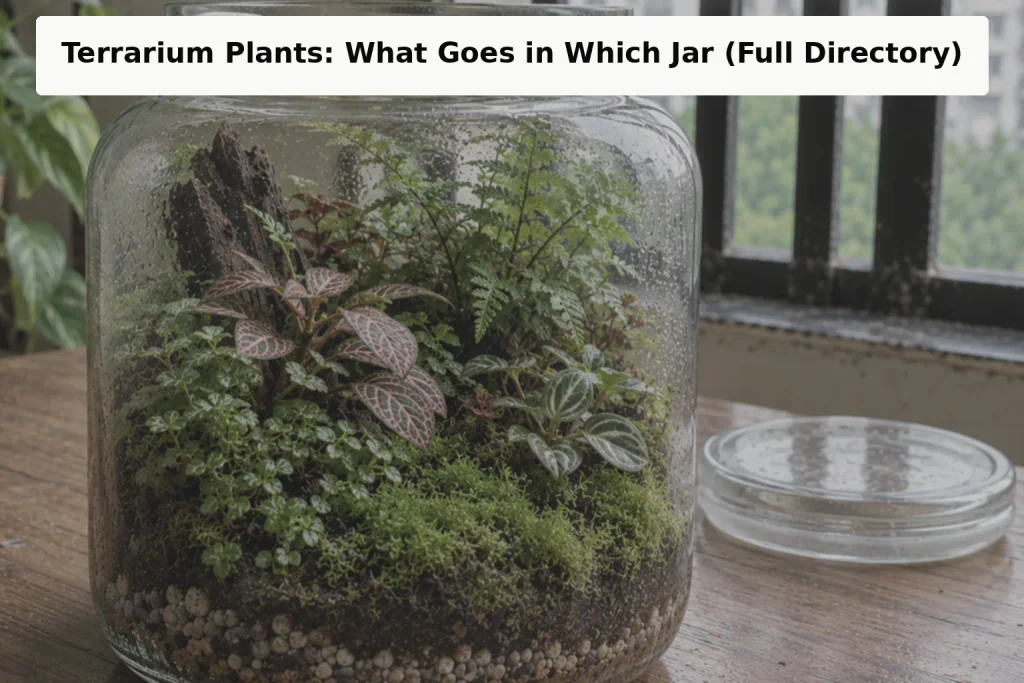
“In my own terrariums, I’ve found that plant choice gets much easier once I stop asking which plants look good together and start with what kind of jar I’m actually building. In a closed jar, I lean toward small humidity-loving plants like fittonia, pilea, selaginella, mosses, and compact ferns, while anything that needs drying between waterings belongs somewhere open instead. I also try to give each plant a clear job in the layout, usually a carpet, a mid-layer, and one focal plant, because cramming several plants with the same role into a small jar almost always turns into a pruning problem later. The biggest practical check for me now is mature size, not nursery size: leaving empty space at build time is what keeps the terrarium looking balanced months later instead of immediately becoming overcrowded.“
Start With the Container, Not the Plant
A closed terrarium and an open terrarium are two different climates, and no plant is happy in both. With the lid on, water cycles from the substrate, through the leaves, onto the glass and back down. The air stays close to saturated. Leave the lid off and that moisture escapes, so the jar behaves more like a sheltered pot.
Two horticultural authorities agree on the split. The Royal Horticultural Society’s guide to terrariums and bottle gardens, which we read on September 23, 2026, recommends “small and slow-growing foliage plants, miniature ferns and mosses” for sealed terrariums and “succulents and cacti for open terrariums.” The Iowa State University Extension guide to creating and caring for a terrarium, read the same day, tells readers to avoid cacti and succulents in a covered terrarium because “they suffer in a humid environment.”
So the first question is never “which plant do I like?” It is “will this jar have a lid?” Everything below is organized around that answer. If you have already settled on a sealed jar, our guide to the best plants for a closed terrarium covers that side in more depth.
The Terrarium Plant Directory
Use this table as the quick reference. “Role” is where the plant sits in a layout. “The catch” is the failure that plant is known for inside glass, which is what a care label written for an ordinary pot will not tell you.
| Plant | Role | Closed or open | Growth habit | The catch inside glass |
|---|---|---|---|---|
| Fittonia (nerve plant) | Mid-layer, color | Closed | Low, spreading | Collapses dramatically when stressed; wilting in a wet jar is not always thirst |
| Peperomia (small species) | Mid-layer, texture | Closed or open | Compact, slow | Larger species outgrow small jars; buy the small-leaved types |
| Pilea glauca and small pileas | Ground cover, trailing | Closed | Creeping | Can bury smaller neighbors if never trimmed |
| Selaginella (spike moss) | Ground cover | Closed | Low, feathery | Needs constant humidity; dries out fast in an open jar |
| True mosses (cushion, sheet) | Carpet | Closed | Very slow | Moss collected outdoors can carry insects and seeds in with it |
| Baby’s tears (Soleirolia) | Carpet | Closed | Fast, mat-forming | Spreads quickly and climbs over everything |
| Button fern (Pellaea) | Focal or mid-layer | Closed | Slow, arching | Fronds brown if the jar runs dry |
| Small Nephrolepis ferns | Focal | Closed | Moderate | Standard Boston fern types get far too big; choose dwarf cultivars |
| Creeping fig (Ficus pumila) | Climber | Closed | Vigorous | Will cover the glass and block your view without regular cutting |
| Polka dot plant (Hypoestes) | Color accent | Closed | Fast, upright | Stretches and turns leggy; needs frequent pinching |
| Earth star (Cryptanthus) | Focal, low | Closed or open | Slow rosette | Keep the base out of soggy substrate |
| Calathea and Maranta | Focal, upright | Closed, large jars only | Broad leaves | Leaf size alone outgrows anything smaller than a big jar |
| Flame violet (Episcia) | Mid-layer | Closed | Trailing | Sends out runners that need steering |
| Mini African violet | Flowering accent | Closed, with care | Rosette | Dead flowers mean opening the jar to remove them |
| Succulents and cacti | Focal | Open only | Slow | Rot in the humidity of a sealed jar |
| Air plants (Tillandsia) | Accent | Open, mostly | Rootless | Need airflow and drying out between waterings |
Two plants on this list come up constantly as “easy,” and both need a note. Fittonia is recommended by nearly every guide, and it does love humidity, but its habit of flopping flat when stressed sends new growers reaching for the watering can when the jar is already wet enough. Air plants are sold next to terrarium jars in almost every shop, but a sealed jar is the wrong home for them, because they need moving air and a chance to dry out between waterings.
Sort Your Terrarium Plants by Role
A terrarium that looks deliberate usually has one plant doing each job, not five plants competing for the same one. Think in layers.
Carpet. The lowest layer covers the substrate so bare soil does not show. True mosses, selaginella and baby’s tears all do this. Moss is the slowest grower of the three. Baby’s tears is the fastest and the most likely to need cutting back.
Mid-layer. These plants give the jar its color and texture at eye level. Fittonia, small peperomias, pileas and Episcia sit here. One or two are usually enough in a small jar.
Focal plant. One slightly taller plant gives the eye somewhere to land: a button fern, a dwarf Nephrolepis, an earth star or, in a big container, a calathea. The Iowa State guide sorts its own list the same way, into upright, mid-size and low or trailing plants, which is a useful way to check you have not chosen three focal plants for one small bowl.
Climber. Creeping fig is the usual choice. It looks lovely on the glass for a while, and then it is the only thing you can see. Plant it only if you are willing to cut it back.
A note on names, because it matters when you shop. Selaginella is sold as “spike moss” or “club moss,” but it is not a true moss. It is a lycophyte, a vascular plant with roots and veins. True mosses are bryophytes, with no true roots at all, and they take up water through their leaves. Liverworts, which often turn up uninvited in terrariums, are bryophytes too but a separate group from mosses. Green slime on the glass is usually algae, which is none of these.
Match Terrarium Plants to Jar Size
The question readers ask most often is not “what is pretty?” but “will it still fit in six months?” The honest answer is that no plant stays still. The Iowa State guide says it directly: “no plant can be a permanent addition to a terrarium as they will eventually outgrow the space.” What you can control is how fast that happens.
The RHS advice is the most practical test available: “Check the eventual height and spread on the label, as many standard tropical houseplants, even young ones, will be too vigorous for terrariums in the long term.” A plant sold in a small pot is often just a young plant of a large species.
Small jars, the kind that fit in one hand, suit moss, selaginella, a small pilea or a single fittonia cutting. Anything with broad leaves will press against the glass quickly. Our guide to how small is too small for a closed terrarium explains where the practical floor sits.
Medium jars can take a carpet, one or two mid-layer plants and a small focal fern.
Large jars, carboys and bottle gardens are where calathea, maranta, bird’s nest fern and creeping fig start to make sense, because there is room for their leaves and room for your hand or tools to reach in and prune.
When a plant does outgrow its space, you have two choices: cut it back, or swap it out. Our walkthrough on pruning terrarium plants covers cutting back an overgrown jar without disturbing the rest of the build.
Plants That Fail Inside Glass
Some plants are sold for terrariums and still do badly in them. Others are fine houseplants that were never meant for a jar.
- Succulents and cacti in a sealed jar. Both the RHS and Iowa State place them in open terrariums only. The humidity that fittonia loves is what rots them.
- Common philodendron and spider plant. Iowa State names both as plants to avoid in a terrarium.
- Flowering plants in closed jars. The RHS points out that opening a sealed terrarium every time you remove faded blooms disturbs its balance. Foliage plants avoid the problem.
- Young plants of big species. A baby monstera or a small rubber plant looks the right size in the shop. It will not stay that way.
- Air plants in closed containers. They need air movement and a chance to dry out.
For the full do-not-buy list with the reason behind each entry, see plants that should never go in a closed terrarium.
What a Plant Label Does Not Tell You
Care labels are written for plants in open pots on a windowsill. Inside a closed terrarium, most of that advice stops applying, and following it is one of the most common ways new builds fail.
“Water when the top of the soil is dry.” In a sealed jar, the water never leaves. The Iowa State guide notes that a closed terrarium may need water only every three to six months, depending on conditions. A label instruction to water weekly will drown the roots.
“Keep in bright light.” On a pot, that often means a sunny window. Behind glass, direct sun heats the air inside quickly. The RHS recommends “bright, indirect light for at least six hours a day,” from a north- or east-facing window, and says to keep terrariums “out of direct summer sun and away from heat sources.”
Symptoms mean different things. A drooping plant in a pot is usually thirsty. A drooping plant in a closed jar with fog on the glass usually is not. Before adding water, look at the condensation and the substrate, not just the leaves.
Growth rates change. Warmth and steady humidity can speed up plants that grow slowly on a shelf. The same plant may need pruning far sooner in a jar than the label suggests.
This is the gap most plant lists leave open. They tell you a plant “likes humidity” and stop there. The useful question is what that plant does after three months in a jar that never dries out.
Choosing Terrarium Plants in a Hot, Humid Climate
Much of the advice online is written for cool, dry homes in Europe and North America. If you live in Dhaka, Kolkata, Bangkok or anywhere with a long monsoon, a few things shift.
The room air itself is humid for much of the year. That makes open terrariums with tropical foliage plants more workable than they would be in a centrally heated apartment, and it makes open succulent jars harder, because the air around them rarely dries out during the rains. Air-conditioned rooms pull the other way: they dry the air, so an open jar of ferns or selaginella in an air-conditioned bedroom will dry faster than one in a living room with the windows open.
Heat is the bigger risk. A windowsill that gets strong afternoon sun can cook a closed jar, so the RHS rule about keeping terrariums out of direct sun matters even more in a tropical summer.
Local nurseries rarely have a “terrarium” section. Ask instead for the plants by name: fittonia, small-leaved peperomia, pilea, selaginella and small ferns are ordinary nursery stock in much of South and Southeast Asia. Check the undersides of leaves for pests before buying, and rinse any moss you collect outdoors, since it brings insects, seeds and soil life in with it.
A Five-Point Check Before You Buy
- Closed or open? Decide before you shop. Humidity lovers for sealed jars, succulents and cacti for open ones.
- Eventual size, not current size. Read the label for mature height and spread, as the RHS advises.
- Same light needs. Every plant in one jar gets the same light. Do not pair a shade-loving moss with a plant that wants sun.
- Foliage over flowers for closed builds.
- Who can reach the jar? If a cat or a small child can get to it, check each plant against the ASPCA Toxic and Non-Toxic Plants list before you buy.
Fewer plants almost always beats more. A jar with room left over will still look good next season. A jar that looks full on day one will be crowded long before then.
Frequently Asked Questions About Terrarium Plants
What is the easiest terrarium plant for a beginner?
For a closed jar, small peperomias, pilea and moss are among the most forgiving. Fittonia is the most recommended and grows well in humidity, but it droops dramatically when stressed, which confuses beginners into overwatering. For an open jar, slow succulents are the easy choice.
Can succulents go in a closed terrarium?
Not for long. The RHS places succulents and cacti in open terrariums, and the Iowa State Extension advises against them in covered containers because they suffer in humidity. In a sealed jar they tend to rot.
Is selaginella a moss?
No. Selaginella is sold as spike moss or club moss, but it is a lycophyte, a vascular plant with roots and veins. True mosses are bryophytes and have no true roots. Both suit closed terrariums, but they are different plants.
How much light do terrarium plants need?
The RHS recommends bright, indirect light for at least six hours a day, ideally from a north- or east-facing window, and advises keeping terrariums out of direct summer sun and away from heat sources.
How many plants should go in one terrarium?
Fewer than you think. Choose one plant for each role (carpet, mid-layer, focal) and leave space for growth. Every plant will eventually outgrow a jar, so empty room is what buys you time between prunings.