
Terrarium Leaf Rot: Black Spots, Explained

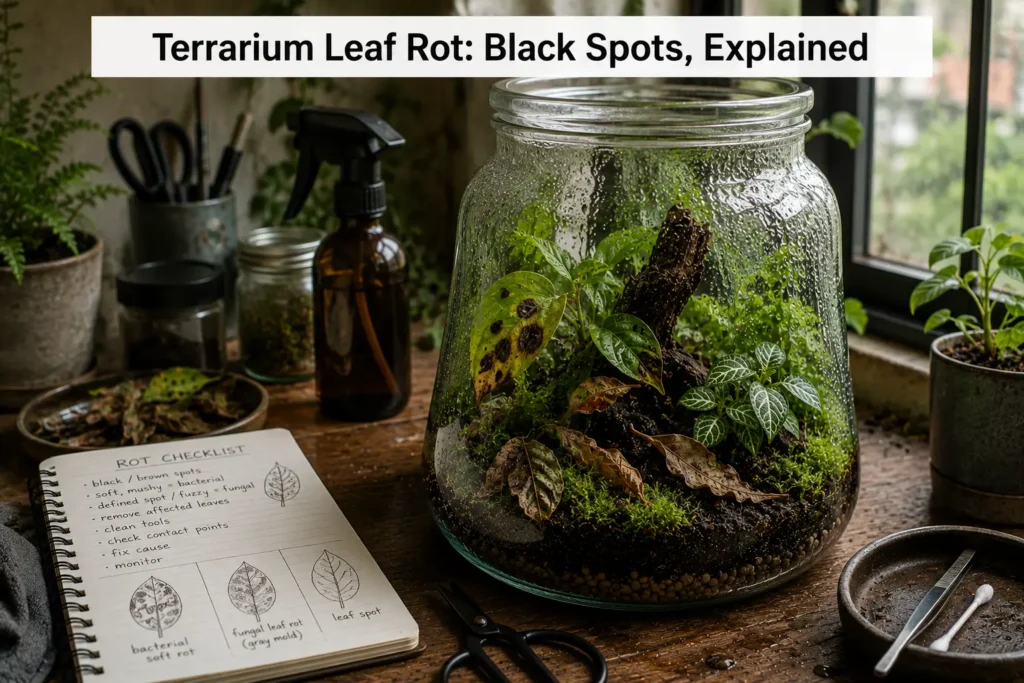
Black or dark brown spots that feel soft rather than crisp, and that are visibly spreading from one leaf to the next, mean rot: living plant tissue breaking down, either from bacteria or from fungus. The two look similar at a glance but behave differently. Bacterial soft rot is water-soaked, slimy, often smells bad, and spreads quickly once conditions favor it. Fungal leaf rot forms more defined lesions, can look dry or slightly fuzzy at the edge, and tends to advance more gradually. Both mean act now, not wait and see: remove the affected tissue with a clean tool before it reaches the next leaf. If the whole terrarium’s air is too wet or too still, that is a separate, environmental question covered in the mold and condensation guide; this piece is about what happens to the leaf itself once that environment, or something else entirely, has already started killing tissue.
If you are not yet sure this is rot rather than another leaf symptom, the troubleshooting pillar walks through reading the glass, substrate, and smell together first, since rot rarely shows up alone.
Two different problems wearing the same description
Most terrarium guides treat “rot” as one thing. It is not, and the distinction changes what you should actually do.
Bacterial soft rot turns tissue water-soaked, translucent, and mushy, often with an unpleasant smell as it advances. As reported by SDSU Extension, as bacterial numbers increase inside the plant the water-soaked spots enlarge and soften, and the affected tissue can collapse into a slimy mass once conditions favor the bacteria. There is no fuzzy growth to look for. The tissue itself just falls apart.
Fungal leaf rot, including the gray mold caused by Botrytis, looks different. As reported by University of Maryland Extension, gray mold typically starts as grayish to tan areas on leaves, the infected area can rapidly enlarge and cause tissue collapse, and dusty gray spores are often easily visible once the fungus is sporulating. It is favored specifically by still, humid air sitting directly against leaf surfaces, which is exactly the condition a sealed jar with no airflow creates by design.
There is also a category most guides skip entirely: ordinary fungal leaf spot, which as reported by Missouri Botanical Garden shows up as tan to brown lesions with distinct, delimited borders, sometimes merging into a larger blotch as spots multiply. It is milder than either soft rot or Botrytis and often stays put on one or two leaves if caught early.
You do not need a lab test to act correctly. If the tissue is slimy, mushy, and smells sour, treat it as bacterial and act the same day. If it is a defined spot, dry-edged or with a gray, dusty coating, treat it as fungal and act promptly but with slightly less alarm. Either way, the response starts the same: get the tissue out.
Rot is also worth telling apart from two symptoms that look related but are not tissue death at all. Yellowing leaves are more often a sign of overwatering or too little light than active rot; see the yellow leaves guide. Brown, crispy leaves usually mean heat damage and stay dry rather than turning soft; see the brown leaves guide. Rot is the one that is dark, soft, and spreading.
Causes that have nothing to do with a “too wet” terrarium
The mold and condensation guide already covers general excess moisture and stagnant air as an environmental condition. Leaf rot has three additional causes that show up even in a terrarium whose overall moisture balance is fine, and none of the general fixes address them:
- A leaf resting against the glass. Constant contact with a cool, condensation-slicked surface keeps that one point of the leaf wet at all times, even when the rest of the plant is dry. Rot often starts at exactly that contact point and nowhere else on the plant, which is a useful clue: if the first dark spot lines up with where a leaf touches the glass, reposition the plant rather than treating the whole build as too wet.
- A leaf buried or half-buried in substrate. Settling after watering, a plant shifting during placement, or springtail and isopod activity can cover part of a lower leaf. Buried tissue sits in constant contact with damp substrate and often rots before it is even visible, showing up first as a bad smell from that spot rather than as a visible spot.
- Water sitting in a crown or leaf axil. Rosette-forming plants and some ferns hold a small pool of water where the leaves meet the stem after misting or condensation runoff. That pooled water does not evaporate the way it would in open air, and the tissue underneath it softens and rots from the inside of the rosette outward, which is why crown rot is often noticed later than leaf-surface rot.
None of these three needs a drier terrarium overall. They need a plant repositioned off the glass, an exposed lower leaf, and water that is not allowed to sit where two leaves meet.
What to do the moment you see it
- Isolate what you can. If more than one plant is affected, or the rot is close to another plant’s leaves, gently separate them if the layout allows it, so contact does not spread bacteria or fungal spores directly.
- Cut with a clean tool. Use scissors or a blade wiped with rubbing alcohol between cuts, especially if you suspect bacterial soft rot, which spreads easily on a contaminated blade. Cut into healthy tissue past the visible spot, not right up to its edge, since bacterial rot in particular can be advancing under tissue that still looks green.
- Remove the cut material from the jar entirely. Do not leave a trimmed leaf sitting on the substrate. It is now dead organic matter and will feed exactly the mold problem covered in the condensation guide if left in place.
- Check what it was touching. Look at the glass, the substrate level, and the crown of the plant for the three contact causes above. Fixing the position or the pooled water matters as much as removing the leaf, because a leaf grown back into the same spot will rot again.
- Do not add a fungicide or antibacterial product as a first response. Physical removal plus fixing the contact cause resolves the large majority of cases. If rot keeps returning across several leaves despite removal and repositioning, the underlying environment, not the individual leaf, is the problem, and that points back to drainage and airflow rather than to a stronger product.
When it stops being a leaf problem
Leaf-by-leaf triage works when the rot is limited to one or two points of contact in an otherwise balanced terrarium. It stops working once the substrate itself has gone anaerobic: waterlogged, oxygen-starved, and sour-smelling all the way through, rather than just wet at the surface. At that point, rot is not really a leaf disease anymore. It is a symptom of a substrate that cannot support root health anywhere in the build, and new leaves will keep rotting as fast as you remove the old ones.
Be honest with yourself about which situation you are in. If removing rotted tissue and fixing one or two contact points stops new spots from appearing within about a week, the build is fine. If rot keeps appearing across multiple plants, faster than you can trim it, and the substrate smells sour when you check the drainage layer, a full rebuild, fresh substrate, cleaned hardscape, and correct drainage from the start, is a more honest use of your time than continuing to fight it one leaf at a time. That is not a failure. It is the correct call once a sealed system has gone that far past balance.
Preventing it going forward
Give plants enough space that no leaf rests directly against the glass. Check crowns and rosettes after watering and gently blot standing water out of them with a cotton swab if it collects there. Watch the substrate line after the first few weeks for settling that has buried a lower leaf. None of this requires more monitoring than the condensation checks you should already be doing; it is the same habit, aimed at the plant instead of only at the glass.
FAQ
Is terrarium leaf rot contagious to other plants in the same jar?
Bacterial soft rot can spread through direct contact and through contaminated tools, so keep affected leaves away from healthy ones and clean your scissors between cuts. Fungal rot spreads more gradually but can still move to a touching leaf, particularly in still, humid air. Removing affected tissue promptly limits spread either way.
How do I tell bacterial rot from fungal rot without a lab test?
Texture and smell are the fastest tells. Bacterial soft rot is slimy, water-soaked, and often has an unpleasant odor. Fungal rot tends to hold a more defined spot shape, can look dry at the edges even while soft in the center, and sometimes shows a gray, dusty coating as it progresses. When in doubt, treat it as bacterial and act the same day, since that is generally the faster-moving of the two.
Can a single rotting leaf be saved, or should I always remove the whole leaf?
Remove the whole leaf. Partial removal often leaves infected tissue behind that is not yet visibly discolored, and both bacterial and fungal rot can be advancing under tissue that still looks green at the edge of a cut.
My terrarium smells sour and several leaves are rotting. Is it too late?
A sour smell combined with rot spreading across multiple leaves usually means the substrate has gone anaerobic, not just that one leaf had bad luck. At that stage, leaf-by-leaf trimming will not keep up. A rebuild with fresh substrate and corrected drainage is the more honest fix.
Will springtails or isopods stop leaf rot on their own?
They help with decaying matter on the substrate surface, but they do not treat active rot on a living leaf. Removing rotted tissue promptly is still the necessary first step; a cleanup crew reduces how much future decaying material accumulates, it does not reverse rot already in progress.