
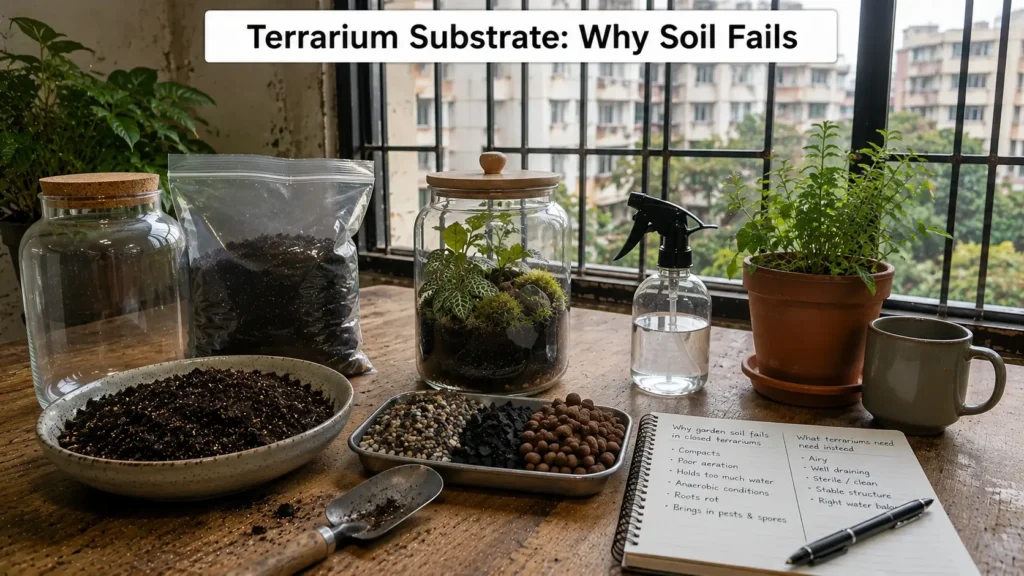
Terrarium Substrate: Why Soil Fails

No, garden soil or ordinary potting soil from an outdoor pot does not work in a sealed terrarium, and reaching for what is already on hand is a common and understandable first instinct. Inside a closed jar with no drainage holes, garden soil compacts into a dense, airless block. The root zone goes anaerobic, and plants rot from the bottom up over a matter of weeks, not because the soil is bad in general, just because it is built for an entirely different job than the one a sealed jar demands of it.
What garden soil does inside a sealed jar
Garden soil is formulated, or simply exists in nature, to drain freely into the ground beneath it. A sealed terrarium removes that option entirely: there is no ground underneath, only a drainage layer that can only hold so much before it is saturated. Garden soil’s fine, dense particle structure packs down under its own weight and the water added at planting, closing off the air pockets roots depend on for gas exchange. Once that happens, the root zone goes anaerobic, meaning oxygen-starved, and anaerobic bacteria that thrive in that environment begin breaking down root tissue rather than supporting it. The visible result, over one to a few weeks, is roots that look dark, soft, and rotted rather than firm and pale, sometimes accompanied by a sulfurous smell if the process has gone on long enough.
What a terrarium substrate mix actually needs to do
A working substrate has to do several things at once that garden soil cannot: hold structure so it does not compact, provide drainage and airflow at the particle level even without external drainage holes, retain enough moisture to support roots between the water cycle’s natural swings, and resist breaking down into fine sediment over months of humidity. No single ingredient does all of this alone, which is why every credible terrarium substrate recipe is a blend, not a single material.
A basic mix you can build from what you already have
A workable, budget-friendly terrarium mix combines:
- A base of coco coir or a light potting mix, for structure and some moisture retention.
- Bark or a similar chunky, slow-to-break-down material (orchid bark, small wood chips), for air pockets that keep the mix from compacting over time.
- Sphagnum moss, fresh or rehydrated dried moss, mixed through for extra moisture retention without waterlogging.
- A small amount of activated charcoal, mixed in rather than only layered separately, as a mild buffer against decay.
None of these has to be purchased new for a first build. Coco coir bricks are inexpensive and widely available, bark can often be sourced from a local nursery in small quantities, and moss can be collected locally where it is not protected or restricted, with the collection and cleaning steps covered separately. The goal is a mix that holds together when squeezed but crumbles rather than compacts, and that never turns to sludge under normal watering.
Why particle-size variety matters more than any single ingredient
The organizing principle behind every credible terrarium substrate recipe is heterogeneity: a mix of particle sizes, from fine coco coir fiber to chunkier bark pieces, rather than a single uniform material. A substrate made of only fine particles compacts the same way garden soil does, just more slowly. A substrate made of only chunky material drains too freely and dries out faster than most terrarium plants tolerate. The blend of fine and coarse particles is what keeps air pockets open between the fine particles that hold moisture, which is the actual mechanism behind “why the mix works” rather than any one ingredient carrying the whole job. This is also why professional formulations like the ABG mix, developed for tropical epiphytes in sealed enclosures, balance several components rather than relying on one.
Building the mix, step by step
- Start with a base of two parts coco coir or light potting mix.
- Add one part bark or chunky wood fiber for structure and air pockets.
- Mix in a half part sphagnum moss, fresh or rehydrated, for moisture retention.
- Fold in a small handful of activated charcoal as a mild buffer, rather than relying on it as a separate layer alone.
- Combine thoroughly before adding to the jar, so the components are distributed evenly rather than sitting in visible layers within the substrate itself.
These ratios are a starting recipe, not a fixed formula. A build with more moss-loving species can lean slightly wetter; a build with ferns that prefer sharper drainage can lean slightly chunkier.
Adjusting the mix for an already-humid room
In a climate where ambient humidity already runs high, a substrate mix leaning toward the drier, chunkier end of the recipe, less sphagnum moss relative to bark and coir, needs less moisture-holding capacity than the same recipe built for a dry Western room, since the surrounding air is already contributing moisture to the sealed system. This is one of several adjustments a build needs in a humid climate; see building a terrarium in a humid climate for the full picture, and terrarium layer depths by jar size for how substrate depth scales with container size.
Signs your substrate is the problem, not something else
Substrate trouble has a recognizable signature that is worth distinguishing from other causes:
- Compaction and standing water at the base, visible if the container is clear enough to see through the substrate line, points to a mix that has packed down and lost its drainage capacity.
- A sulfurous or rotten smell without visible surface mold suggests anaerobic activity happening below the surface, in the root zone itself, rather than a surface mold problem.
- Roots that look dark and soft rather than pale and firm when checked at the surface confirm the rot has already started.
If the pattern points to drainage rather than substrate composition, check the drainage layer itself; the two interact closely, and a substrate problem is sometimes actually a drainage problem wearing a different symptom.
FAQ
Can I mix in some of my houseplant potting soil?
Standard houseplant potting soil is less prone to compaction than garden soil but still holds more moisture and drains less freely than a purpose-built terrarium mix. A small amount blended into a lighter mix, rather than used on its own, is more forgiving than substituting it entirely.
Do I need sphagnum moss specifically, or will any moss work?
Sphagnum moss is favored for its moisture-retention properties without breaking down quickly. Other moss types can be incorporated for ground cover and appearance, but sphagnum’s structural role in the substrate mix itself is harder to replace with a different species.
How often does terrarium substrate need replacing?
A well-built substrate mix in a stable, correctly maintained terrarium can last a long time without full replacement, though it gradually compacts and loses structure over months to years and may eventually need topping up or refreshing.
Is bagged “terrarium soil” sold in stores actually different from potting mix?
Commercial bagged terrarium mixes are generally formulated closer to the blend described above, lighter and chunkier than standard potting mix, and are a reasonable shortcut if building a custom mix from scratch is not appealing. Check the ingredient list against the qualities above rather than assuming the label alone guarantees the right texture.
Can I skip one of the four components if I do not have it on hand?
The mix still functions with three components rather than four, provided the remaining ones cover structure, drainage, and moisture retention between them. Charcoal is the most skippable on its own, covered in do you actually need activated charcoal; coco coir or a base material is the least skippable, since nothing else in the mix substitutes for its structural role.