
Yellow Leaves in a Terrarium: What They Actually Mean

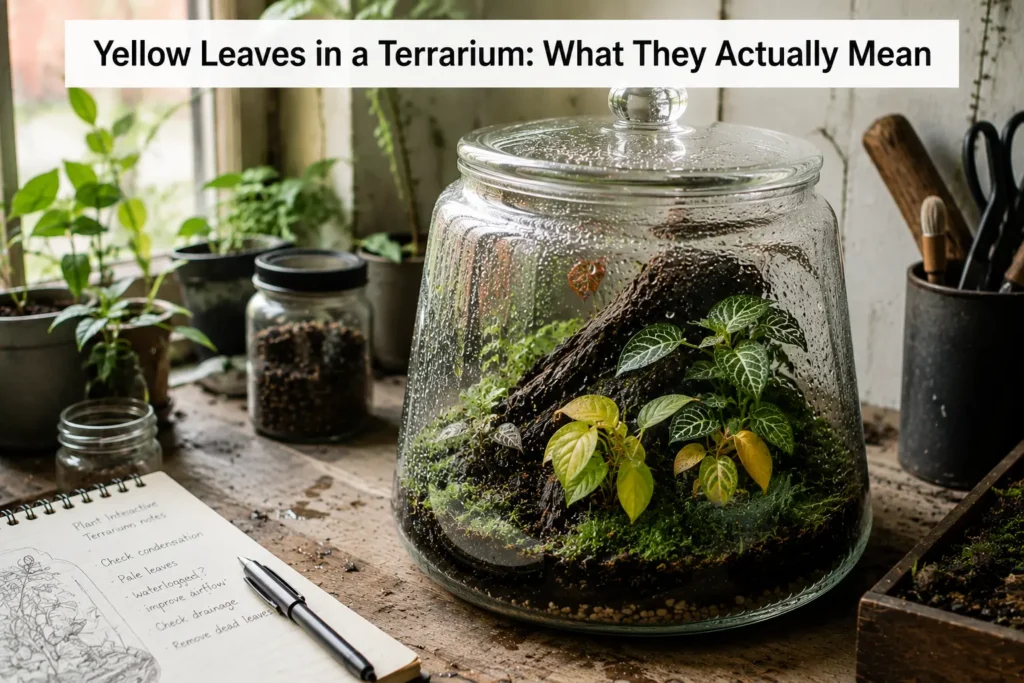
Yellowing inside a closed terrarium is most often a sign of overwatered, waterlogged substrate rather than a light or nutrient problem, because a sealed jar recycles nearly all its water and rarely needs as much as instinct suggests. But not every yellow leaf means overwatering: a single older leaf yellowing while the rest of the plant looks healthy is usually normal aging, and yellowing combined with a low-light position points somewhere else entirely. Pairing the leaf color with the condensation on the glass at the same time tells these apart faster than looking at the leaf alone.
Why yellowing alone is the least specific symptom in a terrarium
Of everything covered across this troubleshooting series, yellow leaves are the hardest symptom to read in isolation. Overwatering causes it, too little light causes it, and completely normal aging causes it, and a leaf does not announce which one is responsible. Most terrarium guides list all three causes side by side and leave the reader to guess. The more useful approach is to check what else the jar is telling you at the same time, since the other signals (condensation, which leaves specifically, how many, how recently the plant was added) narrow the list considerably.
Start by counting: one leaf or several?
A single older, lower leaf yellowing, especially on an otherwise healthy-looking plant with new growth still emerging, is very often normal. Plants shed older leaves as they age and as the plant redirects energy toward newer growth, and this happens inside sealed jars just as it happens in open pots. This pattern does not need a response.
Multiple leaves yellowing at once, including newer growth, or a pattern spreading across more than one plant, is the pattern worth investigating further using the condensation cross-check below.
Cross-check: what does the glass say?
Yellowing plus heavy, unclearing condensation is the combination most consistent with overwatering. A sealed jar holding more water than it can cycle keeps the substrate consistently wet, which over time starves roots of oxygen and shows up above ground as yellowing, sometimes followed by soft or mushy stem tissue. See the too much condensation guide for the glass reading and the smells bad guide for the smell check that often accompanies advanced cases, since waterlogged substrate frequently produces both symptoms together.
Yellowing plus normal or light condensation shifts the likely cause away from water and toward light. Too little light slows a plant’s ability to produce chlorophyll efficiently, and pale, yellowing new growth in a jar sitting in a dim corner is a more likely light problem than a water one. Moving the jar to a brighter, indirect-light location and watching over the next couple of weeks is the reasonable next step.
Yellowing plus no condensation at all is a less common combination but worth checking against the no condensation guide, since a genuinely dry, under-watered jar can also produce yellowing, distinct from the far more common overwatering pattern.
Two edge cases worth ruling out first
A plant added recently. Newly planted specimens sometimes drop or yellow a leaf or two simply from the stress of transplanting and adjusting to a new, much more humid environment than a nursery pot. If the yellowing plant was added within the last week or two and the rest of the jar looks stable, give it time before treating this as a build problem.
A plant that was never suited to a sealed jar in the first place. Some species tolerate constant high humidity poorly regardless of how correctly the rest of the build is managed, and steady yellowing on one specific plant while everything else nearby stays healthy can point at species mismatch rather than a build-wide condition. If only one plant is affected and the water and light readings both look normal, consider whether that specific species belongs in a closed, humid jar at all.
Why “just water it” is the wrong instinct here
Yellowing in a houseplant kept in an open pot is a common cue to check whether it needs water, and often it does. That instinct actively misleads inside a sealed jar. A closed terrarium loses almost no water to the air around it, so a yellowing plant sitting in visibly damp, dark substrate with heavy condensation on the glass does not need more water; it likely needs less, plus better drainage and a period of restraint while the substrate dries out toward a normal level. Watering in response to yellowing without checking the substrate and glass first is one of the more common ways beginners make an overwatering problem worse rather than better.
What to actually do, by cause
If overwatering is the likely cause: stop adding water, vent the lid for several hours to help the substrate dry slightly, and check whether the drainage layer is doing its job. If yellowing has progressed to soft, mushy stem tissue, remove the affected material promptly, since decaying tissue feeds the mold and rot problems covered elsewhere in this cluster.
If low light is the likely cause: relocate the jar to a brighter spot with indirect light, and give it two to three weeks before judging whether new growth is greener than the growth that prompted the check. Terrariums respond slowly to light changes, so patience matters here more than with a watering correction.
If it is a single aging leaf: remove the yellowed leaf if it has fully died back, and otherwise leave it alone. This is routine plant maintenance, not a build problem.
If it is transplant stress on a recent addition: hold off on intervening for one to two weeks and watch whether the rest of the plant continues producing healthy new growth alongside the yellowing leaf.
When yellowing is not urgent
Unlike a sour smell or substrate rising with standing water, yellowing on its own, even when caused by overwatering, is rarely an emergency requiring same-day action. It develops over days to weeks and the underlying cause (excess water, light) is corrected the same way whether addressed today or in a few days. Prioritize confirming the cause correctly over reacting quickly to the wrong one.
FAQ
Is yellowing always a sign of overwatering in a closed terrarium?
It is the most common cause, but not the only one. Check the condensation on the glass at the same time: heavy fog supports overwatering, while normal or light condensation with yellowing points more toward a light issue or a recently transplanted, still-adjusting plant.
Should I remove a single yellow leaf?
Yes, once it has fully yellowed and died back, removing it is reasonable routine maintenance. A single older leaf yellowing while the rest of the plant looks healthy is not usually a sign of a broader problem.
How long does it take for a plant to recover from overwatering-related yellowing?
Once the substrate dries toward a normal moisture level, which can take one to two weeks with venting and no additional water, new growth typically comes in green while already-yellowed leaves generally do not recover their color and can be removed.
Can too much light cause yellowing instead of too little?
Yes, though it more commonly shows up as bleached or scorched patches rather than an even yellowing, and it is often accompanied by heat symptoms; see the brown leaves guide for how heat and excess light present differently from a water-related cause.
My terrarium has heavy condensation and yellow leaves. What should I fix first?
Address the water side first: stop watering and vent the lid. Both symptoms usually share the same underlying cause, so correcting the excess water addresses the condensation and gives the yellowing plant its best chance to stabilize at the same time.