
Reviving a Dying Terrarium: What’s Actually Saveable

The real question when a terrarium looks like it is failing is rarely “can this be saved” in general. It is “which parts, specifically, are dead versus just badly stressed,” and most guides skip straight past that test to generic advice about trimming and patience. A simple scratch test on stems and a look at root color and firmness answers it directly: green underneath the surface and firm, pale roots mean living tissue worth keeping; brown all the way through and mushy, disintegrating roots mean that piece is gone. Test before you cut, and triage before you decide whether this is a save or a rebuild.
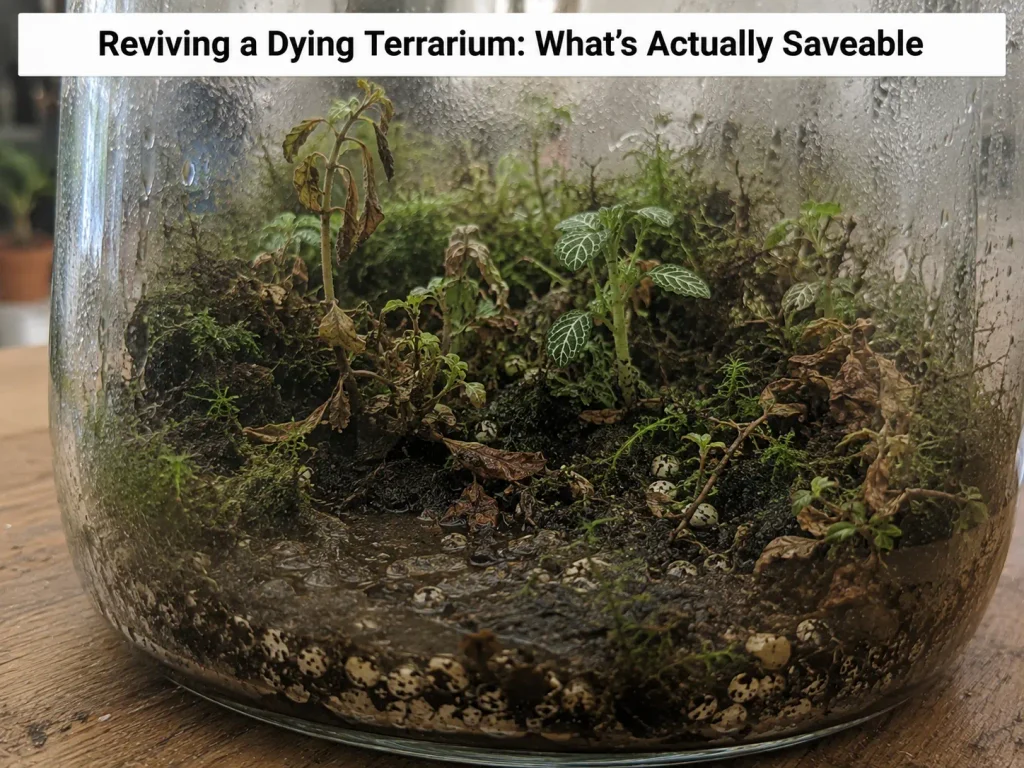
Find the cause before touching anything
Trimming dead material without knowing why it died just delays the same outcome. Before doing anything else, work out what actually went wrong using the terrarium troubleshooting pillar, which walks through reading the glass, the substrate, and the smell to identify the underlying cause. A terrarium that has been sitting in standing water shows a different pattern than one that dried out or one that cooked in direct sun, and the flooding guide covers the specific case where too much water is the culprit, which is one of the more common paths to “most of it died.”
Knowing the cause matters for triage because it tells you what to expect from what remains. A build recovering from a single overwatering event is a different situation than one that has been slowly failing for weeks from consistently poor conditions; the first often has more salvageable tissue than it looks like.
The test: dead or just stressed
This is the decision point most checklist guides skip, and it is worth doing properly before removing anything, since a stressed plant that gets pulled out because it looked bad is a plant that might have recovered.
| Test | Alive / recoverable | Dead |
|---|---|---|
| Stem scratch (near base) | Green tissue underneath | Brown, dry tissue underneath |
| Crown firmness (rosettes, moss) | Firm resistance | Soft, mushy give, often with a smell |
| Root color and texture | Pale, firm | Dark brown or black, slimy, falls apart |
Run all three where relevant rather than relying on leaf appearance alone. Leaves are the slowest and least reliable indicator, since a plant can hold visibly green leaves for a while even after its roots have failed, and can also drop leaves as a stress response while the crown and roots underneath remain fully viable.
Triage: what to cut, what to leave, what to watch
Cut immediately: anything that fails the scratch test, crown test, or root check outright. Dead tissue left in place is not neutral; it becomes a substrate for rot and mold to spread from, covered in the leaf rot guide and the yellow leaves guide for reading which symptom pattern applies to what remains.
Leave and watch: anything that passes the scratch or crown test but still looks visually rough. Damaged leaves on an otherwise living stem can often be trimmed individually while the stem itself is left to recover, rather than removing the whole plant.
Watch without acting yet: plants that look stressed (wilting, slightly yellowed, leggy) but pass every physical test above. Give the underlying cause time to be corrected before judging these; stress symptoms often lag behind the actual fix by several days.
The reset sequence once triage is done
Work through this order rather than doing everything at once, since changing several variables together makes it impossible to tell what actually helped.
- Remove everything confirmed dead, including fallen leaves and any obviously rotted material, since it will otherwise continue feeding mold and rot in the meantime.
- Correct the underlying cause identified earlier: drain standing water, adjust the drainage layer, fix light placement, or whatever the diagnosis pointed to.
- Clean the glass so you can actually monitor recovery clearly going forward, using the gentle, non-abrasive methods covered in the algae guide, which apply equally to other haze on the glass.
- Re-water conservatively, only enough to correct genuine dryness if that was part of the diagnosis, and hold off entirely if excess water was the original problem.
- Reseal and observe rather than opening repeatedly to check. Give the system days, not hours, to show whether the correction is working.
When it is honestly a full rebuild
Not every terrarium is worth partially saving, and it is worth naming that plainly rather than defaulting to optimism. A full rebuild is the more honest call when the substrate has gone anaerobic and sour throughout rather than in one spot, when every plant in the build fails the scratch, crown, or root test, or when what remains is a small handful of stressed but living tissue inside a container whose substrate and hardscape are themselves compromised. In those cases, salvaging individual plants that do pass the test and starting the build again with fresh substrate is usually a better outcome than nursing a container that is fighting its own base conditions. The build guide covers doing that correctly, including plant selection for the fresh start, since a rebuild is also a chance to correct choices that were not well suited to the original conditions.
Patience and a realistic timeline
Once the cause is corrected and dead material removed, recovery is rarely immediate. A plant that passed the scratch and crown tests but still looks rough can take anywhere from several days to a few weeks to show visible new growth, depending on how stressed it was and how quickly the underlying condition improves. Resist judging success or failure in the first day or two; that window mostly reflects the plant settling into the corrected conditions rather than confirming whether the correction worked at all.
What not to do
Do not remove a plant based on leaf appearance alone. Leaves are the slowest, least reliable signal. Run the scratch or root test before deciding.
Do not add fertilizer or a “boost” to help recovery. A stressed, recovering root system is not in a position to use extra nutrients well, and it can add further stress on top of what already caused the problem.
Do not open the lid repeatedly to check progress. Each opening resets the humidity and temperature the plants are trying to stabilize in. Check daily at most through the glass rather than opening the container itself.
Do not rebuild around a cause that has not actually been fixed. Replanting into the same conditions that killed the original selection just restarts the same failure on a delay.
FAQ
How do I know if a plant in my terrarium is dead or just dormant? Use the scratch test on the stem near the base: green tissue underneath means alive, brown and dry means dead. For rosette plants, check crown firmness. For anything you can inspect without excessive disturbance, root color and texture (firm and pale versus dark and mushy) is the most reliable single signal.
Is it worth trying to save a terrarium where most of the plants have died? Sometimes. Test each remaining plant individually rather than judging the whole build at once; a build that looks mostly dead can still have a few genuinely viable plants worth keeping through a rebuild, even if most of it needs replacing.
Can I reuse the substrate and hardscape after a failed terrarium? Hardscape (wood, stone) can usually be rinsed and reused if it is not visibly rotted or moldy through. Substrate that caused or was part of the failure, particularly anything that went sour or waterlogged, is generally better replaced than reused, since it can carry the same conditions into the rebuild.
How long does it take a stressed terrarium to bounce back? It varies with how stressed the plants were and how completely the underlying cause was corrected, typically ranging from several days to a few weeks before visible new growth appears. Judge it on trend over that window rather than day to day.
Should I add new plants right away or wait? Wait until the underlying cause is confirmed corrected and the build has stabilized for at least a week or two. Adding new plants into conditions that are still shifting risks losing them to the same problem that affected the original selection.